

Russia launched one of its largest aerial assaults on Ukraine’s capital overnight into Thursday, killing at least 13 people, injuring scores of others and damaging residential neighborhoods and civilian infrastructure across Kyiv as emergency crews raced to rescue survivors.
Air raid sirens sounded for hours as ballistic missiles, cruise missiles and attack drones targeted the Ukrainian capital, forcing thousands of residents into underground subway stations and bomb shelters after officials warned of the incoming strikes.
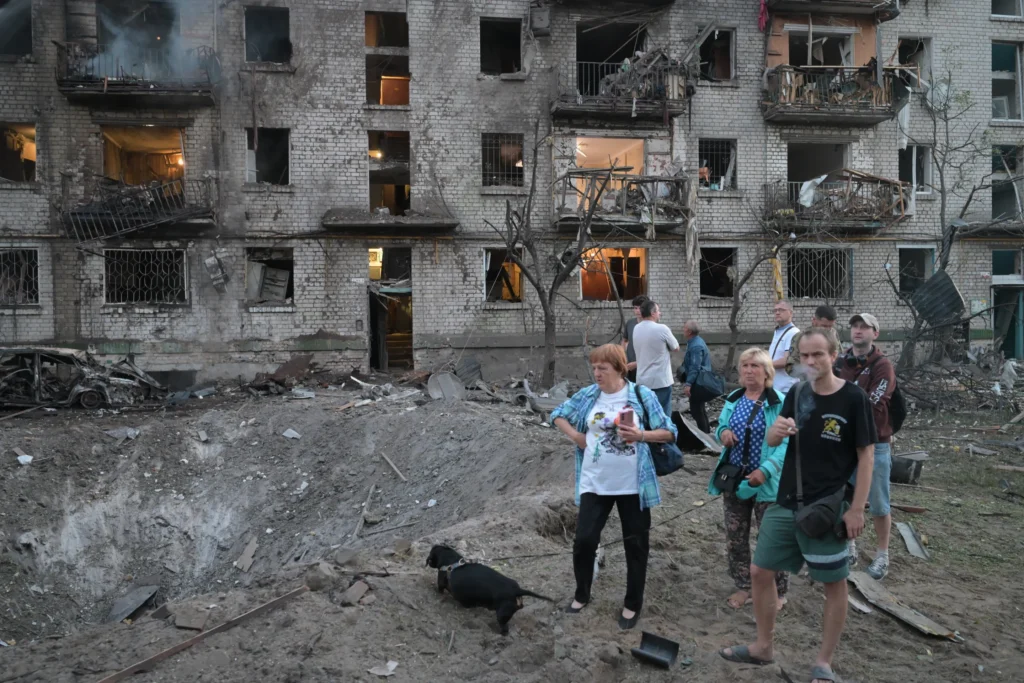
The Associated Press, citing Kyiv Mayor Vitali Klitschko, said at least 13 people were killed and 86 others were injured during the overnight bombardment. Rescue operations continued throughout the day, raising concerns that the casualty count could increase.
The coordinated attack struck multiple districts across Kyiv, damaging apartment buildings, hotels, businesses and public infrastructure while emergency responders battled fires and searched collapsed buildings for survivors.
Officials described the bombardment as one of the most extensive attacks on the capital in recent weeks.
What We Know So Far
City authorities reported damage at about 30 locations across Kyiv, most involving residential buildings and civilian facilities.
Tymur Tkachenko, head of the Kyiv City Military Administration, said the strikes affected neighborhoods throughout the capital, while Interior Minister Ihor Klymenko said 20 residential buildings sustained damage.
Ukraine’s State Emergency Service deployed nearly 500 emergency personnel, approximately 100 specialized response vehicles and a helicopter to assist rescue and recovery operations.
The destruction stretched across several districts.
In the Shevchenkivskyi district, a hotel and two apartment buildings suffered significant damage. Klitschko said one critically injured paramedic was among those receiving emergency treatment.
In the Desnianskyi district, rescuers searched a damaged nine story apartment building after residents became trapped inside. Authorities also reported partial destruction of another residential building.
A fire broke out on the roof of a 16 story building in the Holosiivskyi district, while emergency crews responded to fires at private homes in the Sviatoshynskyi district, where debris trapped residents beneath collapsed structures.
In the Darnytskyi district, part of a nine story residential building collapsed after the strike, while another apartment block and a nearby 16 story building sustained damage.
Additional destruction was reported in the Pecherskyi, Solomianskyi, Obolonskyi and Podilskyi districts.
Outside the capital, Mykola Kalashnyk, head of the Kyiv Regional Administration, said damage was recorded in five districts across the surrounding region. Three people were injured in Bucha district.
Reuters reported that the strikes also caused casualties and damage in the Kharkiv, Sumy, Dnipropetrovsk, Zaporizhzhia and Cherkasy regions.
Ukraine’s Air Force said Russia launched 74 missiles and 496 drones during the overnight operation.
According to the military, Ukrainian air defenses intercepted or electronically neutralized 48 missiles and 476 drones. Nevertheless, 25 ballistic missiles and 12 drones reached their intended targets, striking 33 locations. Officials said additional assessments remain underway.
What Authorities Are Saying
Foreign Minister Andrii Sybiha urged Ukraine’s international partners to strengthen the country’s air defense capabilities, describing the bombardment as “a night of horror.”
He appealed for faster delivery of additional missile defense systems and interceptor missiles, warning that rescue teams were still working through damaged buildings and that the death toll could rise.
President Volodymyr Zelenskyy said on social media that more than 90 people had been wounded nationwide and condemned the attacks on civilian areas.
Sybiha rejected Russian claims that the strikes were justified retaliation for Ukrainian operations inside Russia, arguing that Ukraine’s military actions fall within its right to self defense under Article 51 of the United Nations Charter while maintaining that Russia remains the aggressor in the conflict.
Meanwhile, Russia’s Defense Ministry said its overnight strikes targeted military facilities, energy infrastructure around Kyiv and military airfields in several Ukrainian regions. Moscow described the operation as retaliation for recent Ukrainian attacks on civilian infrastructure inside Russia.
Those claims have not been independently verified.
Why This Matters
The latest bombardment underscores the continued escalation of long range warfare between Russia and Ukraine as both countries expand attacks beyond front line positions.
Russia has increased the scale and frequency of missile and drone strikes against Kyiv in recent weeks, while Ukraine has intensified long range drone operations targeting Russian military installations, logistics hubs and energy facilities far from the battlefield.
The renewed attacks also highlight the growing importance of advanced air defense systems. Although Ukrainian forces intercepted the overwhelming majority of incoming drones and missiles, the number that penetrated defensive lines was still sufficient to inflict substantial civilian casualties and widespread destruction.
The attack is also likely to intensify Kyiv’s calls for additional military assistance from Western allies, particularly interceptor missiles capable of defending against increasingly sophisticated ballistic missile attacks.
What Happens Next
Emergency crews continue clearing debris and searching damaged buildings for survivors as investigators assess the full extent of the destruction.
Ukrainian officials are expected to provide updated casualty figures as rescue operations continue, while military analysts monitor whether the latest barrage signals a broader escalation in Russia’s aerial campaign.
The attack is also expected to feature prominently in ongoing diplomatic discussions between Ukraine and its international partners regarding additional air defense support and long term military assistance.
The overnight assault reflects the increasingly strategic use of large, coordinated missile and drone attacks designed to overwhelm Ukrainian air defenses through sheer volume.
While Ukraine’s interception rate remains high, the strikes demonstrate that even limited numbers of missiles reaching urban centers can cause significant civilian losses and infrastructure damage.
The continued exchange of long range attacks by both countries suggests the conflict is entering a phase where pressure on logistics, energy networks and civilian resilience is becoming as important as battlefield gains.
Sources: The Associated Press; Reuters




