

A small cargo ship came under attack Tuesday in the Bab el Mandeb Strait, killing three crew members, according to two Yemeni coast guard sources and two military officials within Yemen’s government who attributed the strike to Iran aligned Houthi rebels.
The UK Maritime Trade Operations agency said it had been informed that a cargo vessel off the coast of al Mokha, Yemen, was hit by an unidentified projectile, resulting in casualties. British maritime security firm Ambrey said the ship, the Tanzania flagged Tihamah, was targeted and damaged while anchored about 3.3 nautical miles northeast of Perim Island.
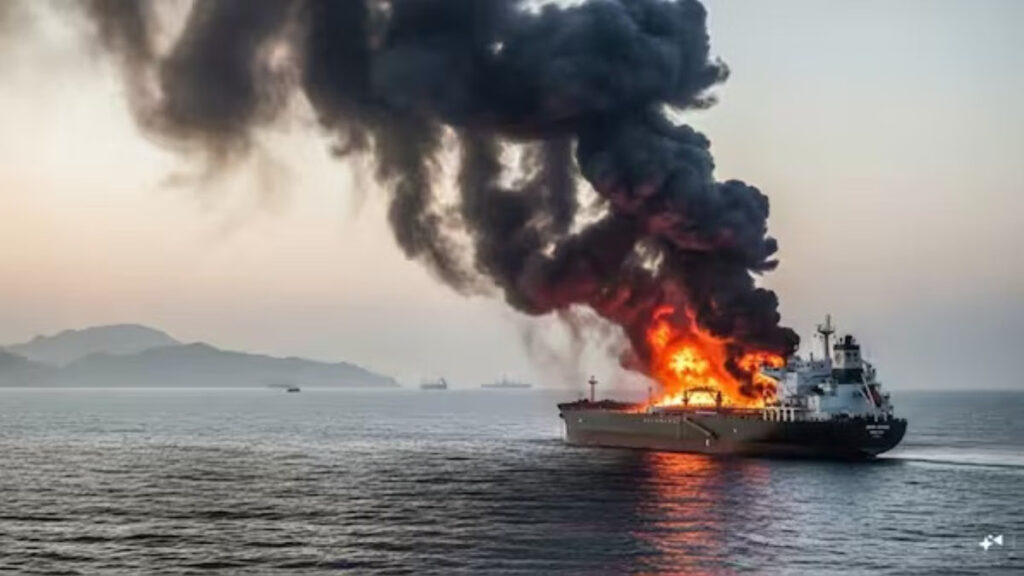
Yemeni sources said two Pakistani crew members and one Indonesian crew member were killed. The vessel had been sailing from Salalah, Oman, via Djibouti at the time of the attack.
What We Know So Far
The Yemeni sources said the crew lost control of the ship following the strike and were subsequently approached by the Yemeni coast guard. The Houthis had not claimed responsibility for the attack as of the latest reporting.
If confirmed, the deaths would mark the first fatalities from a Houthi strike on a commercial vessel since the broader Middle East conflict began following U.S. and Israeli attacks on Iran in late February.
The attack follows a naval blockade the Houthis declared against Saudi Arabia in the Red Sea last month, which the group said was a response to what it called a Saudi siege, a characterization Riyadh has denied. Shipping data from Kpler showed an average of 32 ships passing through the Bab el Mandeb Strait last week, down from an average of 50 ships daily before the current conflict began, reflecting how attacks in the strait have compounded uncertainty already caused by the closure of the Strait of Hormuz.
Other Developments in the Region
Houthis strike central Yemen and Red Sea port city
Yemen’s military said Houthi rebels targeted the government held Red Sea port city of Mokha and the central province of Marib with missiles and drones Tuesday, though it did not provide further detail on casualties or damage from that specific strike. The group struck Marib and the eastern province of Hadramout last week, killing dozens of government troops and civilians, and hit Mokha with missiles and drones over the weekend in an attack that killed at least seven people, including three soldiers, according to Yemen’s military.
Mokha serves as a main port for Yemen’s internationally recognized government and has been renovated specifically to handle shipping traffic diverted away from the Houthi controlled port of Hodeida. The renewed strikes are part of a broader escalation by the Houthis against Yemeni government forces, Saudi oil facilities, and Saudi shipping in the Red Sea, raising fears the violence could reignite Yemen’s civil war following a 2022 truce and open a new front in the wider regional conflict.
Mohammed Abdul Salam, the Houthis’ chief negotiator and spokesperson, accused Saudi Arabia in a social media post of using the ceasefire period to tighten an air and sea blockade first imposed in 2015. He said the group remains open to negotiations but that any settlement must include lifting that blockade.
Iran reiterates Strait of Hormuz demands
Iranian Foreign Minister Abbas Araghchi told reporters that Iran had proven itself a tough and resilient power throughout its conflict with the United States and Israel. Iran has maintained that it will not consider reopening the Strait of Hormuz until the United States ends its naval blockade of Iranian ports and meets a broader set of conditions.
Araghchi said on his Telegram channel that in a call with German Foreign Minister Johann Wadephul, he emphasized that securing the strait requires an end to what he called unlawful U.S. interventions, including the naval blockade. Wadephul said separately on social media that he had stressed the strait needs to reopen unconditionally to ensure free and safe navigation for all countries.
President Trump said in a social media post that he was directing negotiators to seek compensation from Iran for people killed or wounded in attacks over the years, a response to Iran’s own demand for compensation over damage from recent U.S. and Israeli strikes. Speaking separately to reporters in the Oval Office, Trump said the U.S. Navy’s blockade was preventing Iran from selling oil internationally. “Now, can they make trouble? Yeah, they can make trouble, but they’re broke,” Trump said.
Former Syrian president sentenced to death in absentia
A Syrian court sentenced former President Bashar Assad and his brother Maher to death for crimes against humanity and war crimes committed during Syria’s 14 year conflict, which killed an estimated half a million people. Both men fled to Russia after opposition insurgents entered Damascus in December 2024, and were tried and sentenced in absentia at Syria’s Fourth Criminal Court in the capital.
Why This Matters
The cargo ship attack marks a significant escalation in the Red Sea, since it would represent the first fatal Houthi strike on a commercial vessel since the current phase of the regional conflict began, a threshold that could further deter shipping companies already navigating a sharply reduced flow of traffic through the strait. Combined with the closure of the Strait of Hormuz, continued instability in the Bab el Mandeb Strait threatens to cut off two of the most important maritime chokepoints for global energy shipments simultaneously.
The parallel diplomatic standoff over the Strait of Hormuz, with Iran and the United States each demanding compensation from the other and neither side showing signs of compromise, suggests the broader conflict remains far from resolution even as narrower, localized agreements are pursued elsewhere in the region. Trump’s public claim of “100% control” over the Strait of Hormuz, paired with his acknowledgment that Iran retains some capacity to cause disruption, reflects the limits of unilateral U.S. pressure in fully stabilizing the waterway.
The Syrian court’s death sentence against Assad, while largely symbolic given his location in Russia and the unlikelihood of extradition, signals an effort by Syria’s post Assad government to formally establish accountability for wartime atrocities, even without any near term prospect of the sentence being carried out.
What Happens Next
Yemeni and international maritime authorities are expected to continue investigating Tuesday’s cargo ship attack, including confirming whether the Houthis carried it out, given the group had not claimed responsibility as of the latest reports. Shipping companies are likely to reassess routes and risk calculations through the Bab el Mandeb Strait if the attack is confirmed as Houthi directed.
Diplomatic efforts around the Strait of Hormuz are continuing alongside the escalating Yemen conflict, though neither the U.S. Iran standoff nor the Houthi government conflict in Yemen shows clear signs of near term resolution based on the latest statements from involved parties.
Reporting drawn from the Associated Press and The Times of Israel





