

SEOUL — A South Korean appeals court handed former first lady Kim Keon Hee a four-year prison sentence Tuesday, significantly toughening an earlier conviction on corruption charges tied to gifts she accepted from the Unification Church — a ruling that arrives roughly two months after her husband, ousted President Yoon Suk Yeol, received a life sentence for rebellion.
The Seoul High Court more than doubled the 20-month term a district court had imposed in January, finding Kim guilty of accepting an additional Chanel handbag from the church beyond the items that formed the basis of the original conviction, and reinstating a stock price manipulation charge from which she had previously been acquitted. The district court had found her culpable for receiving a Graff diamond necklace and a separate Chanel bag from Unification Church representatives in exchange for pledges of political assistance.
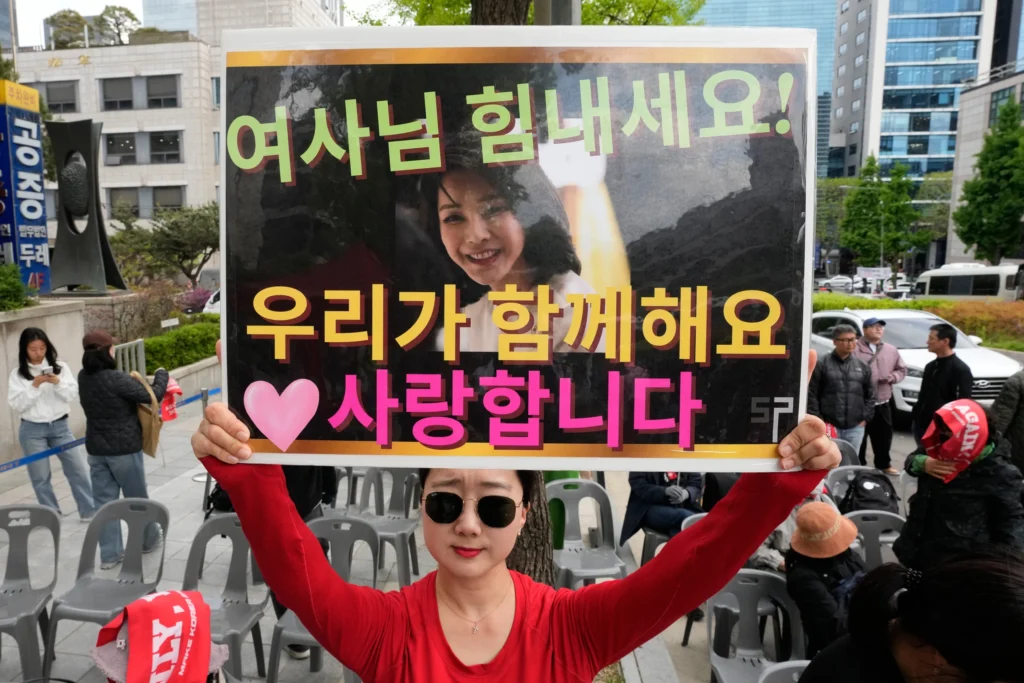
In its ruling, the Seoul High Court drew a sharp distinction between the obligations of an ordinary citizen and those of a sitting first lady, noting that a president’s spouse occupies a position uniquely proximate to national power, carries influence over the head of state, and bears a corresponding responsibility to uphold public trust. The court determined Kim had not only failed that standard but had exploited her elevated standing to extract luxury gifts from a religious organization with active political interests.
Both Kim and independent counsel Min Joong-ki have one week to petition the Supreme Court for review. Min’s team had sought a 15-year sentence, arguing the original term drastically underestimated the gravity of the offenses. Kim’s defense has maintained that Min’s prosecution was politically motivated rather than driven by legitimate evidentiary concerns.
A Presidential Marriage Under Legal Siege
The sentencing marks the latest chapter in the cascading legal reckoning that has consumed South Korea’s most prominent political couple since Yoon’s stunning imposition of martial law in December 2024 triggered a constitutional crisis that ultimately ended his presidency.
Kim has been held in custody since last August, when the Seoul district court approved an arrest warrant citing concern that she might tamper with or destroy evidence if left free. During Yoon’s tenure, she had become a persistent liability — a figure whose repeated controversies drained his approval ratings and handed opposition forces an unending supply of political fodder.
On the night of Dec. 3, 2024, Yoon abruptly declared martial law and dispatched military units and police officers to surround the National Assembly, framing the move as a necessary measure to neutralize what he characterized as anti-state forces and North Korea sympathizers embedded in the liberal opposition. Lawmakers physically broke through the cordon and convened an emergency session, voting to lift the decree within hours. Yoon was subsequently impeached by the National Assembly and removed from office by the Constitutional Court.
In February, the Seoul Central District Court convicted Yoon of rebellion, finding that he had mobilized armed forces in an unlawful bid to seize the legislature, detain political opponents, and establish unchecked executive authority over an indefinite period. The court sentenced him to life in prison — the stiffest penalty permissible under the rebellion statute short of execution. Yoon has defended his conduct throughout, casting the martial law declaration as a desperate act of political self-defense against a Democratic Party majority he accused of systematically obstructing his governing agenda.
Investigators have drawn a clear separation between Yoon’s martial law conduct and Kim’s legal exposure, determining she played no role in the planning or execution of the military deployment.
The Unification Church at the Center
The corruption charges against Kim center on her relationship with the Unification Church, the organization founded by the late Sun Myung Moon that maintains deep and enduring roots within South Korea’s conservative political establishment. Prosecutors alleged that Kim accepted luxury goods from church representatives with the understanding that her husband’s administration would extend favorable treatment — an arrangement the courts determined crossed into criminal bribery territory.
The Unification Church’s proximity to South Korean conservative politics has drawn sustained scrutiny for decades, but the Kim prosecution represents one of the most prominent judicial findings linking church gift-giving to explicit promises of political reciprocity. The Seoul High Court’s decision to reinstate the stock manipulation charge, which the lower court had dismissed, further expanded the scope of Kim’s criminal accountability beyond the church-related counts.
A Legal Reckoning With Political Aftershocks
The convergence of life imprisonment for Yoon and a four-year term for Kim represents an extraordinary moment in South Korean democratic history — a sitting president and his spouse simultaneously imprisoned following the collapse of an administration that began with substantial electoral support and ended in constitutional rupture.
South Korea has now prosecuted two former presidents in the post-democratization era, with Yoon joining the ranks of predecessors whose tenures ended in disgrace and criminal conviction. The breadth and speed of the legal proceedings against both Yoon and Kim signal an institutional willingness to apply accountability measures regardless of the political costs — a posture that analysts note reflects both the strength of South Korea’s judicial independence and the depth of public anger over the martial law episode.
For the Democratic Party, now dominant in the National Assembly and holding the political initiative, the twin convictions offer validation of years of pressure campaigns against the Yoon administration. For South Korea’s conservative bloc, the rulings present a generational reckoning — the need to rebuild credibility on rule-of-law grounds while simultaneously managing a base that views elements of the prosecution as partisan overreach.
Kim’s legal fate now rests with the Supreme Court if either side pursues the remaining appeal window. Whatever the outcome at that final tier, the Seoul High Court’s ruling Tuesday ensures she will enter the history of the South Korean republic as the first former first lady convicted of corruption by an appellate bench — a distinction her husband’s own legal catastrophe has done nothing to soften.
The Associated Press





