

GOMBI, Nigeria — Islamic State militants descended on a remote northeastern Nigerian village under cover of darkness Sunday, slaughtering at least 29 residents in an assault that drew swift condemnation from the state’s top official, even as a separate armed attack hundreds of miles away left one female student dead and six others seized at gunpoint in Kaduna State.
The twin episodes of bloodshed unfolded on the same day, exposing once more the depth and geographic reach of a security breakdown that has come to define daily life across large swaths of Africa’s most populous nation.
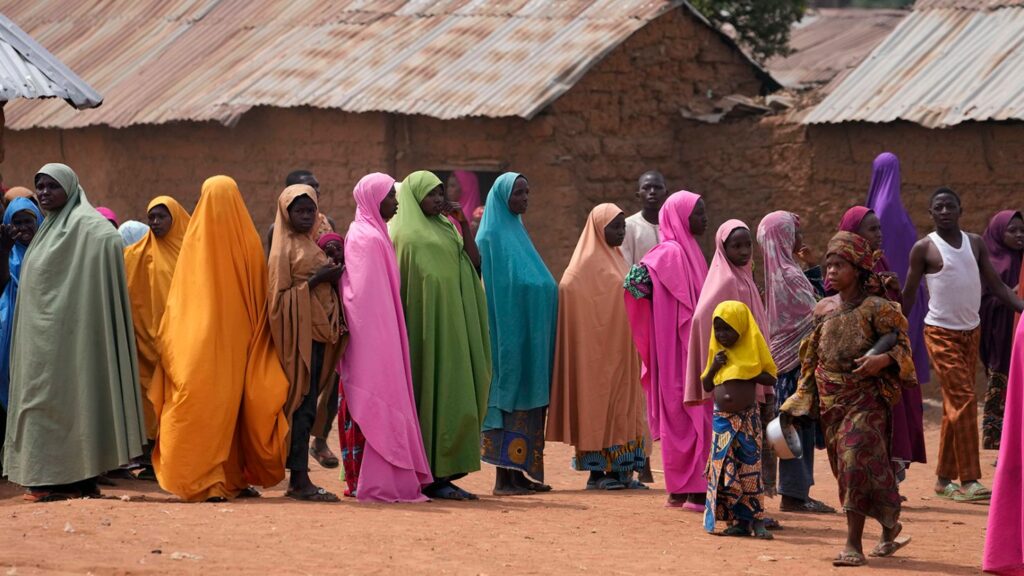
The nighttime rampage struck Guyaku, a settlement within the Gombi local government area of Adamawa State, where gunmen affiliated with the Islamic State group opened fire on residents and torched properties before withdrawing into the surrounding terrain. Adamawa State Governor Ahmadu Umaru Fintiri traveled to the village Monday and condemned the slaughter as tragic and wholly unacceptable, vowing that those responsible would face accountability.
The Islamic State group formally acknowledged carrying out the attack through a posting on the Telegram messaging platform, though authorities did not immediately confirm which of two IS-aligned factions operating in Nigeria was responsible. The Islamic State West Africa Province, widely known as ISWAP, has maintained an operational foothold in the northeast, including in Adamawa State, for years. A second IS-connected network, known regionally as Lakurawa, tends to concentrate its violence farther west in the northcentral states of Sokoto and Kebbi.
A Nation Engulfed
Nigeria has wrestled with compounding security emergencies for more than two decades, particularly across its northern corridor, where jihadist insurgencies, criminal banditry networks, and intercommunal violence have displaced millions and claimed tens of thousands of lives. In February, the United States deployed military advisers to the country to assist Nigerian forces in confronting the overlapping threats — a move underscoring Washington’s recognition that instability in West Africa’s largest economy carries consequences well beyond its borders.
The Guyaku assault coincided with yet another mass abduction unfolding simultaneously in north-central Nigeria, where gunmen raided an orphanage in Lokoja, the capital of Kogi State, seizing 23 pupils. Fifteen of the children were subsequently rescued through security operations, and the federal government announced that intensive pursuit efforts were continuing to recover the remaining eight and bring the attackers to justice. The facility targeted, identified as Dahallukitab Group of Schools, was operating without official authorization, according to Kogi State Commissioner Kingsley Femi Fanwo, who described the compound as situated in an isolated section of Lokoja.
No organization immediately claimed responsibility for the Kogi orphanage attack. Officials declined to specify the ages of the abducted children, though the designation “pupil” in Nigerian educational parlance typically refers to students in kindergarten or primary school, generally spanning ages up to 12.
Kaduna Ambush: One Student Killed, Six Seized
In a parallel episode that same Sunday, armed bandits ambushed a vehicle transporting female students through the Southern Kaduna region, killing one and abducting six others in a brazen roadside assault that security forces had not publicly addressed as of Monday.
The attack unfolded in Akwando village, within the Kachia Local Government Area of Kaduna State, according to Reuben Buhari, a community member originally from the area whose account was first brought to light by Sahara Reporters. The students, all residents of Akwando village, had boarded the truck before dawn to travel to Kachia, where they were scheduled to resume school attendance Monday morning.
Fewer than ten minutes into the journey, the vehicle was intercepted by armed men who overpowered the occupants and forced several passengers off the truck. One student, identified as Purity Babangida, was found dead after she apparently attempted to flee on foot during the ambush.
Among those taken captive, Buhari identified the following individuals: Augustina Muntari, an SS2 student at Government Secondary School Gumel; Happy Muntari, a JS2 student at the same institution; Favour Tanimu, a JS2 student at Government Secondary School Kachia; Patience Joseph, also a JS2 student at GSS Kachia; Peace Irimiya, a student at St. John’s School in Kachia; and Bishara Irimiya, likewise enrolled at St. John’s School in Kachia. The driver, identified as Irimiya Galadima, was also among those seized, along with two adults — Fatu Danladi and Laraba Caleb.
In a desperate bid to escape, 15 other students leapt from the moving truck and fled into surrounding bush, trekking for several hours through rugged terrain before reaching nearby villages, Buhari told Sahara Reporters. The Kaduna State government and the Kaduna State Police Command had issued no formal statement on the incident by Monday.
Schools as Strategic Targets
Security analysts have long cautioned that armed networks across Nigeria view educational institutions and the students within them as deliberately chosen targets — high-visibility objectives that amplify media attention, generate ransom leverage, and expose governmental impotence in areas where the state struggles to project authority. Mass abductions of students have recurred with alarming regularity since the 2014 seizure of 276 schoolgirls from Chibok in Borno State — an atrocity that galvanized international outrage but failed to produce lasting policy change sufficient to stop further attacks.
The pattern has since metastasized far beyond the northeast. Successive governments have invested in military reinforcements, pursued peace negotiations with some armed factions, and accepted foreign military assistance — yet the frequency and geographic spread of attacks suggests those measures have not yet reversed the underlying dynamics enabling armed groups to move and strike with apparent impunity.
The back-to-back violence on Sunday — a jihadist massacre in Adamawa, a school abduction in Kogi, and a student kidnapping in Kaduna — laid bare the scale of the challenge facing Nigerian authorities. With national elections on the political horizon and civilian frustration mounting over the human cost of prolonged insecurity, the government faces escalating pressure to demonstrate that its security architecture can do more than respond to attacks after they occur.
For the families of those killed in Guyaku, the parents of the abducted Kaduna students, and the children still missing from the Kogi orphanage, that shift cannot arrive soon enough.
AP/SaharaReporters





