

ATLANTA — Ted Turner is dead. The man who invented the 24-hour news cycle, built a cable television empire from a failing Atlanta UHF station, gave a billion dollars to the United Nations, and said whatever crossed his mind without apology — died Wednesday at 87.
Turner Enterprises confirmed his death. No cause was given. Turner had been living with Lewy body dementia since at least 2018, when he disclosed the diagnosis publicly from his Montana ranch.
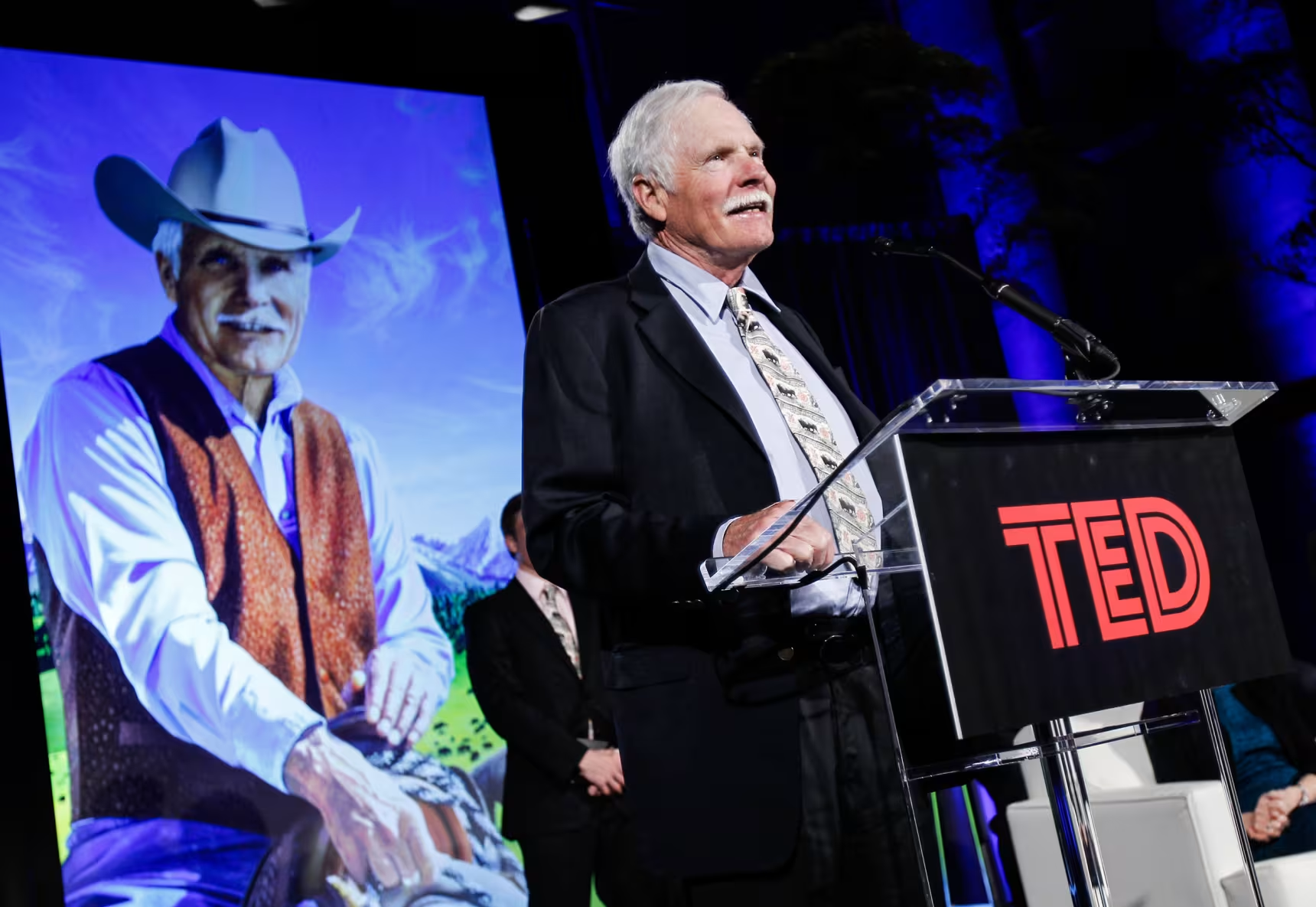
“Ted was an intensely involved and committed leader, intrepid, fearless and always willing to back a hunch and trust his own judgment,” CNN chairman and CEO Mark Thompson said in a statement. “He was and always will be the presiding spirit of CNN.”
He was also, depending on who you asked, the Mouth of the South, Captain Outrageous, Terrible Ted, and — for one glorious year — Time magazine’s Man of the Year.
“If I only had a little humility,” Turner once said, “I’d be perfect.”
The Man Who Built the Machine
Robert Edward Turner III was born Nov. 19, 1938, in Cincinnati. His father was a billboard advertising magnate. His mother was Florence Turner. The family moved south when Ted was nine, and the boy was sent to military schools where he became a champion debater and an accomplished yachtsman — two skills that would serve him well in a life defined by argument and competition.
He enrolled at Brown University in 1956, studied classics instead of business against his father’s wishes, got caught with a woman in his dorm room, and never graduated. He went to work for the family company in Savannah, selling billboard space.
At 24, his father killed himself. Turner took over. He repurchased the firm after a family dispute, made it profitable, and in 1970 — against the advice of everyone around him — bought a failing Atlanta UHF television station for $2.5 million.
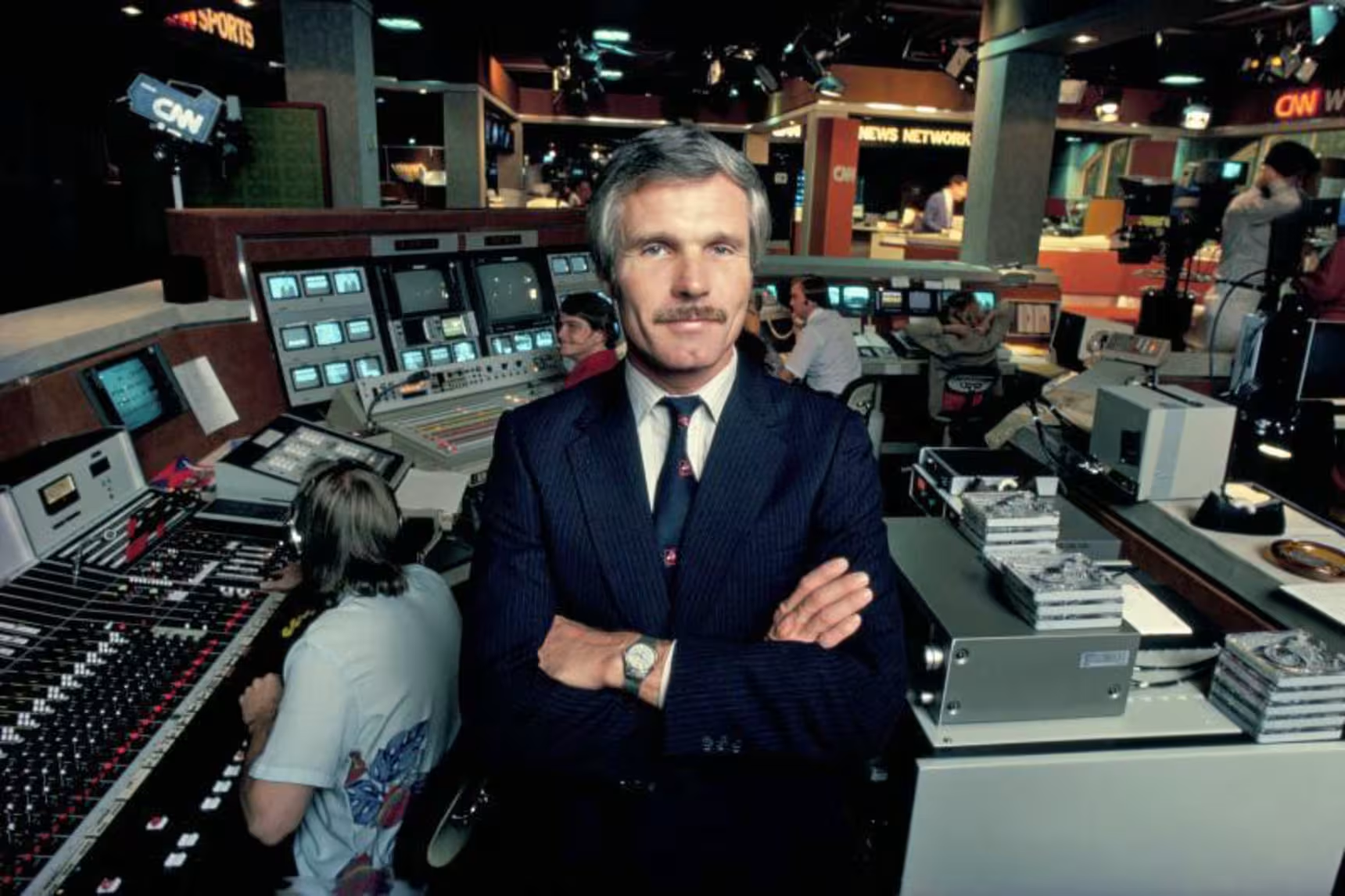
They called it the Chicken Noodle Network when he launched CNN a decade later. Nobody was laughing by the time the Gulf War played out live on television in 1991 and the whole world was watching.
CNN and the Superstation
The move that changed everything came in the mid-1970s. Turner became one of the first media owners to use satellite technology to broadcast his station nationally, turning a local Atlanta outlet into the country’s first superstation — programming picked up by cable systems across America.
The lineup was cheap and brilliant: old Hollywood films, throwback sitcoms, Atlanta Braves baseball. The station made money. Turner made more channels. TBS, TNT, Cartoon Network, Turner Classic Movies — each one built on the same instinct that had rescued the UHF station. Give people something to watch. Keep the costs down. Own the library.
CNN aired its first broadcast June 1, 1980, anchored by the husband-and-wife team of David Walker and Lois Hart. Turner said he built it to counter what he called sleazy coverage by the major networks. He promised it would stay on the air until the world ended.
It changed everything about how news moved. The format, the speed, the expectation that something was always happening somewhere and you could watch it right now — all of it traces back to that first broadcast from Atlanta. Fox News and MSNBC exist because CNN proved the model worked.
Warner Bros. Discovery head David Zaslav put it plainly in a message to staff Wednesday. “He did not just disrupt media. He transformed it.”
Sports, Wrestling, and One Very Bad Game
Turner bought the Atlanta Braves in 1976 and the Atlanta Hawks in 1977. The Braves won the World Series in 1995 under his ownership. He marketed the franchise as America’s Team with the unapologetic confidence of a man who believed whatever he said loudly enough would eventually become true.
In 1977, during a losing streak, Turner appointed himself manager of the Braves for one game. They lost 2-1 to Pittsburgh. Baseball officials told him to sit down and stay there.
His involvement in professional wrestling was equally colorful. He had aired wrestling on his stations since the 1970s. In 1988 he bought Jim Crockett Promotions and rebranded it World Championship Wrestling. WCW’s head-to-head ratings battle with the World Wrestling Federation through the late 1990s became one of the most fiercely contested periods in the history of the industry — the Monday Night Wars, as it was known. Turner eventually sold WCW to Vince McMahon’s WWF in 2001.
He also skippered his yacht, the Courageous, to win the America’s Cup. He started the Goodwill Games in 1986 as an Olympic alternative during the Cold War. He ran his life the way he ran his businesses — at speed, with maximum exposure, trusting his gut over everyone else’s expertise.
The Colorization War and the MGM Library
In the mid-1980s Turner bought MGM/UA Entertainment, which came with a library of more than 4,000 films. He announced plans to colorize the black-and-white classics. Hollywood erupted.
Film critic Roger Ebert called Turner’s airing of a colorized version of Casablanca “one of the saddest days in the history of the movies.” The Los Angeles Times labeled Turner “The Man Hollywood Loves to Hate.”
Turner eventually backed down, deciding the process was not worth the cost. He sold MGM/UA but kept the movie library. That library became the backbone of Turner Classic Movies, launched in 1994 — now regarded as one of the finest film preservation channels in television history. The man who tried to colorize Casablanca ended up protecting it.
Jane Fonda, Time Warner, and the Fall
Turner married three times and divorced three times. He had five children — two from his first marriage to Judy Gale Nye and three from his second marriage to Jane Shirley Smith.
His third marriage, in 1991, was to Jane Fonda. The union between a hard-charging capitalist and one of Hollywood’s most outspoken progressives raised eyebrows everywhere. It lasted a decade.
“In his heart, Ted is not a wealthy, powerful, privileged person,” Fonda said in the 2018 HBO documentary “Jane Fonda in Five Acts.” “He’s a little boy who likes to play, and who has wild brilliance, and that’s what I was attracted to.”
They divorced in 2001. Turner told documentarians it was the hardest thing he had survived. “I feel like I was happier when I was with her than subsequently,” he said.
In 1996, Time Warner bought Turner Broadcasting System for $7.5 billion, creating the largest communications company in the world. Turner became vice chairman. In 2001, Time Warner merged with AOL in a $99 billion deal Turner voted for. The merger destroyed billions in shareholder value. Turner was stripped of his oversight of the cable networks he had built. He resigned as vice chairman in 2003 and stepped down from the board three years later.
It was, by any measure, a bad ending to the corporate chapter of his life. Forbes pegged his remaining fortune at $2.8 billion.
The Philanthropist and the Land Baron
Turner channeled what came after into causes. In 1997 he announced a $1 billion donation to the United Nations — the largest single philanthropic gift in American history at the time. The funds created the United Nations Foundation. Twenty years later Turner called it “the best investment I’ve ever made.”
He co-founded the Nuclear Threat Initiative with former Senator Sam Nunn in 2001, a nonprofit organization dedicated to preventing the use of weapons of mass destruction globally. He poured millions into environmental causes through his Turner Foundation.
He became one of the largest private landowners in the United States, holding more than 1.9 million acres across six states. He owned a herd of roughly 50,000 bison and in 2002 co-founded Ted’s Montana Grill, a restaurant chain built around what it claimed was the largest bison menu on earth. He owned ranches in Argentina’s Patagonia. He spent much of his later years on his Montana ranch, fly-fishing and hiking and living the kind of life he had always said mattered more than the business.
In 2018 he told journalist Ted Koppel about the dementia diagnosis with characteristic bluntness. “It’s similar to Alzheimer’s. But not nearly as bad. Alzheimer’s is fatal,” he said. He withdrew from public life in the years that followed.
The Last of the Originals
Ted Turner belonged to a generation of American entrepreneurs who built things from scratch and broke the rules doing it. He was not a technologist or a disruptor in the Silicon Valley mold. He was a salesman, a showman, and a genuine visionary who looked at television in 1979 and saw something nobody else saw — that news could run all day, every day, and people would watch.
He was right. Every cable news network that exists today, every breaking news alert on your phone, every scrolling chyron at the bottom of a screen owes something to the decision Ted Turner made to launch CNN from Atlanta on June 1, 1980.
He was also, by his own admission and by the accounts of people who worked for him, difficult. Blunt to the point of cruelty. Prone to statements that landed like grenades. He compared Rupert Murdoch to Adolf Hitler. He called his employees Jesus freaks. He managed a Major League Baseball team for one game and lost.
None of it diminished what he built. The Chicken Noodle Network became the template for how the world receives its news. The superstation concept rewrote the economics of cable television. The MGM library he almost ruined with colorization now lives on Turner Classic Movies, preserving the films future generations will watch.
He was 87. He got to see what he built become the world.
NBC/Reuters





