

President Donald Trump declared the ceasefire with Iran effectively over on Wednesday and the United States launched a second consecutive night of military strikes against Iranian targets, escalating a cycle of retaliation that has pushed the fragile interim peace agreement to the edge of collapse and raised fears of a return to full-scale war across the Middle East.
U.S. Central Command confirmed the strikes in a statement on X, saying American forces had begun conducting additional attacks against Iran at Trump’s direct order, aimed at further degrading Tehran’s ability to threaten commercial shipping in the Strait of Hormuz.
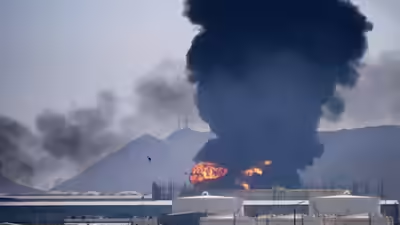
What We Know So Far
The strikes were the second consecutive night of American military action against Iran, following Tuesday’s wave of attacks that itself came in response to Iranian strikes on three merchant vessels in the strait earlier in the week.
The three ships targeted by Iran were the Al Rekayyat, flagged to the Marshall Islands, the Wedyan, flagged to Saudi Arabia, and the Cyprus Prosperity, flagged to Liberia, Sky News confirmed. All three were struck while transiting the strait on a route near Oman’s shore that multinational maritime authorities had designated as open for commercial traffic, rather than the route Iran had ordered vessels to use.
Explosions were heard in multiple Iranian coastal cities following the Wednesday night strikes. Iran’s semi-official Fars News Agency reported blasts near Bandar Abbas and Sirik, with air defenses described as engaging hostile targets in both areas.
Mehr News Agency separately reported explosions in Konarak and Chabahar. Power cuts were reported in Chabahar. Blasts were also heard in the Bushehr area, though Sky News noted that the attack on Bushehr did not damage the nuclear plant located there.
On Tuesday, U.S. Central Command said American forces had hit Iranian air defense systems, radars, and more than 60 small Revolutionary Guard boats used to threaten shipping in the strait, the Associated Press confirmed. Iranian state television reported that eight members of Iran’s Army air and naval forces were killed in Bandar Abbas and Bushehr during Tuesday’s strikes, and that one Revolutionary Guard member was killed in Bandar Mahshahr.
Iran retaliated Wednesday morning with missile and drone strikes on U.S. military installations in Bahrain and Kuwait. Kuwait confirmed it intercepted two ballistic missiles and 13 drones launched by Iranian forces.
The Kuwaiti Electricity Ministry said power lines were disrupted after shrapnel from the intercepted projectiles fell on infrastructure. The Revolutionary Guard separately claimed it had targeted 85 U.S. military sites across Bahrain and Kuwait during the overnight exchanges.
What Trump And U.S. Officials Are Saying
Trump used blunt and personal language to describe the state of the conflict at the NATO summit in Ankara, where coverage of the Iran crisis dominated the gathering.
“For me, I think it is over,” Trump said when asked directly about the status of the ceasefire. He added that American negotiators could continue talking but questioned whether it would lead anywhere. “They can talk, but I think they are wasting their time,” he said.
Earlier in the day, Trump had telegraphed the coming strikes openly. “We will probably hit them hard again tonight. I will give them a little warning. We are going to hit them hard tonight. But we will see how it all works out,” he told reporters during a meeting with Ukrainian President Volodymyr Zelenskyy on the sidelines of the summit.
Trump also threatened to hit Iranian civilian infrastructure, including electric plants and desalination facilities, and raised the possibility of seizing Kharg Island, through which 90 percent of Iranian oil exports pass.
He said the back and forth fighting would not result in long-term military action, adding that “anything that happens is going to happen very fast,” though he also said the United States might “just finish the job.”
Asked why he viewed Tehran’s leadership as “scum,” Trump told the NATO summit he had simply “got to know them.” He also described himself as “number one” on Iran’s kill list, a claim he appeared to make without alarm.
Vice President JD Vance, speaking at an event in Milwaukee, framed the American position in stark and simple terms. “The basic deal that we cut was we will lift our blockade if you stop shooting at ships. But if you shoot at ships, we are going to punch back, and we are going to punch back harder than ever before,” Vance said. “The deal is very simple: If they shoot at ships, we are going to knock the hell out of them.”
Vance also confirmed that the United States considered Iran to be in violation of the memorandum of understanding the two countries had signed, and said Trump “maintains a lot of options” in pursuit of his core objective of keeping the Strait of Hormuz open to oil and gas shipments.
What Iran Is Saying
Iranian Deputy Foreign Minister Kazem Gharibabadi pushed back against Trump’s framing in a post on X, saying the president’s comments were “not a sign of power but an admission of the failure” of U.S. policy toward Iran.
Parliament Speaker Mohammad Baqer Qalibaf, one of Tehran’s top negotiators in the peace talks, maintained a defiant posture. “The era of bullying and extortion is over. It leads nowhere. We don’t fold,” Qalibaf wrote on X.
Iran threatened to close the Strait of Hormuz again in response to any further American strikes, the most serious signal yet that Tehran was prepared to return to the chokehold strategy that had caused severe disruption to global energy markets since the war began in February.
Iran’s armed forces, through a military source cited by Nour News, vowed to launch a “massive” attack on American military bases across the region in retaliation for the Wednesday night strikes. The Revolutionary Guard described the U.S. attacks as a ceasefire violation.
Why This Matters
What is happening in the Strait of Hormuz is not simply a military exchange between two adversaries. It is a contest over who controls one of the most consequential pieces of geography in the global economy.
Before the war, a fifth of all globally traded oil and natural gas passed through the strait. Iran’s demonstrated capacity to bring that traffic to a near halt during the conflict represented its single greatest strategic advantage over the United States, a fact that American officials have openly acknowledged. Control of the waterway, or the credible threat of closing it, gives Tehran leverage that no other instrument of Iranian power can replicate at the same scale or speed.
The attacks on the three tankers Tuesday and the pattern that preceded them reflect a calculated Iranian strategy rather than impulsive aggression. By striking ships that used the Oman route rather than Iran’s designated corridor, Tehran was asserting in the most direct terms available that its authority over the strait is non-negotiable.
The United States, Qatar, Saudi Arabia, and the Gulf Arab coalition have equally and explicitly said they will not accept Iranian control over an international waterway governed by maritime law for generations.
That fundamental incompatibility was not resolved by the interim memorandum. It was deferred, and it is now asserting itself with escalating force on both sides.
Trump’s willingness to declare the ceasefire over while simultaneously saying negotiations can continue reflects the contradictions embedded in the American position. Washington wants a deal that strips Iran of nuclear capability, ends its support for armed proxy groups, and keeps the strait open without Iranian tolls or route restrictions.
Tehran wants sanctions lifted, frozen assets released, and recognition that it retains meaningful authority over the waterway. Those two sets of demands have not moved meaningfully closer to reconciliation in the weeks since the interim agreement was signed.
The division within Iran’s own leadership may be contributing to the current escalation. Analysts and the Associated Press noted that hard-liners seeking permanent control over the strait and the leverage it provides may be driving the tanker attacks, while pragmatists focused on economic relief through a permanent deal watch their negotiating position erode with each American strike that degrades Iranian military capacity.
Oil prices surged after Trump’s comments and the announcement of fresh strikes, a reminder that every hour of military exchange has an immediate and tangible cost to consumers and economies far beyond the Persian Gulf.
Pakistan, which served as a key mediator in brokering the interim agreement, urged both sides to step back from the brink as Wednesday’s events unfolded, according to Sky News. Whether that appeal carries sufficient weight to interrupt the current momentum remains deeply uncertain.
What Happens Next
Khamenei’s burial is scheduled for Thursday at the Imam Reza shrine in Mashhad. U.S. officials had indicated that substantive final-deal negotiations would begin after the burial, but the current military exchanges have made even that tentative timeline difficult to envision.
Trump’s assertion that the ceasefire is over, combined with his openness to continuing negotiations simultaneously, leaves the situation in a state of deliberate ambiguity that appears designed to keep maximum pressure on Tehran without formally closing the diplomatic door.
Whether Iran’s leadership interprets that ambiguity as an invitation to negotiate or as a justification for further escalation will determine what the next 48 hours look like.
The threat to close the strait again, if carried out, would trigger immediate consequences for global energy markets and would almost certainly draw a military response of greater scale than what has occurred so far.
The potential for miscalculation in an environment where both sides are conducting active military operations while simultaneously claiming to remain open to talks is significant.
Mediator Pakistan and other regional actors including Qatar and Turkey face an urgent challenge: finding a formula that allows both Washington and Tehran to stop shooting without either side being seen domestically as having capitulated.
Whether they can do so before the next exchange of strikes further narrows the space for diplomacy is the question that will define the next chapter of a conflict that the entire world has a stake in seeing resolved.
Reuters, The Associated Press, CNN, Sky News, The Independent





