

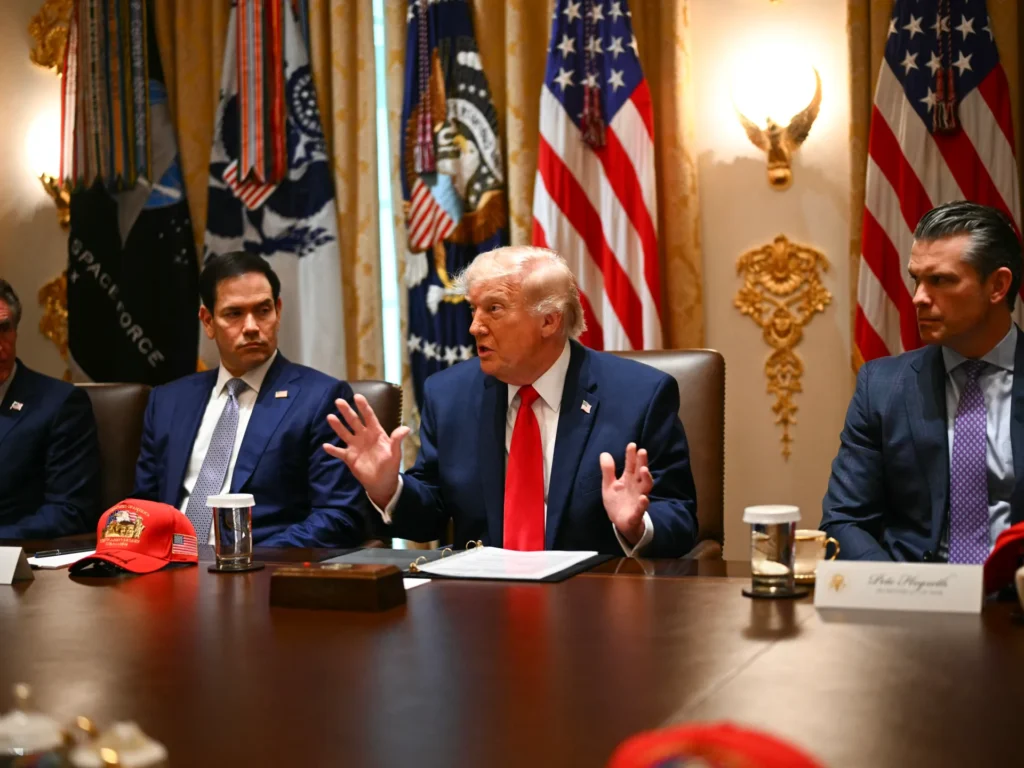
President Donald Trump spent roughly two hours in the White House Situation Room Friday meeting with his top national security advisers on a tentative agreement to extend the Iran ceasefire and reopen the Strait of Hormuz, but emerged without announcing a decision, leaving the fate of the fragile deal unclear as Iran’s chief negotiator warned his country gains concessions “through missiles, not talks.”
Trump had described the session beforehand as a meeting to make a “final determination” on the emerging agreement. A senior administration official who was not authorized to speak publicly confirmed to the Associated Press that the meeting had concluded but declined to say whether Trump had signed off on anything. Secretary of State Marco Rubio and Vice President JD Vance were among the participants.
The ambiguity from Washington was matched by pointed skepticism from Tehran. Iran’s parliament speaker and top nuclear negotiator Mohammed Bagher Qalibaf posted a stark warning on X as the Situation Room session was underway.
“No step will be taken before the other side acts,” Qalibaf wrote. “We do not gain concessions through talks, but through missiles.”
Iranian Foreign Ministry spokesman Esmail Baghaei added before the meeting concluded that the agreement “has not been finalized yet,” pushing back against the characterization by American and international outlets that the two sides had reached terms.
What the Tentative Deal Contains
The Associated Press and other outlets had reported Thursday that U.S. and Iranian negotiators had come to terms on a framework. The proposed memorandum, according to a U.S. official who spoke anonymously because they were not authorized to discuss the contents, would extend the fragile ceasefire by 60 days while new negotiations on Iran’s nuclear program take place.
On the Strait of Hormuz, the framework would prohibit Iran from charging tolls on commercial vessels transiting the waterway and require Iran to remove all mines from the strait within 30 days. In exchange, the United States would gradually lift its naval blockade of Iranian ports and agree to ease sanctions, allowing Tehran to sell more oil on international markets.
Iran has effectively controlled the strait since the United States and Israel launched a surprise attack on February 28 that killed Iran’s supreme leader and other senior officials. Before the war, the waterway handled roughly a fifth of the world’s seaborne oil and gas. Since then, traffic has dropped from more than 100 vessels daily to approximately two dozen, with Iran imposing tolls on some ships and establishing a formal transit authority this month that prompted a new round of American sanctions.
Baghaei said Friday that Iran and Oman, which sit on opposite sides of the strait, would jointly manage the waterway and develop mechanisms for transit based on their national interests and those of the international community. Iran’s Foreign Minister Abbas Araghchi said he had spoken by phone with his Omani counterpart earlier Friday and expressed solidarity “in the face of any threat.”
Trump had warned Oman specifically on Wednesday not to enter any agreement with Iran to share control of the strait, threatening that the United States would “have to blow them up” if it did. Oman has served as a back-channel diplomatic link between Washington and Tehran throughout the conflict.
The Nuclear Gap
The nuclear dimension of the emerging deal remains the most contested. Trump said from the beginning of the conflict that preventing Iran from obtaining a nuclear weapon was a primary objective. On Friday, he returned to one of his firmest stated demands: that Iran’s stockpile of highly enriched uranium be physically removed and destroyed as part of any agreement. “The material would be unearthed by the U.S., in coordination with Iran and the IAEA, and DESTROYED,” Trump posted on social media.
Iran holds 440.9 kilograms of uranium enriched to 60 percent purity, one short technical step from the 90 percent threshold required for weapons-grade material, the International Atomic Energy Agency has confirmed. The stockpile is believed to be stored at three nuclear sites that were heavily damaged in U.S. strikes last year. Iran has long maintained its nuclear program is entirely peaceful and has not publicly committed to surrendering the uranium.
Baghaei said Friday that Iranian officials were “focused on the end of war and are not discussing the details of the nuclear plan at this point” — a position that directly contradicts the sequencing the American side has publicly described as essential.
Vance offered a more modest framing of what the war had achieved on the nuclear question than the administration’s initial rhetoric had promised. “We’re in a position where we could substantially set back their nuclear program, not just during the term of this president but over the long term,” Vance said Thursday, calling that outcome “very, very good” for Americans. The shift in language from elimination to substantial setback reflected the distance between where the administration started and where the negotiations have landed.
Lebanon as an Unresolved Condition
Iran has also insisted that any final agreement include a truce covering Israel’s military operations against Hezbollah in Lebanon, where fighting has intensified despite a nominal ceasefire that has been repeatedly violated. That condition has not been publicly addressed in the framework that American officials have described, creating another potential obstacle between a tentative agreement and a signed deal.
Seven Weeks of Ceasefire, Seven Weeks of Violations
Since the ceasefire took effect approximately seven weeks ago, the United States and Iran have exchanged strikes multiple times and accused each other of violations. Neither side has returned to full-scale hostilities, and negotiations have continued through those exchanges. The pattern has established a functional if unstable equilibrium: enough restraint to keep the ceasefire technically alive, not enough trust to close the gap between what each side says it needs from a permanent agreement.
Qalibaf’s statement Friday captured Iran’s institutional distrust with particular bluntness. “Iran has no trust in guarantees or words, only actions,” he wrote, pointing to the two separate occasions in the past year when the United States and Israel launched military strikes against Iran while nuclear negotiations were underway.
A Decision Unmade at a Decisive Moment
Trump’s decision to call a Situation Room meeting and describe it in advance as a final determination, then end that meeting without a public announcement either way, produced a specific kind of diplomatic signal regardless of what was actually decided behind closed doors.
If Trump approved the deal and simply chose not to announce it Friday, the delay is likely tactical: managing the announcement timing to maximize political impact or waiting for Iranian confirmation that the framework is accepted. If Trump did not approve the deal and is continuing to deliberate, the gap between the two sides on nuclear terms may be wider than the optimistic framing of recent days has suggested.
Either way, the situation room meeting and its indeterminate conclusion underscored the fundamental challenge that has defined this entire negotiation. An agreement that reopens the strait and begins nuclear talks gives Trump a version of victory he can describe publicly. An agreement that leaves Iran’s enriched uranium in place, defers the nuclear specifics to future talks, and does not definitively prevent Iran from reconstituting its nuclear program gives Trump’s Republican critics the ammunition they need to call it an Obama-style surrender with better marketing.
The deal’s advocates argue that something is better than nothing and that a 60-day window of extended ceasefire and active nuclear talks is a platform from which better terms can be secured. The critics argue that history with Iran consistently shows that the moment pressure eases is the moment Iran stops making concessions, not the moment it starts making more.
Trump is the one who has to decide which argument to believe. Friday evening, he had not yet said.
CNN/AP





