

A 14-year-old student opened fire inside a middle school in southeastern Turkey on Wednesday, killing nine people and wounding 13 others before taking his own life, officials said, marking the country’s second school shooting in as many days.
Interior Minister Mustafa Ciftci confirmed that eight students and one teacher were killed in the attack in Kahramanmaras province. He added that several of the injured remain in critical condition as medical teams continue treatment efforts.
Authorities indicated the violence was not linked to organized militancy. “This was a personal act carried out by one of our students and does not constitute terrorism,” Ciftci told journalists during a briefing.
Earlier, provincial governor Mukerrem Unluer outlined details of the assault, describing how the student arrived armed with multiple weapons and ammunition. “An eighth-grade student entered the school carrying five firearms and seven magazines, which are believed to belong to his father, a former police officer,” Unluer said. “He entered two classrooms of younger students and opened fire indiscriminately.”
The attacker later died by suicide amid the chaos, Unluer added.
The victims included fifth-grade students, typically aged 10 and 11, underscoring the scale of the tragedy at a school level rarely associated with such violence in Turkey.
Broadcaster NTV indicated that the suspect’s father had been taken into custody as part of the ongoing investigation, though officials have not publicly detailed potential charges or legal actions.
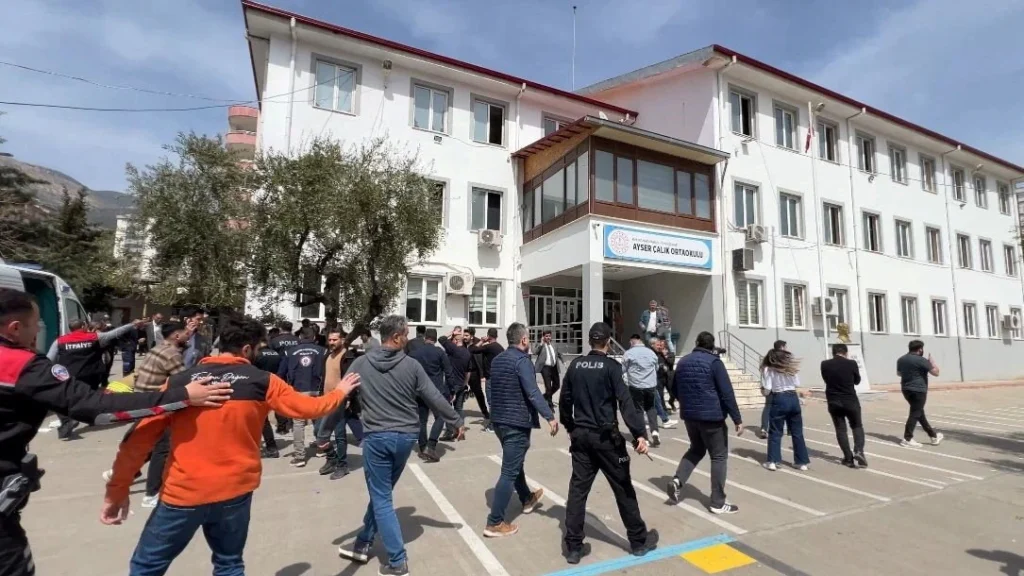
Scenes from the school showed a rapid emergency response, with ambulances arriving as police secured the area and anxious families gathered outside the gates. Footage aired by Turkish media captured the aftermath, while unverified videos circulating online appeared to show students leaping from upper-floor windows as gunfire echoed through the building. Separate surveillance images, also unverified, seemed to depict the attacker firing in a hallway.
The shooting comes just one day after another violent incident at a school in the southeastern province of Sanliurfa. In that case, a former student wounded at least 16 people, including students and teachers, before dying by suicide.
The back-to-back attacks have shaken a country where school shootings remain extremely uncommon. Turkey maintains relatively strict firearm regulations, requiring individuals to be at least 21 years old and licensed to own weapons. Despite these restrictions, firearms are present across the country, particularly among security personnel and former officers.
When pressed about potential policy changes following the two incidents, Ciftci said authorities would evaluate security measures but did not provide specifics. “Necessary steps will be taken,” he said.
The twin school shootings in Turkey represent a deeply unsettling departure from the country’s historical pattern, where such incidents have been rare compared with other parts of the world. The fact that both attacks occurred within 48 hours is likely to intensify scrutiny of school safety protocols, firearm access, and mental health support systems for young people.
One of the most striking elements in the Kahramanmaras attack is the reported access to multiple firearms, allegedly linked to a former police officer. This raises broader questions about how weapons are stored and monitored within households connected to law enforcement. Even in countries with relatively strict gun laws, loopholes or lapses in storage practices can create opportunities for unauthorized access, particularly by minors.
The targeting of younger students also adds a disturbing dimension. Attacks involving elementary or middle school populations tend to generate heightened public fear because they strike at environments widely considered safe. In Turkey, where schools have not historically been focal points of gun violence, the psychological impact may be especially profound.
The government’s early emphasis that the attack was not terrorism appears aimed at preventing broader public panic or political escalation. However, the classification of the incident as a “personal act” does not diminish its severity or the systemic questions it raises. Authorities may face increasing pressure to address underlying factors such as bullying, social isolation, or mental health challenges that can contribute to youth violence.
The second shooting in Sanliurfa further complicates the national response. While details differ, the proximity of the two incidents could lead to concerns about copycat behavior, a phenomenon observed in other countries following high-profile attacks. This possibility may influence how Turkish officials and media outlets handle information dissemination in the coming days.
Another critical issue is emergency preparedness within schools. Reports of students jumping from windows to escape gunfire suggest that evacuation procedures and physical safety measures may require reassessment. Investments in secure entry points, communication systems, and staff training could become central to policy discussions.
Internationally, the events may draw comparisons with countries that have grappled with repeated school shootings, prompting debate about whether Turkey is witnessing an isolated anomaly or the early signs of a broader trend. The answer will likely depend on how authorities respond in the immediate aftermath and whether preventive measures are strengthened.
For now, the focus remains on the victims and their families, as well as the recovery of those injured. Yet the broader implications of the attacks—ranging from firearm oversight to youth mental health—are expected to shape public discourse in Turkey in the weeks ahead.
NBC/Reuters





