

The United States imposed 50 percent tariffs on a range of Canadian goods just after midnight Saturday after last-minute negotiations between the two countries broke down, with each side blaming the other for the failure.
Canadian Prime Minister Mark Carney said Canada would retaliate dollar for dollar and announced he was suspending trade negotiations, directing Canada’s negotiating team to return to Ottawa. “Last-minute changes in the U.S. proposed terms were unfair, uneconomic, and called into question the reliability of any deal,” Carney said in a statement, adding that Canadian negotiators had worked in good faith throughout the talks up until the very end.
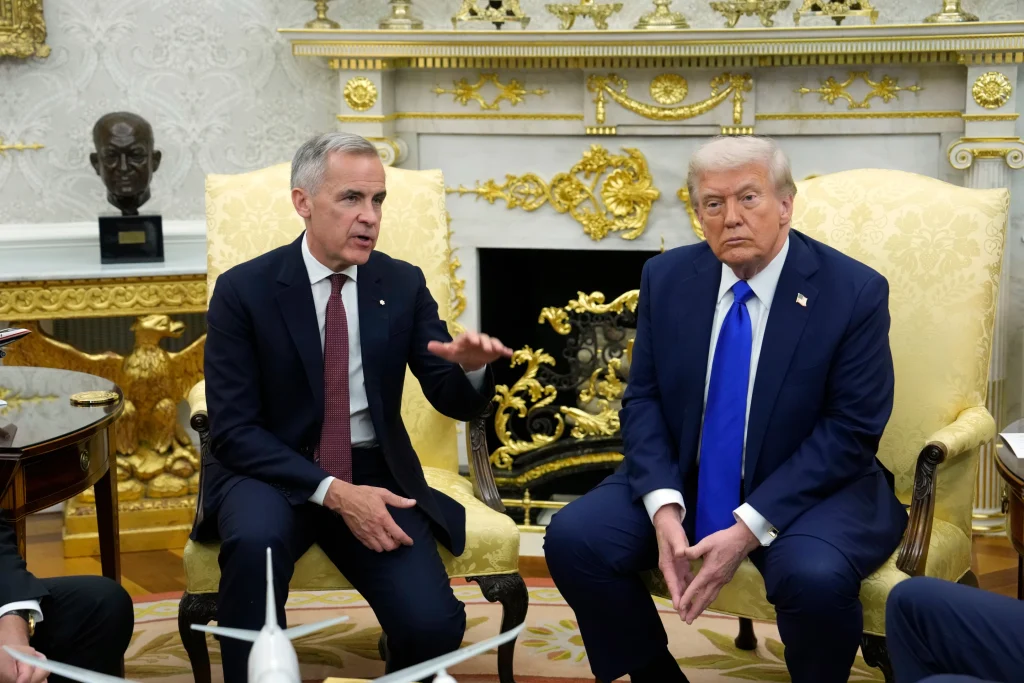
U.S. Trade Representative Jamieson Greer placed responsibility on Canada, saying the country declined to finalize a deal under terms both sides had agreed to earlier in the week. “New demands and walk-backs of other commitments by Canada have upended the careful balance reached in the past days,” Greer said, adding that Canada was continuing to maintain what he called prolonged retaliation against the United States, including outright prohibitions on some American goods and services.
What We Know So Far
Reports differed on the total value of Canadian goods affected by the new tariffs. Some accounts put the figure at 20 billion dollars, or just over 5 percent of Canada’s total exports to the United States, while one Canadian outlet reported the tariffs would apply to hundreds of products worth more than 28 billion dollars. That discrepancy in the total value affected had not been resolved across the differing reports. The tariffs cover a wide range of goods, including hockey sticks, tongue depressors, plywood, cement and wine, and unlike many earlier tariffs, they do not qualify for exemption under the U.S.-Mexico-Canada trade agreement even for otherwise compliant products.
The tariffs were imposed under Section 338 of the 1930 Tariff Act, a Great Depression era provision commonly known as the Smoot-Hawley Act that had never previously been used to impose tariffs. The law allows the president to apply duties of up to 50 percent on countries found to be discriminating against U.S. businesses, with no investigation required to justify the levies and no limit on how long they can remain in place. Tariff rates under past trade disputes have typically been closer to 10 to 20 percent, making Saturday’s 50 percent rate notably steep by historical comparison.
Sources familiar with the talks said the two sides had appeared close to an agreement just hours before the deadline, one that would have lowered sectoral tariffs on Canadian steel, aluminum and autos in exchange for Canada easing provincial restrictions on American alcohol sales. A senior Trump administration official said the U.S. offer would have given Canada the best tariff treatment of any major exporter to the American market, but that Canada sought additional concessions, particularly on steel, aluminum, autos and softwood lumber, that the U.S. was unwilling to provide. Sources briefed on the talks said U.S. Commerce Secretary Howard Lutnick had expressed dissatisfaction with the proposed deal as of Thursday night.
Canadian Trade Minister Dominic LeBlanc met with Greer throughout the week in Washington in an effort to reach an agreement before the Friday night deadline, which itself represented a three-day extension from an original deadline of 12:01 a.m. Wednesday that Trump had granted to allow more time for talks.
Canada’s electronics sector is expected to be hit hardest by the new tariffs, with more than 4 billion dollars in electronic equipment exports affected, including certain circuit boards and controllers that represent Canada’s largest single export category among the targeted goods. Canada’s plastics industry, covering items such as bottles, floor coverings and household goods valued at about 3 billion dollars, is also significantly exposed. British Columbia is expected to be disproportionately affected given that wood and paper products subject to the new tariffs make up more than 13 percent of the province’s total exports to the U.S., the highest share of any province. Quebec faces exposure across roughly 10 percent of its exports, compounding existing 50 percent tariffs already in place on the province’s steel and aluminum industries.
What Authorities and Analysts Are Saying
Carney said his government would announce additional support for Canadian workers and businesses in the coming days, and emphasized that Canada’s goal throughout the negotiations had been securing the best possible agreement rather than accepting a deal at any price or under any deadline pressure. He said Canada recognizes that the United States has changed and that the two countries will not return to their previous relationship.
Candace Laing, president and CEO of the Canadian Chamber of Commerce, said the tariffs amount to a body blow to North American competitiveness, warning that a tariff of this size is not sustainable or viable for businesses on either side of the border.
Ryan Majerus, a trade attorney and former U.S. trade official, said Canada likely wanted more sector specific relief than the U.S. was willing to offer, or that Canada’s own concessions fell short of what Washington sought. He said both governments will face significant pressure to find a resolution in the coming days, though Canada’s retaliatory tariffs could make that harder to achieve.
Barry Appleton, a senior fellow at the Center for International Law at New York Law School, said both countries had publicly committed themselves to their positions in advance, Canada by warning it would retaliate if the tariffs landed, and the U.S. by declaring it would not tolerate retaliation, a dynamic he said effectively removed the option of quietly stepping back from escalation.
A senior Trump administration official, asked what could pull the two countries out of the standoff, said the situation is largely up to Canada, framing further escalation as Canada’s choice and suggesting Trump could be given options to respond in kind if Canada follows through on retaliatory tariffs.
Why This Matters
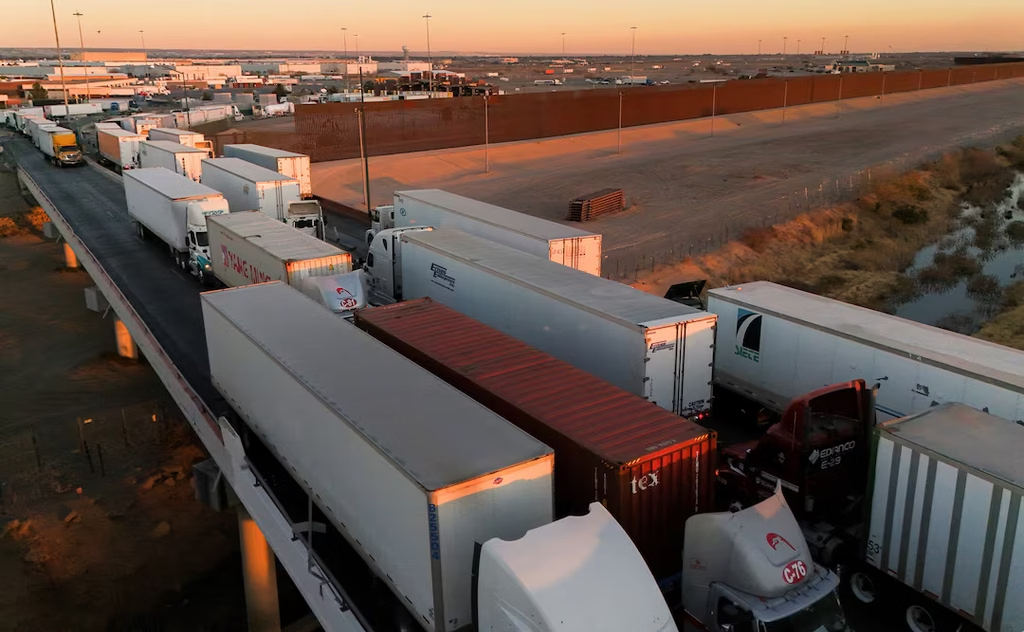
The breakdown marks a significant deterioration in a relationship long regarded as one of the world’s closest trading partnerships, with the two countries having exchanged 880 billion dollars in goods and services last year. Nearly 72 percent of Canada’s total goods exports go to the United States, underscoring how much more exposed Canada is to the dispute’s economic fallout than the U.S., even though the tariffs cover a relatively narrow slice of overall trade between the two countries.
The rift complicates the broader effort to renew the U.S.-Mexico-Canada trade agreement, since formal renegotiation talks have already begun with Mexico but had not yet started with Canada even before this breakdown, casting further doubt on when or whether those talks will proceed. The dispute also carries political risk for the Trump administration, since tariffs are typically paid by U.S. importers who often pass costs on to consumers through higher prices, a dynamic that could prove unpopular ahead of November’s midterm elections amid existing voter frustration over living costs.
Public sentiment in Canada has hardened considerably, reflected in a petition seeking the expulsion of U.S. Ambassador Pete Hoekstra that has collected nearly 248,000 signatures since July 21, accusing him of normalizing Trump’s past remarks about annexing Canada. Despite the depth of the current dispute, the two countries retain deep practical ties, including an undefended 5,525 mile shared border crossed daily by nearly 330,000 people and 2 billion dollars in goods, and roughly 800,000 Canadians living in the United States.
What Happens Next
No further talks are currently scheduled, according to a senior Trump administration official, leaving the immediate trajectory of the dispute uncertain. Carney has directed Canadian negotiators to return to Ottawa, and his government is expected to detail its dollar for dollar retaliatory measures along with additional support for affected Canadian workers and businesses in the coming days.
Given both sides’ public commitments to their positions, analysts including Appleton suggested the dispute may now escalate further before any de-escalation becomes politically viable for either government, complicating prospects for a near term resolution or the broader renewal of the North American trade agreement.
Reporting drawn from Reuters, the Associated Press and CBC News, citing Canadian Prime Minister Mark Carney, U.S. Trade Representative Jamieson





