

The United States has urged its citizens to reconsider travel to Nigeria and authorized the departure of non-emergency U.S. government employees and their families from the embassy in Abuja, citing worsening security conditions in Africa’s most populous nation that show no signs of improvement despite years of government counterinsurgency operations.
The embassy disclosed separately it had closed for visa appointments but American citizen services remained available in emergencies and by appointment. Officials did not provide a reason for the closure or specify how long it would last, though the timing alongside the expanded travel warning suggests security concerns motivated the suspension of routine consular services.
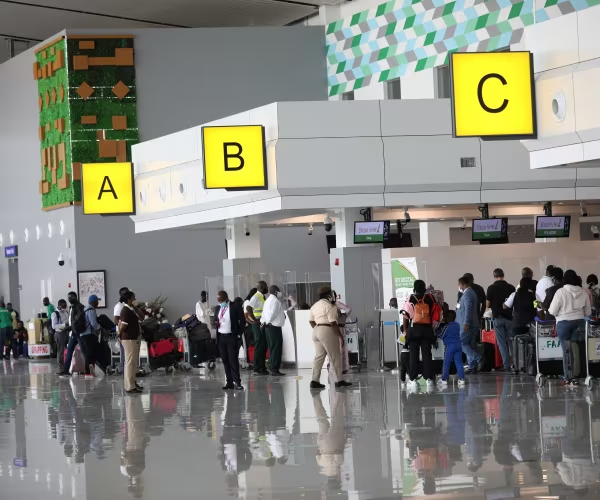
Reuters documented that U.S. travel advisories often shape how investors, international organizations, and airlines assess country risk. The move to allow staff departures signals heightened concern in Washington as kidnappings, banditry, and attacks on security forces persist, particularly in northern Nigeria where government authority remains tenuous across vast territories.
In an updated advisory released late Wednesday, the State Department maintained Nigeria at Level 3: Reconsider Travel, but added Plateau, Jigawa, Kwara, Niger, and Taraba to states Americans were warned not to visit. That expansion places 23 out of 36 of the country’s states in the “Do Not Travel” category—a staggering proportion suggesting that nearly two-thirds of Nigerian territory is considered too dangerous for American travelers.
The U.S. highlighted threats from extremist insurgents in the northeast, criminal gangs in the northwest, and ongoing violence in parts of southern and southeastern Nigeria, including oil-producing regions where kidnapping for ransom has become endemic. The geographic breadth of security threats illustrates how violence has metastasized across Nigeria rather than remaining contained in specific conflict zones.
Nigeria’s information ministry issued a statement characterizing the travel alert as guided by U.S. internal protocols that did not reflect the overall security situation across Nigeria. “While we acknowledge isolated security challenges in some areas, there is no general breakdown of law and order, and the vast majority of the country remains stable,” the statement declared, employing language minimizing the severity of threats that the U.S. government clearly views as serious and widespread.
The Nigerian government response reflected sensitivity about international perceptions of security deterioration and potential economic consequences from heightened travel warnings that could discourage foreign investment and tourism. However, the gap between official Nigerian assurances and American threat assessments suggests either fundamentally different risk tolerances or governmental reluctance to acknowledge the extent of security failures.
Last month, Washington warned of a “terrorist threat” against U.S. facilities and affiliated schools in Nigeria—alerts that preceded the current expanded travel warning and embassy staff departure authorization. The United States reviews the advisory several times annually and has maintained Nigeria at Level 3 or Level 4 for much of the past decade due to persistent insecurity that successive Nigerian governments have proven unable to eliminate.
The U.S. military operates multiple MQ-9 drones in Nigeria alongside 200 troops providing training and intelligence support to the Nigerian military, which is fighting extremist militants across the north. The American military presence reflects Washington’s concern about terrorism threats while illustrating the limited effectiveness of such assistance given continuing security deterioration.
According to Ripplesnigeria, the United States government directed non-essential personnel and their families to depart its embassy in Abuja, raising fresh concerns over Nigeria’s security landscape. In the revised travel advisory released Wednesday, the State Department confirmed the move takes effect from April 8, 2026, as part of precautionary measures in response to worsening security conditions across the country.
“On April 8, 2026, the Department of State authorized non-emergency U.S. government employees and U.S. government employee family members to leave U.S. Embassy Abuja due to the deteriorating security situation,” the advisory stated explicitly, employing language that signals serious concerns about potential threats to diplomatic personnel and their families.
The updated guidance places Nigeria under a “Level 3: Reconsider Travel” classification while identifying several states under the stricter “Level 4: Do Not Travel” category due to heightened risks that the State Department concluded make travel to those areas too dangerous for American citizens regardless of precautions.
“Reconsider travel to Nigeria due to crime, terrorism, unrest, kidnapping, and inconsistent availability of health care services. Some areas have increased risk,” the advisory added, cataloging multiple threat categories that collectively paint a picture of comprehensive insecurity affecting multiple dimensions of safety and wellbeing.
Five additional states—Plateau, Jigawa, Kwara, Niger, and Taraba—were newly included in the highest-risk category, bringing the total number of “Do Not Travel” states to 23. The expansion suggests security conditions have deteriorated in states previously considered relatively safe or that improved intelligence has revealed threats not previously recognized.
According to the advisory, northern states including Borno, Yobe, Kogi, and parts of Adamawa were flagged over terrorism and kidnapping threats, alongside others including Bauchi, Kaduna, Kano, Katsina, Sokoto, and Zamfara, where civil unrest and violent crime remain prevalent despite government claims of security improvements.
“The security situation in these states is unstable and uncertain due to civil unrest. Widespread violence between communities and armed crime, including kidnapping and roadside banditry,” the advisory specified, describing conditions where government security forces cannot guarantee traveler safety even on major roads during daylight hours.
“Security operations to counter these threats may occur without warning,” the advisory added, noting that Nigerian military and police operations themselves can create dangers for civilians caught in firefights or mistaken for militants during counterinsurgency sweeps.
In the southern and southeastern regions, the State Department listed Abia, Anambra, Bayelsa, Delta, Enugu, Imo, and Rivers states—excluding Port Harcourt—as areas to avoid due to rising cases of crime, kidnappings, and unrest. The inclusion of southern states in elevated threat categories contradicts narratives that violence remains primarily a northern Nigerian problem.
“Crime is widespread in Southern Nigeria. There is a high risk of kidnapping, violent protests, and armed gangs,” the advisory emphasized, documenting how insecurity has become nationwide phenomenon rather than regionally contained crisis.
The U.S. government also warned that violent crimes including armed robbery, carjacking, and ransom kidnappings are common, noting that American citizens are often targeted because they are perceived as wealthy—regardless of their actual financial circumstances. The targeting of foreigners reflects both opportunistic criminality and deliberate strategies by kidnapping gangs who understand that American victims generate international attention and potentially higher ransom payments.
The advisory further cautioned that terrorist threats persist nationwide, potentially affecting crowded locations including markets, hotels, places of worship, and public events. The assessment that terrorism risks exist across Nigeria rather than only in specific conflict zones reflects intelligence suggesting extremist groups maintain cells and operational capabilities far beyond their traditional strongholds.
In addition to security concerns, the advisory highlighted challenges within Nigeria’s healthcare system, describing medical services as inconsistent and below standards obtainable in the United States and Europe. The healthcare warning carries particular significance given that violent crime victims require immediate medical attention that may not be available, potentially turning survivable injuries into fatalities.
Despite the warnings, the State Department advised Americans who must travel to Nigeria to take precautionary measures, including enrolling in the Smart Traveler Enrollment Program for real-time updates, avoiding large gatherings, and establishing personal safety plans, including “proof of life” arrangements—protocols typically associated with war zones or failed states rather than functioning democracies.
The authorization for embassy staff to depart represents a significant escalation in American threat assessment beyond mere travel warnings for private citizens. Diplomatic personnel receive security protection and intelligence briefings unavailable to ordinary travelers, so the decision that even these protected individuals should be allowed to leave signals genuine concern about potential attacks on American government facilities or personnel.
For Nigeria, the expanded travel warning and embassy staff departure authorization carry significant reputational and economic costs. International businesses rely heavily on State Department travel advisories when making decisions about operations in foreign countries, and the designation of 23 states as too dangerous for travel will likely deter investment and complicate efforts to attract foreign expertise.
The aviation industry similarly uses American security assessments when evaluating routes and insurance costs, potentially leading to reduced flight service or higher ticket prices that further isolate Nigeria from global commerce. Tourism—already minimal given security concerns—will face additional obstacles as travelers who might have considered visits reconsider after seeing comprehensive warnings about violence, kidnapping, and inadequate healthcare.
For the approximately 300,000 Nigerian-Americans who maintain family ties to their country of origin, the travel warnings create difficult choices about whether to risk visits to relatives or remain abroad while family members face the very dangers that prompted American warnings. The personal toll of security deterioration extends beyond those directly victimized to diaspora populations navigating impossible decisions about family obligations versus personal safety.
As Nigeria approaches its next presidential election cycle, opposition politicians will likely cite the expanded American travel warnings as evidence of governing party failures to provide security despite campaign promises and massive defense budgets. Whether such political pressure will generate meaningful security reforms or merely produce defensive rhetoric remains uncertain given patterns of governmental responses to previous crises.
For now, the message from Washington is unmistakable: Nigeria’s security situation has deteriorated to the point that even American diplomatic personnel—typically committed to maintaining embassy operations regardless of local conditions—should be allowed to depart if they conclude remaining poses unacceptable risks to themselves and their families.
Reuters/Ripplenigeria





