

(Reuters/NYPost) — The United States carried out military strikes against Iranian military installations on Friday after Tehran allegedly launched a drone attack against a commercial cargo vessel sailing through the Strait of Hormuz, marking a significant escalation in tensions along one of the world’s busiest maritime trade routes.
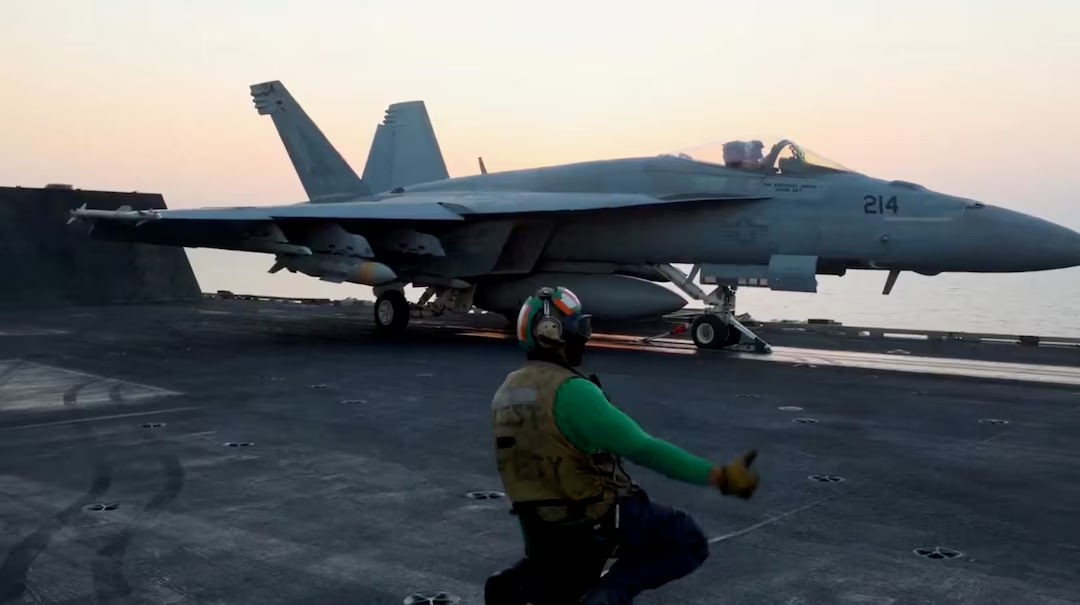
The United States Central Command announced that American aircraft struck Iranian missile and drone storage facilities as well as coastal radar installations in what officials described as a direct response to Thursday’s attack on the M V Ever Lovely, a Singapore flagged cargo ship operating in the strategic waterway.
In a statement, Central Command said the strikes were intended to deter further attacks against commercial shipping and reinforce freedom of navigation through the Strait of Hormuz, a corridor that carries a substantial share of global oil and liquefied natural gas exports.
“The unwarranted aggression against commercial shipping by Iranian forces clearly violated the ceasefire,” Central Command said. “Furthermore, Iran’s dangerous behavior undermined freedom of navigation as commerce increasingly flows through the vital international trade corridor.”
The military added that American forces remain deployed throughout the region to help safeguard commercial vessels transiting the strait and to ensure compliance with existing agreements intended to reduce hostilities.
“Central Command forces continue to provide safe passage coordination and support to commercial vessels transiting the strait,” the statement said. “The United States military remains present and vigilant to ensure all aspects of the agreement with Iran are adhered to and remain in full force.”
The operation represents one of the latest military exchanges between Washington and Tehran following months of heightened tensions across the Middle East. While U.S. officials described the strikes as limited and focused on military infrastructure, the action underscores the fragile security environment surrounding one of the world’s most strategically important maritime chokepoints.
The Strait of Hormuz serves as the primary gateway for crude oil exports from several Gulf producers, making any disruption a matter of global economic concern. Energy analysts have repeatedly warned that attacks targeting commercial vessels or military escalation in the area can quickly influence international oil prices, insurance premiums for shipping companies and freight costs across global supply chains.
Financial markets have closely monitored developments in the Gulf, with investors assessing the potential impact on energy supplies and inflation. Even short lived disruptions to shipping traffic through the strait can trigger volatility in crude oil markets, affecting fuel prices and transportation costs worldwide.
Maritime security experts also note that commercial shipping companies may be forced to increase security measures or reroute vessels if threats persist, adding to operational expenses for global trade. Such developments could place additional pressure on industries that depend heavily on uninterrupted energy supplies and efficient cargo transportation.
The latest military action is also likely to draw renewed attention from regional allies and international partners seeking to prevent a broader conflict. Diplomatic efforts aimed at preserving stability in the Gulf have intensified in recent months, with several governments urging restraint while emphasizing the importance of protecting international shipping lanes.
Defense analysts say both Washington and Tehran face strategic calculations following the latest exchange. While the United States has signaled its willingness to respond to attacks on commercial vessels, Iran may also weigh its next steps carefully to avoid triggering a wider regional confrontation that could further destabilize the Middle East.
The situation remains fluid, and additional military or diplomatic developments are expected as governments continue monitoring activity in the region. International shipping operators are also expected to maintain heightened vigilance while navigating the Strait of Hormuz, where security concerns remain elevated.
Why this matters
The latest military exchange highlights the continuing risks facing one of the world’s most critical energy corridors. Any prolonged instability in the Strait of Hormuz could affect global oil supplies, increase shipping costs and heighten geopolitical uncertainty at a time when international markets remain sensitive to supply disruptions.
What happens next
Military officials are expected to continue monitoring maritime traffic while regional governments assess the security situation. Market participants will also watch closely for any response from Iran that could influence energy markets, commercial shipping and diplomatic efforts aimed at preventing further escalation.





