Home Blog Page 133

Second U.S. Deportation Flight Sends 55 Iranians Home Amid Persecution Fears

0

MESA, Ariz. — A chartered aircraft carrying approximately 55 Iranian citizens departed from Arizona on Sunday bound for Tehran, marking only the second time in American history that the United States has organized a mass deportation flight to Iran, officials confirmed, intensifying concerns among advocates that deportees could face interrogation or worse upon arrival in the Islamic Republic.

The plane lifted off from Mesa airport carrying Iranians alongside deportees from Arab nations and Russia, according to two Iranian officials who spoke on condition of anonymity because they lacked authorization to discuss the matter publicly. The aircraft will make intermediate stops in Egypt and Kuwait before Iranian passengers complete the final leg to Tehran, the officials told the New York Times.

Mojtaba Shasti Karimi, director of consular services for Iran’s Foreign Ministry, confirmed Tehran expected to receive about 55 deportees in the coming days. Iran’s official judiciary news agency Mizan quoted Karimi as saying the individuals had expressed willingness to return home due to “continuation of anti-immigration and discriminative policy against foreign nationals particularly Iranians by the United States.”

Karimi claimed Tehran had received reports of “inhumane” treatment of Iranians held in Immigration and Customs Enforcement custody, characterizing their departure as voluntary responses to “racist and anti-immigration policies” of the U.S. government.

A U.S. official, speaking on condition of anonymity to discuss operational details, confirmed the flight departed Sunday but described it as a routine deportation operation that included nationals from multiple countries beyond Iran. The Department of Homeland Security declined to comment on the flight.

The deportation flight represents the second such operation since September, when the first planeload of Iranian deportees touched down in Tehran after months of negotiations between Washington and Tehran brokered through intermediaries. That inaugural flight carried 45 people, at least eight of whom reportedly resisted deportation and pleaded not to be sent to Iran because they feared for their safety, according to the Associated Press.

Two deportees from the September flight later recounted disturbing experiences, alleging they had been beaten by immigration officials in the United States and Qatar, then physically forced onto the aircraft. The United States and Qatar both denied allegations of violence against deportees or coercing them onto Iran-bound flights.

Upon landing in Tehran in October, deportees described being terrified as they underwent questioning at the airport and were required to complete forms explaining why they had fled Iran and sought asylum in America. Several deportees said they subsequently received summonses for interrogation by the intelligence wing of the Revolutionary Guards Corps, raising alarm among human rights advocates about the fate awaiting those returned to Iranian custody.

One Iranian official familiar with Sunday’s passenger manifest said those aboard had entered the United States through the southern border, spent months in detention facilities, and ultimately had their asylum requests denied. The identities of individual deportees and their specific circumstances, including whether they voluntarily accepted deportation or were compelled onto the plane, remained unclear as of Sunday evening.

Representative Yassamin Ansari, an Iranian-American Democrat from Arizona, issued warnings on social media as reports of the pending flight circulated over the weekend. Ansari cautioned that the aircraft could include “vulnerable individuals who could face persecution” if returned to Iran, according to the New York Times.

The deportations unfold against a backdrop of elevated tensions between Washington and Tehran following American airstrikes on Iranian nuclear facilities during Iran’s 12-day conflict with Israel in June. Activists abroad have voiced deep concern about returning deportees to a country where the theocratic government has intensified crackdowns on intellectuals and ramped up executions to rates unseen in decades.

The United States and Iran have maintained no diplomatic relations since the 1979 Islamic Revolution that toppled the Shah and established the current theocratic government. For more than four decades, the United States has provided refuge to Iranian dissidents, religious and ethnic minorities, LGBTQ community members, and others fleeing persecution in their homeland. This longstanding policy created a substantial Iranian-American community, particularly in states like California, that has maintained cultural ties while building new lives in America.

The Trump administration’s agreement with Tehran to coordinate deportation of an estimated 2,000 Iranian citizens facing removal orders marks a dramatic policy shift. Previously, the United States deported Iranians individually on commercial airlines rather than organizing dedicated charter flights, making the current operation unprecedented in scope and methodology.

The deportation program represents a collision between President Trump’s top priority of targeting illegal immigration and decades of U.S. practice welcoming Iranian exiles and dissidents. The administration has declared its intention to execute the largest deportation operation in American history, targeting undocumented immigrants and those who crossed the border illegally. Officials have also said they would drastically reduce asylum grants and limit them primarily to white migrants from South Africa or English-speaking Europeans.

Iranians are among citizens of 19 countries targeted in Trump’s travel ban. Their legal immigration pathways have been further restricted following new limits Trump announced after the fatal shooting of a National Guard member in Washington last month. The suspect in that incident is an Afghan immigrant, though the administration expanded restrictions beyond Afghanistan in response.

Iranian officials acknowledged in September that as many as 400 Iranians could be returned under Trump administration policy, suggesting Sunday’s flight represents merely one installment in a much larger deportation campaign. One Iranian official who has worked closely with American counterparts on the transfers explained that Arab and Russian nationals would disembark when the plane lands in Cairo, while Iranians would continue to Kuwait to transfer onto a chartered Kuwait Airways aircraft for the final segment to Tehran.

The mechanics of the deportation arrangement highlight the complex diplomatic gymnastics required when two nations lacking formal relations coordinate on sensitive matters. Switzerland has traditionally served as the protecting power representing U.S. interests in Iran, while Pakistan has performed similar functions for Iran in Washington, providing channels for communication on issues ranging from prisoner swaps to, now, deportation logistics.

Iran has maintained that only individuals facing criminal charges face prosecution upon return, insisting others can travel freely within the country. However, Tehran’s history of detaining Westerners and dual nationals with ties abroad to use as leverage in prisoner exchanges undermines official assurances about safety for returnees. U.S. federal prosecutors have accused Iran of hiring hitmen to target dissidents living in America, further amplifying concerns about what awaits deportees.

The treatment of September’s deportees, who reported being interrogated by Revolutionary Guards intelligence officers, suggests returned asylum seekers face heightened scrutiny regardless of whether they face specific criminal charges. For those who fled Iran citing political persecution, association with opposition movements, religious conversion, or LGBTQ identity, such interrogations could expose them to arrest, prosecution, or worse.

The deportation flights also raise troubling questions about due process and asylum adjudication. If deportees entered through the southern border and languished in detention for months before having asylum claims denied, did they receive adequate legal representation and fair hearings? Were country conditions in Iran properly evaluated, including the documented increase in executions and crackdowns on dissent? These procedural questions will likely fuel legal challenges and congressional scrutiny as the deportation program continues.

As the chartered plane made its way across the Atlantic on Sunday, the 55 Iranians aboard faced an uncertain future in a country many had risked everything to escape. Whether they truly volunteered to return home, as Iranian officials claim, or were coerced by indefinite detention and denied asylum claims remains a central question that will shape how history judges this extraordinary deportation program.

NewYorkTimes/AP
Kitchen Fire at Indian Nightclub Kills 25, Mostly Staff, as Safety Probe Launched

0

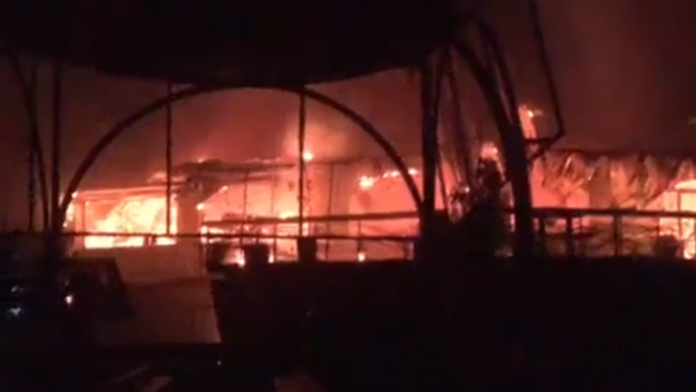
ARPORA, India — A fire that erupted in the kitchen of a packed nightclub near one of Goa’s most popular beaches killed 25 people early Sunday, with authorities confirming that 20 of the dead were staff members and raising urgent questions about fire safety enforcement at entertainment venues across India’s smallest state.

The blaze broke out around midnight Saturday at Birch by Romeo Lane, a nightclub in Arpora village in North Goa, a renowned party destination that draws millions of tourists annually to its coastal stretches along the Arabian Sea. Emergency crews worked through the night to extinguish the flames and recover bodies, completing operations by Sunday morning, according to Shri Alok Kumar, Goa’s Director General of Police.

“The fire was mainly concentrated around the kitchen area on the ground floor,” Kumar told the BBC, adding that the location of victims suggested most were employees working at the club. “Two bodies have been found on the staircase. The fire occurred around midnight. It has now been brought under control.”

The government of Goa confirmed that five domestic tourists died alongside the 20 staff members. Four of the tourists had traveled from Delhi, while the fifth came from Karnataka, the neighboring state that shares a border with Goa. Six additional people sustained injuries in the incident, though all were reported in stable condition and receiving medical treatment at nearby hospitals, officials said.

Videos circulating on social media platforms showed emergency services vehicles lined up outside the venue as paramedics rushed to assist the wounded. The scenes captured the chaotic aftermath as first responders transported victims to medical facilities across the coastal region.

Dr. Pramod Sawant, Goa’s chief minister, visited the fire site Sunday and immediately ordered a comprehensive inquiry into the tragedy. “I am deeply grieved and offer my heartfelt condolences to all the bereaved families in this hour of unimaginable loss,” Sawant said in a statement.

Speaking later after assessing the damage, Sawant outlined the scope of the investigation. “The inquiry will examine the exact cause of the fire and whether fire safety norms and building rules were followed,” he said, according to Skynews. “Those found responsible will face most stringent action under the law — any negligence will be dealt with firmly.”

Indian Prime Minister Narendra Modi described the incident as “deeply saddening” and said he had spoken directly with Goa’s chief minister to coordinate response efforts. Modi confirmed that “the state government is providing all possible assistance to those affected,” according to Reuters news agency.

The discovery of two bodies on the staircase suggests some victims attempted to flee the building but became trapped as smoke and flames spread from the ground floor kitchen. The concentration of fatalities among kitchen staff indicates the fire likely spread rapidly through cooking areas before employees could escape or alert patrons in other sections of the venue.

Goa’s unique status as India’s smallest state by area, combined with its outsized role in the country’s tourism economy, makes fire safety at hospitality and entertainment venues a particularly sensitive issue. The former Portuguese colony has transformed itself into a magnet for both international and domestic tourists drawn by its distinctive cultural blend, pristine beaches stretching along the Arabian Sea coast, and vibrant nightlife scene that operates year-round.

The tragedy at Birch by Romeo Lane raises troubling questions about enforcement of building codes and fire safety regulations across Goa’s hospitality sector. Rapid development to accommodate surging tourist numbers has sometimes outpaced regulatory oversight, with nightclubs, restaurants and hotels proliferating across beach communities like Arpora and nearby Baga, where this incident occurred, according to People.com citing the Indian Express.

Fire safety experts note that commercial kitchens pose particular hazards due to open flames, hot cooking oils, gas lines and electrical equipment all concentrated in confined spaces. Proper ventilation systems, fire suppression equipment, clearly marked emergency exits and regular safety drills are essential, yet enforcement remains inconsistent across India’s entertainment venues, particularly in rapidly developing tourist zones.

The high death toll among staff members also highlights vulnerabilities faced by hospitality workers, who often labor in back-of-house areas with limited emergency exits and may lack adequate safety training. Kitchen staff working late-night shifts during peak tourist season would have been preparing food and cleaning when the fire erupted, potentially trapping them in the very area where flames originated.

Sawant’s promise of “most stringent action” suggests authorities recognize the potential for systemic failures beyond this single venue. Whether the investigation reveals problems with building permits, inadequate fire suppression systems, blocked emergency exits, overcrowding or other violations will determine whether the tragedy prompts broader reforms across Goa’s entertainment industry.

The timing of the fire, occurring during the height of the winter tourist season when Goa welcomes visitors escaping colder climates across India and abroad, could have economic reverberations for a state heavily dependent on hospitality revenue. Tourist confidence in safety standards may suffer if the investigation uncovers widespread regulatory lapses.

As authorities continue their probe into what sparked the blaze and why so many people died, the incident serves as a grim reminder that rapid economic development and tourism growth must be matched by rigorous safety enforcement. The 25 lives lost represent not just a local tragedy but a potential inflection point for how India’s most tourism-dependent state balances growth with public safety in venues that pack hundreds of people into confined spaces night after night.

Rebels Seize Strategic Congo Town Hours After U.S.-Brokered Peace Deal Signed

0

Rebel forces captured the strategic town of Luvungi and pushed deeper into South Kivu Province through Saturday, defying a U.S.-mediated peace agreement signed just two days earlier between Congo and Rwanda that was supposed to halt the escalating violence in eastern Africa’s most volatile conflict zone.

The March 23 Movement, known as M23, mounted sustained attacks across multiple fronts from Tuesday through the weekend, seizing territory around Kaziba, Lubarika, Rurambo and Luvungi while battling toward the heights of Mount Munanira, military sources confirmed. The rebel advance threatens Uvira, South Kivu’s temporary administrative seat, raising alarm among Congolese authorities that the province could become a second major war theater after Bukavu, the provincial capital, fell to insurgents in February.

“The rebels launched several attacks on our positions and attempted to bypass our defensive arrangements along the Kaziba-Luvungi axis, but the army continues to repel these attempts. Fighting is still ongoing,” FARDC spokesperson Reagen Mbuyi said Thursday, speaking for the Armed Forces of the DRC. By Friday, however, local sources confirmed M23 had broken through toward the Ruzizi Plain and established control over corridors leading to Uvira from Luvungi.

The rebel breakthrough occurred even as Congolese and Rwandan officials put pen to paper Thursday in Washington on an agreement that DRC presidential spokesperson Tina Salama described as addressing three critical objectives: ending violence in the east, restoring Congo’s sovereignty and territorial integrity, and dismantling illicit mineral supply chains that bankroll the conflict. The stark disconnect between diplomatic assurances and battlefield realities has deepened skepticism about whether international mediation can contain a war that has displaced millions and destabilized the mineral-rich Great Lakes region.

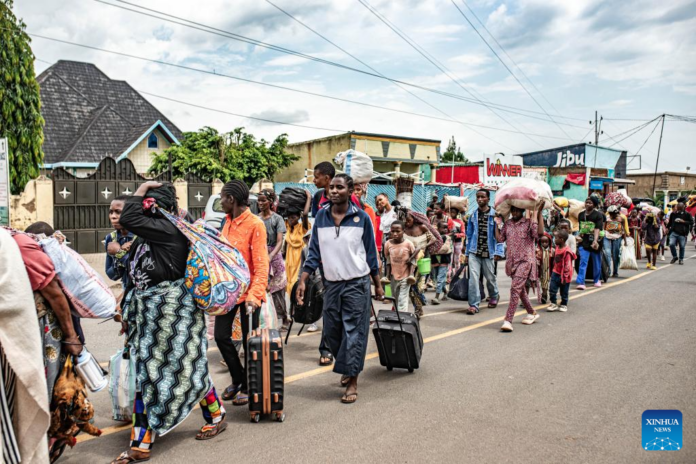
Congolese forces, fighting alongside Burundian troops and several local armed groups, have pulled back from contested areas, residents said. The retreat triggered a fresh wave of civilian displacement, with hundreds of families streaming into Uvira while others fled from Kamanyola, a strategic crossroads in the province, into Rwanda to escape artillery fire. Photographs distributed by Xinhua showed displaced children and families boarding buses bound for refugee camps in Bugarama, Rwanda, on December 5.

Uvira occupies a critical position on the transportation artery connecting Bukavu with Burundi and Tanzania. The town serves as a logistical hub for FARDC operations across the Ruzizi Plain, an area teeming with local and foreign armed factions. Loss of control over Uvira would sever supply lines and leave government forces vulnerable across a broad swath of South Kivu.

“If the rebels reach the outskirts of Uvira, the security impact would be considerable,” warned a Goma-based Congolese analyst who requested anonymity due to the sensitivity of the conflict. “South Kivu would effectively become a second epicenter of the conflict.”

The expansion of M23 operations into South Kivu represents a significant strategic shift. The group, which takes its name from a failed March 23, 2009 peace agreement, has long operated primarily in North Kivu Province. Its push southward suggests either a broadening of military objectives or increased confidence in its capacity to hold captured territory against government counteroffensives.

The violence unfolds against a backdrop of bitter diplomatic accusations between Kinshasa and Kigali. Congo has consistently accused Rwanda of providing military backing to M23, allegations that Kigali denies while countering that Congolese forces collaborate with the Democratic Forces for the Liberation of Rwanda, a group linked to the 1994 genocide against the Tutsi. These mutual recriminations have poisoned regional diplomacy for years, making sustainable peace agreements difficult to achieve or enforce.

The human toll continues to mount at catastrophic levels. United Nations figures show that more than 2.4 million people have been forcibly displaced since January 2025 alone, bringing the total number of internally displaced persons to nearly 6 million. An additional 1 million Congolese have sought refuge in neighboring countries, while 27 million people face severe food insecurity, according to Xinhua reporting originally published by English.news.

The humanitarian emergency reflects not just the immediate violence but the collapse of agricultural production, disruption of trade routes, and breakdown of basic services across eastern Congo. Displaced populations overwhelm host communities and strain resources in areas already struggling with poverty and weak infrastructure. The flow of refugees into Rwanda and other neighboring states creates additional regional tensions and complicates diplomatic efforts to resolve the underlying conflict.

The timing of the rebel advance, occurring virtually simultaneous with the Washington peace signing, raises uncomfortable questions about the sincerity of commitments made by the parties and whether external mediation can compel compliance from armed groups operating with apparent impunity in Congo’s eastern borderlands. The agreement’s third pillar, addressing illicit mineral supply chains, acknowledges the economic incentives driving the conflict. Eastern Congo’s vast deposits of coltan, gold, and other valuable minerals have long fueled armed groups, but enforcement mechanisms to cut off these revenue streams remain unclear.

Military analysts note that M23’s ability to sustain multi-front operations suggests access to steady supplies of weapons, ammunition, and logistical support that would be difficult to maintain without external backing. The group’s tactical sophistication and coordination across dispersed combat zones indicate command structures more elaborate than typical militia organizations.

As fighting continued into the weekend, the gap between diplomatic rhetoric and ground-level violence illustrated the immense challenge facing peacekeepers, humanitarian organizations, and regional governments attempting to stabilize eastern Congo. The displacement of civilians into Rwanda, ironically the country Congo accuses of sponsoring the rebels, underscores how desperate populations seek safety wherever they can find it, regardless of political complications.

Source: Xinhua/Africanews

Gunmen Kill 12, Including 3 Children, in South African Bar Massacre

0

Three gunmen stormed an unlicensed bar in a township hostel early Saturday, unleashing random gunfire that killed 12 people, among them a 3-year-old boy, authorities said, marking the latest mass casualty shooting to plague South Africa’s escalating violence crisis.

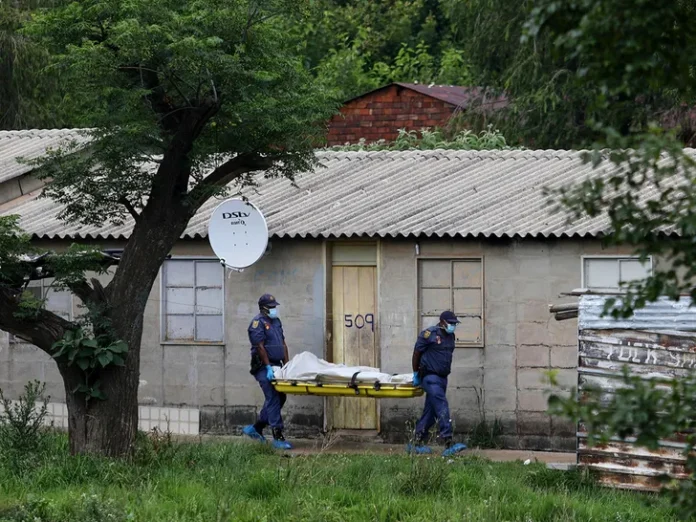
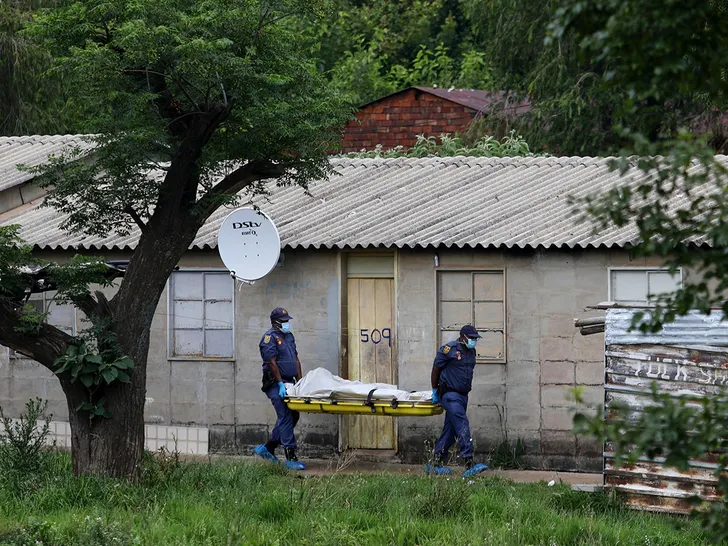
The attackers entered the establishment in Saulsville township, west of Pretoria, around 4:15 a.m. and began shooting indiscriminately at patrons, according to police spokesperson Brig. Athlenda Mathe, who spoke with national broadcaster SABC. Ten victims died where they fell. Two more succumbed to their injuries after reaching the hospital, bringing the confirmed death toll to 12 by Saturday evening.

The dead included three children: a 3-year-old boy, a 12-year-old boy, and a 16-year-old girl. Thirteen additional victims remained hospitalized with gunshot wounds, though authorities declined to release details about their ages or medical conditions.

Investigators have yet to determine what prompted the bloodshed. “We are told that at least three unknown gunmen entered this hostel where a group of people were drinking and they started randomly shooting,” Mathe said. Despite the shooting occurring before dawn, police received no notification until 6 a.m., raising questions about the two-hour delay in emergency response.

Law enforcement has launched a manhunt for three male suspects believed responsible for the attack.

The massacre underscores a deepening public safety emergency across South Africa, where violent crime has reached crisis levels despite strict firearms legislation. The nation of 62 million recorded more than 26,000 homicides in 2024 alone, translating to an average of more than 70 killings every single day. Firearms remain the predominant weapon in these deaths, with authorities acknowledging that illegal guns drive much of the violence despite stringent ownership laws.

Unlicensed drinking establishments have become particular flashpoints for mass violence. Between April and September of this year, police shut down more than 11,000 illegal taverns and arrested over 18,000 individuals connected to unlawful alcohol sales, according to Mathe. The crackdown reflects growing alarm over what she described as a serious and worsening problem.

Saturday’s attack follows a grim pattern. In 2022, gunmen killed 16 people at a bar in Soweto, Johannesburg’s sprawling township. That same day, four more died in a separate bar shooting in another province, highlighting the nationwide scope of tavern-related violence.

Yet the carnage extends beyond drinking establishments. Last September, 18 people, including 15 women, were killed in coordinated shootings at two houses on the same rural road in Eastern Cape province. Police arrested seven men in connection with those murders and recovered three AK-style assault rifles believed used in the attacks. Those suspects face multiple murder charges.

The Saulsville shooting reveals troubling vulnerabilities in communities where illegal businesses operate beyond regulatory oversight. Unlicensed bars frequently lack basic security measures, adequate lighting, or emergency protocols, creating environments where violence can erupt unchecked. The presence of three young children at the scene at 4 a.m. also raises questions about the circumstances that brought families into such settings during overnight hours.

Public health experts and criminologists point to South Africa’s staggering homicide rate as symptomatic of broader societal challenges, including persistent inequality, unemployment hovering near 33 percent, and fragmented law enforcement capacity across sprawling informal settlements. The proliferation of illegal firearms, often trafficked from neighboring states or stolen from legal owners, has overwhelmed police efforts to control gun violence despite laws requiring background checks, competency tests, and registration for lawful ownership.

As investigators piece together what happened inside the hostel bar, the community faces difficult questions about how to protect vulnerable populations, particularly children, in environments where violence has become disturbingly routine. The attack also intensifies pressure on authorities to accelerate efforts against illegal establishments that operate as magnets for criminal activity while existing beyond the reach of safety regulations.

Police have urged anyone with information about the three suspects to come forward as the investigation continues.

TMZ/ABCnews

Florida man arrested after ‘dirty bomb’ claim triggers shutdown

0

Authorities in central Florida say a routine traffic stop escalated into a major emergency response after a man claimed he had a “dirty bomb” in his truck, prompting road closures, a multi-agency investigation and the deployment of explosive experts before officials determined the device was a hoax, the Independent reports.

Police arrested Benjamin Johnson, 43, after the incident unfolded near a Publix supermarket in Davenport, where Haines City officers stopped his Chevrolet Silverado in connection with a reported crash. Officers said Johnson refused repeated commands to get out of the vehicle before he was forcibly removed. A search of the truck revealed firearms, ammunition, speed loaders, night-vision goggles, knives, thermal scopes, a battering ram, cannabis and THC-infused gummies.

The encounter intensified when Johnson, held in a patrol car, told officers there was a “dirty bomb” inside the truck. A yellow plastic container secured by chains and locks and marked with a radioactive warning label was discovered. Authorities immediately sealed off the area, shut down nearby roads and summoned the Bureau of Fire, Arson, and Explosives along with state hazardous-materials teams. A Florida State Fire investigator confirmed the container was giving off radioactivity, escalating concerns before the bomb squad arrived.

Investigators later determined the container held a Moisture Density Gauge, a soil-testing instrument that emits only low-level radiation and carries far less exposure than a medical X-ray. Officials said the device did not pose a threat to the public but was improperly handled and had triggered the emergency response because of Johnson’s bomb claim.

Johnson faces charges including hoax weapon of mass destruction, false bomb report, unlawful possession of a controlled substance and resisting officers without violence. Police said he previously faced a marijuana possession charge in Tennessee and told officers he had been living inside the truck with his dog. Animal Control took custody of the dog after the arrest.

Authorities said the yellow container was turned over to the Florida Bureau of Radioactive Materials for further analysis, and the weapons seized from the vehicle remain under investigation.

The Independent.com

Benin Government Declares Military Mutiny Thwarted After Soldiers Seize State Television to Announce Coup

0

A military uprising that culminated with soldiers commandeering state television to declare they had overthrown President Patrice Talon has been “foiled,” Benin’s interior minister announced Sunday in a video posted on Facebook, though the whereabouts of the president remained unclear and sporadic gunfire continued echoing through parts of the administrative capital as security forces worked to restore complete governmental control.

“In the early morning of Sunday, Dec. 7, 2025, a small group of soldiers launched a mutiny with the aim of destabilizing the state and its institutions,” Interior Minister Alassane Seidou stated in his video address to the nation. “Faced with this situation, the Beninese Armed Forces and their leadership, true to their oath, remained committed to the republic,” characterizing the incident as an isolated action by a limited faction rather than a widespread military rebellion.

Local media outlets reported the detention of 13 soldiers who participated in the coup attempt earlier on Sunday, citing sources with connections to the presidency. However, it remains uncertain whether Lt. Col. Pascal Tigri, identified as the mutiny’s leader, has been apprehended by authorities. Gunfire was audible and soldiers were observed patrolling around certain locations throughout Cotonou, though the city has remained relatively calm since the coup announcement was broadcast, suggesting the attempted seizure of power failed to generate broader military or civilian support.

Earlier on Sunday, a group of soldiers appeared on Benin’s state television network to announce the dissolution of the government in an apparent coup d’état, the latest in a succession of military takeovers that have destabilized West Africa’s democratic institutions over recent years. The broadcast represented a dramatic moment as armed personnel interrupted normal programming to declare they had assumed control of the government.

According to the Associated Press, the group, which designated itself the Military Committee for Refoundation, announced the removal of the president and all state institutions from power. Tigri was appointed president of the military committee, the soldiers declared during their televised statement, attempting to establish legitimacy through formal organizational structure and leadership designation.

Following its independence from France in 1960, the West African nation witnessed multiple coups, particularly in the decades immediately following its liberation from colonial rule. Since 1991, the country has maintained political stability following the two-decade rule of Marxist-Leninist leader Mathieu Kérékou, whose eventual democratic transition established Benin as a model for peaceful governance in a region frequently plagued by political violence and unconstitutional transfers of power.

No official information about President Talon has emerged from government sources since gunshots were heard near the presidential residence. However, the signal to state television and public radio, which was temporarily interrupted during the coup announcement, has now been restored, suggesting authorities have regained control of broadcasting infrastructure that the mutineers briefly commandeered to amplify their message.

The regional bloc, the Economic Community of West African States (ECOWAS), condemned the coup attempt in a forcefully worded statement. “ECOWAS strongly condemns this unconstitutional move that represents a subversion of the will of the people of Benin. … ECOWAS will support the Government and the people in all forms necessary to defend the Constitution and the territorial integrity of Benin,” the bloc declared, positioning the organization firmly behind constitutional governance and signaling potential intervention if the mutiny succeeded.

Talon has held power since 2016 and is scheduled to step down next April following the presidential election, having reached the constitutional limit of two terms. His impending departure through constitutional processes makes the timing of the coup attempt particularly notable, as mutineers apparently sought to preempt the electoral succession rather than allow the scheduled transition.

Talon’s party selection, former Finance Minister Romuald Wadagni, is considered the favorite to win the upcoming election. Opposition candidate Renaud Agbodjo was rejected by the electoral commission on grounds that he did not secure sufficient sponsors, a controversial decision that opposition figures characterize as manipulation of the electoral process to benefit ruling party candidates.

In January, two associates of Talon were sentenced to 20 years in prison for an alleged 2024 coup plot, demonstrating that Sunday’s mutiny represents at least the second significant threat to the government within the past year. The earlier conspiracy suggests underlying political tensions and dissatisfaction within certain military or political factions despite Benin’s reputation for relative stability.

Last month, the country’s legislature extended the presidential term of office from five to seven years while maintaining the term limit at two mandates. This constitutional modification generated controversy among opposition groups who viewed the change as potentially enabling future leaders to consolidate power for extended periods, though it does not affect Talon’s imminent departure given his existing term limits.

The coup attempt constitutes the latest in a succession of military takeovers that have destabilized West Africa. Last month, a military coup in Guinea-Bissau removed former President Umaro Embalo following a contested election in which both he and the opposition candidate declared themselves victorious, creating constitutional crisis that armed forces resolved through unconstitutional intervention.

Meanwhile, Punchng, citing AFP, revealed that military personnel in Benin on Sunday announced they had ousted President Patrice Talon, although his entourage insisted he was safe and the army was regaining control of the situation. The divergent narratives from mutineers claiming success and government officials asserting control reflected confusion during the critical hours when the outcome remained uncertain.

Soldiers identifying themselves as the “Military Committee for Refoundation” (CMR) stated on state television that they had convened and determined that “Mr Patrice Talon is removed from office as president of the republic,” employing formal language suggesting they viewed their action as legitimate governmental transition rather than illegal rebellion against constitutional authority.

The announcement follows two coups in Madagascar and Guinea-Bissau in as many months, demonstrating accelerating democratic backsliding across the African continent. Benin is bordered in the north by Niger and Burkina Faso, which have also experienced military takeovers in recent years, creating a geographic cluster of countries where armed forces have assumed power through unconstitutional means.

The French Embassy communicated via X that “gunfire was reported at Camp Guezo” situated near the president’s official residence in the economic capital. The embassy urged French citizens to remain indoors for security purposes, reflecting concern that violence could escalate or spread beyond immediate confrontation between loyalist forces and mutineers.

However, Talon’s entourage maintained that Talon, who has served as president of the West African nation for ten years and is scheduled to step down in April, remained safe and secure. “This is a small group of people who only control the television. The regular army is regaining control. The city and the country are completely secure,” his office told AFP, attempting to project confidence and minimize the threat posed by the mutineers.

Benin’s political history has been characterized by several coups and attempted coups, particularly during the post-independence decades when military intervention in politics represented common occurrence. The nation’s democratic stability since the early 1990s represented significant achievement in regional context, making Sunday’s events particularly concerning for those who viewed Benin as demonstrating that sustainable democratic governance was achievable in West Africa.

Talon, who assumed power in 2016, is scheduled to reach the conclusion of his second term in 2026, the maximum permitted by the constitution. His relatively brief remaining tenure raises questions about why mutineers acted now rather than awaiting the electoral transition that would occur naturally within months, unless they feared the electoral process would be manipulated or believed immediate action was necessary to prevent some perceived crisis.

The main opposition party has been excluded from the race to succeed him, with the ruling party instead competing for power against a so-called “moderate” opposition. This limitation of genuine opposition participation has generated criticism from democracy advocates who argue the electoral playing field has been tilted dramatically in favor of Talon’s preferred successor.

Talon, a 67-year-old former businessman nicknamed the “cotton king” of Cotonou, has received praise for bringing economic development to Benin but faces regular accusations from critics of authoritarian governance practices. His record combines economic modernization achievements with democratic backsliding concerns, creating mixed legacy as his presidency approaches its constitutional conclusion.

The attempted coup highlights persistent fragility of democratic institutions even in relatively stable West African nations. Despite Benin’s decades-long democratic track record since 1991, the willingness of military personnel to attempt unconstitutional power seizure demonstrates that armed forces remain potential threats to civilian governance when political grievances or personal ambitions motivate intervention.

Benin’s President Patrice Talon

ECOWAS’s swift condemnation reflects the regional organization’s growing concern about the proliferation of military coups across member states. The bloc has struggled to develop effective deterrence mechanisms, with sanctions and diplomatic isolation proving insufficient to prevent armed forces in multiple countries from overthrowing elected governments. The organization’s pledge to support Benin’s constitutional government “in all forms necessary” suggests potential willingness to consider more aggressive intervention if the situation deteriorates.

The restoration of state television and radio signals represents a critical indicator of governmental control, as access to mass communication platforms provides enormous advantage in shaping public perception during political crises. The mutineers’ brief commandeering of broadcast infrastructure allowed them to project legitimacy and attempt to generate momentum, but their inability to maintain control of these assets suggested lack of broader military support necessary for successful coup execution.

For Benin’s citizens, the hours of uncertainty created fear and disruption as gunfire echoed through normally peaceful neighborhoods and the fate of their government hung in balance. The relatively calm response from the population—with no reports of widespread protests either supporting or opposing the mutiny—may reflect exhaustion with political instability or uncertainty about which faction would ultimately prevail.

The international community’s response beyond ECOWAS will likely prove significant in determining whether additional punitive measures are imposed and whether the coup attempt generates diplomatic consequences for Benin. The African Union and Western governments typically condemn unconstitutional seizures of power, though enforcement mechanisms remain limited and inconsistent across different situations.

As details continue emerging about the coup attempt’s organization, motivation, and the identities of those involved, investigators will seek to determine whether the mutiny represented spontaneous grievance-driven action or carefully planned conspiracy potentially involving external support or coordination. The arrest of 13 soldiers suggests authorities are moving swiftly to identify and detain participants before they can escape or regroup.

The coming days will reveal whether Benin’s democratic institutions can withstand this challenge and proceed with the scheduled electoral transition in April, or whether the attempted coup represents a harbinger of deeper instability that could undermine the nation’s hard-won democratic achievements since the early 1990s.

AP/Punchng

Hegseth Defends Deadly Strikes on Alleged Cartel Boats, Says Trump Can Use Force ‘As He Sees Fit’

0

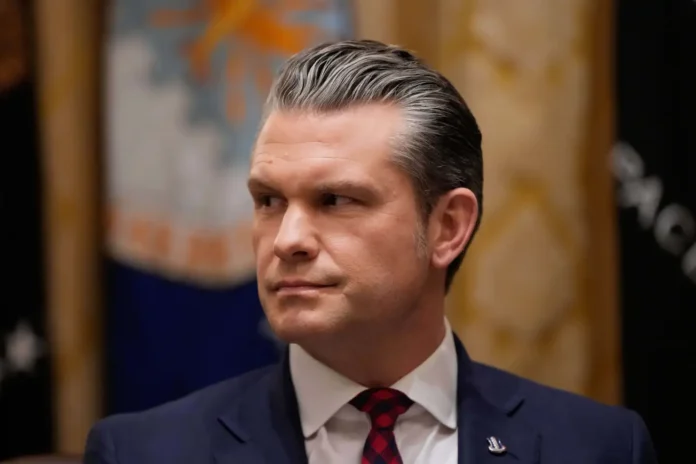
Defense Secretary Pete Hegseth on Saturday forcefully defended U.S. strikes on suspected cartel-operated vessels, insisting President Donald Trump holds full authority to order military force “as he sees fit” to protect the country, despite rising legal and political scrutiny over a lethal Caribbean attack that left survivors in the water.

Speaking at the Reagan National Defense Forum at the Ronald Reagan Presidential Library in California, Hegseth framed the maritime campaign as an extension of Trump’s post-9/11 approach to national security, arguing that alleged drug traffickers transporting narcotics by sea are no different from terrorists targeting Americans. The strikes, launched across the southern Caribbean and Pacific, have killed at least 87 people, including a Thursday attack in the eastern Pacific, according to U.S. officials.

“If you’re working for a designated terrorist organization and you bring drugs to this country in a boat, we will find you and we will sink you. Let there be no doubt about it,” Hegseth said. He added that Trump “can and will take decisive military action as he sees fit to defend our nation’s interests,” insisting that no foreign government should question America’s resolve.

Hegseth’s remarks come as lawmakers demand answers about a September 2 strike that destroyed a vessel in the Caribbean and led to a disputed second strike on survivors. A classified video shown this week to members of Congress depicted two shirtless, unarmed men clinging to wreckage with no visible communications gear. The scene fueled concerns that U.S. forces may have violated the Defense Department’s Law of War Manual, which prohibits firing on combatants who are incapacitated or shipwrecked and no longer resisting.

Reuters reported that Hegseth told the gathering he “fully supports” the September 2 decision to launch the follow-up strike and would have made the same call himself. Officials in Trump’s administration have said Hegseth did not directly order the second attack, asserting instead that Admiral Frank Bradley, then commanding Joint Special Operations Command, concluded the debris field had to be neutralized because it might still contain cocaine.

Hegseth repeated his account of the day, saying he witnessed the first strike before leaving for another meeting. He declined to say whether the administration would release the full video, calling the matter under review. The September attack was the first of 22 conducted under Trump’s directive to curb drug smuggling through maritime interdiction operations.

The Defense Department’s Law of War Manual explicitly describes attacks on shipwreck survivors as “clearly illegal” if they are no longer hostile or attempting to escape. The questions surrounding the September strike have intensified debate in Washington over the administration’s contention that cartel-linked drug runners constitute armed enemy groups that may be lawfully targeted in wartime.

During his address, Hegseth also championed Trump’s newly unveiled national security strategy, which casts European allies as weakened and calls for reasserting U.S. dominance across the Western Hemisphere. Hegseth argued that Trump is the “true and rightful heir” to Ronald Reagan’s foreign policy, distancing the administration from Republican leaders who supported prolonged wars and nation-building in the Middle East, efforts he described as misguided and ineffective.

Hegseth also reiterated Trump’s vow to resume U.S. nuclear testing to match China and Russia, a position that has alarmed nuclear arms experts given that both Beijing and Moscow have avoided explosive tests for decades. Russia has said it would follow Washington’s lead if the United States resumed testing.

Throughout the speech, Hegseth criticized what he called distractions within the national security establishment, including climate change, interventionism, undefined conflicts and “woke moralizing,” insisting the Pentagon must return to a hardened posture focused solely on direct threats.

The Trump administration has defended its maritime campaign as essential to stopping drugs that kill Americans, while critics warn the strikes may push the United States into legally uncharted territory. As Congress continues reviewing the September video and the broader rules governing the campaign, Hegseth stressed that neither the president nor the Pentagon intends to retreat.

“Let no country on earth doubt for a moment,” he said, “that America will strike decisively when its security is on the line.”

Reuters/AP

Messi Orchestrates Inter Miami’s Historic First MLS Cup Championship with Two Assists in Victory Over Vancouver

0

FORT LAUDERDALE, Fla. — Lionel Messi orchestrated Inter Miami’s ascent to its first MLS Cup championship Saturday, providing two decisive assists in a 3-1 victory over Vancouver Whitecaps that completed a remarkable transformation of a franchise that languished in last place when the Argentine legend arrived just two and a half years ago.

The triumph at a packed Chase Stadium delivered Messi the trophy that eluded him during his illustrious career—an American championship—while simultaneously marking the final professional appearances for Spanish legends Sergio Busquets and Jordi Alba, both of whom had announced their retirements following the season. The emotional resonance of watching Barcelona’s legendary midfield trio of Messi, Busquets, and Alba lift one final trophy together provided a poignant capstone to careers that revolutionized modern soccer.

The Associated Press stated that Messi’s legacy was long secured when he joined Inter Miami and Major League Soccer. He had already won a World Cup, collected dozens of trophies, and was generally considered the greatest player in the sport’s history. He didn’t need an MLS Cup. But he wanted one—and got it, extending his unprecedented trophy collection to 47 titles for club and country, a global men’s soccer record that may never be surpassed.

Inter Miami seized an early advantage when Vancouver’s Édier Ocampo inadvertently deflected a shot from Miami’s Tadeo Allende past his own goalkeeper Yohei Takaoka in the eighth minute. Despite the instant lead and some aggressive play that enabled Miami to maintain possession, the Whitecaps gradually assumed control throughout the remainder of the first half.

With captain and Bayern Munich legend Thomas Müller orchestrating attacks, the visitors demonstrated increasing confidence in the final third before halftime. Following the interval, Vancouver’s relentless pressure intensified further as head coach Jesper Sørensen pushed his formation higher up the field, a tactical gambit that produced an equalizer from Ali Ahmed in the 60th minute.

Ahmed’s strike initially appeared routine for goalkeeper Rocco Ríos Novo to handle, but the ball took an unexpected late bounce that carried it beyond the keeper’s outstretched fingertips, knotting the match at 1-1 and igniting hopes among the underdog visitors that an upset might materialize. Those aspirations evaporated when the biggest star on the pitch seized control of proceedings.

Messi, cleverly dispossessing a Vancouver defender in the opposition’s half during the 71st minute, then threaded a dangerous pass through a tiny gap in a wall of defenders to fellow Argentine international Rodrigo De Paul, who was sprinting into space. According to ESPN, Messi stole the ball and made a pass through a virtually impossible angle, demonstrating the vision and technical precision that have defined his career. With only the goalkeeper to beat, De Paul slotted his shot with clinical efficiency into Vancouver’s net, restoring Miami’s lead and sending Chase Stadium into delirium.

The Associated Press further stated that as the final minutes elapsed, Inter Miami’s pink-clad supporters—most wearing Messi’s No. 10 on their backs—stood and stomped and cheered, celebrating a championship that transformed South Florida’s sports landscape. The region has witnessed NFL, NBA, Major League Baseball, and NHL titles previously. It’s a soccer town now, too, and Messi made that happen.

Chants of “Messi! Messi!” reverberated throughout the stadium as the crowd sensed victory was assured. Vancouver, desperate to at least force extra time, maintained its attacking pressure during the dying minutes but found no reward for its efforts. ESPN quoting the Associated Press stated that instead, it was Messi—again—who delivered the knockout blow.

Compounding the visitors’ misery, Messi provided an assist for Allende in the 96th minute to make it 3-1, cementing Miami’s first MLS Cup title and sparking wild celebrations throughout Chase Stadium. First-year coach Javier Mascherano, himself a former Barcelona teammate of Messi, Busquets, and Alba, led the jubilant scenes as confetti rained down and fireworks illuminated the South Florida sky.

The final whistle sounded following a final touch by Busquets, with the legendary midfielder joining Alba in retiring as champions after Saturday’s triumph. Both players had followed Messi to Miami, reuniting the core of Barcelona’s dominant midfield that revolutionized possession-based soccer during their Catalonian glory years.

“They said soccer would never make it in America,” MLS Commissioner Don Garber proclaimed during the trophy ceremony, addressing the passionate crowd. “Inter Miami fans, has soccer made it?” The roaring affirmative response confirmed what two and a half years of Messi’s presence has accomplished—transforming Miami into a legitimate soccer stronghold within the American sports landscape.

Inter Miami became the 16th franchise in the league’s 30-year history to capture an MLS title. The victory extends a remarkable run of parity for MLS, which has witnessed five different franchises win championships in the past five years and eight franchises claim titles in the past nine seasons—only Columbus has achieved multiple victories in that span, highlighting the competitive balance that distinguishes American soccer from European leagues dominated by wealthy superclubs.

The championship represents the culmination of a 12-year journey for David Beckham, part of Inter Miami’s ownership group. He retired as a player in 2013, with his MLS contract stipulating he could establish a franchise at a discounted rate when his playing career concluded. Beckham selected Miami for his project, but actualizing that vision required years of complex negotiations; the franchise wasn’t formally established until January 2018, after he partnered with Miami businessmen Jorge Mas and Jose Mas, and even then the organization lacked a permanent stadium solution.

The team commenced play in 2020, and Messi arrived halfway through the 2023 season when Inter Miami occupied last place in MLS standings. The transformation from league basement to championship contender within two years represents one of the most dramatic turnarounds in professional sports history. “It’s been an incredible journey,” Beckham reflected, his voice carrying the emotion of watching his ambitious vision finally reach fruition.

The trophy represents Messi’s 47th for club and country—some argue it’s actually 48 because MLS awards trophies for winning conference titles as well—extending his unprecedented global record. He has now secured at least 21 titles in one-match final situations, many alongside the core of this team: Busquets, Alba, Luis Suarez, and Mascherano, his longtime Barcelona teammates who followed him across the Atlantic.

Suarez’s future remains uncertain following the championship, while Mascherano transitions from teammate to coach, having transformed Inter Miami’s lineup and tactical approach midway through the season—his first leading the club—with precisely this moment in mind. His willingness to implement significant changes during a championship campaign demonstrated courage that ultimately paid spectacular dividends.

The 38-year-old Messi, the 2024 MLS MVP who appears positioned to capture the award again this season, continues performing at an extraordinary level in crucial moments despite his advancing age. His contract potentially extends his Miami tenure into his early 40s, suggesting more trophies may follow. When next season begins, the team will play in a new stadium near Miami International Airport with consecutive championships as the objective.

“He’s not just here to enjoy living in Miami,” Beckham explained, describing Messi’s competitive mindset. “His wife and the kids love Miami, but he’s come here to win, and that’s really what Leo is all about. He wants to win. He’s got that dedication, the loyalty that he shows to his teammates, to the city, to the club. Leo is a winner. It’s simple as that.”

The match narrative followed a dramatic arc. Inter Miami established a 1-0 lead on the own goal in the eighth minute before Vancouver equalized in the 60th on Ahmed’s score. Another Vancouver attempt struck both posts approximately two minutes later but miraculously stayed out, a moment that proved pivotal as Inter Miami reclaimed the lead permanently when Messi discovered De Paul with his signature through ball.

Shortly after the final whistle, Messi approached the Inter Miami supporters section and raised both hands skyward, acknowledging the passionate fans who had accompanied the team on this journey. It was a moment 2 1/2 years in the making, the realization of a dream that seemed improbable when the Argentine superstar first arrived in South Florida amid skepticism about whether aging European legends could still perform at elite levels in MLS.

The championship validates not only Messi’s individual brilliance but also the broader project Beckham envisioned when he selected Miami as the location for his MLS franchise. Critics questioned whether South Florida’s fragmented sports market could sustain professional soccer amid competition from established teams in other major leagues. Those doubts have been emphatically answered.

The Philip F. Anschutz Trophy represents Messi’s third championship with Inter Miami, following the Leagues Cup in 2023 and Supporters’ Shield in 2024, but the MLS Cup carries special significance as the league’s ultimate prize. While the Supporters’ Shield recognizes regular-season excellence, the MLS Cup determines the playoff champion through knockout competition, a format that creates dramatic tension and unpredictability.

For Vancouver, the defeat represents a missed opportunity to claim an upset victory that would have crowned an improbable playoff run. The Whitecaps competed admirably against a superior opponent, demonstrating tactical discipline and attacking ambition that nearly produced an equalizer when their shot rattled both posts. However, facing Messi in championship moments has proven futile for countless opponents throughout his career, and Vancouver learned that harsh lesson Saturday.

The retirement of Busquets and Alba closes a chapter in soccer history. The Spanish midfielders were instrumental in Barcelona’s golden era, winning multiple Champions League titles and domestic championships while establishing the possession-based “tiki-taka” style that influenced tactical approaches globally. Their decision to conclude their careers in Miami, reunited with Messi under South Florida sunshine, provided a fitting conclusion to playing days spent at soccer’s pinnacle.

As Messi lifted the trophy surrounded by teammates, with confetti swirling and fireworks exploding overhead, the scene captured the improbable reality that Inter Miami—a franchise that didn’t exist five years ago and finished last in MLS two years ago—now stands as champion of American soccer. The transformation testifies to what occurs when the world’s greatest player decides to dedicate his twilight years to elevating a league and legitimizing a sport in a nation where it has historically struggled for mainstream acceptance.

South Florida’s sports landscape has been permanently altered. Messi didn’t merely join Inter Miami; he transformed the franchise into a destination club, elevated MLS’s global profile, and demonstrated that elite European talent can thrive in American soccer when properly supported. The championship validates every decision made along this improbable journey, from Beckham’s persistence in establishing the franchise to Messi’s choice to conclude his career in Miami rather than returning to Barcelona or pursuing other European opportunities.

The celebration will continue throughout South Florida, but attention will eventually turn toward defending the title and sustaining the standard Messi has established. The new stadium awaiting next season promises enhanced revenue and improved matchday experience, while the championship pedigree should attract additional world-class talent seeking to compete alongside Messi during his remaining years. Inter Miami has emerged not merely as an MLS franchise but as a global soccer brand, an achievement that seemed impossible before Messi’s arrival but now appears inevitable in retrospect.

Credits: AP/ESPN/Sportstar

Trump Awarded FIFA’s First Peace Prize at World Cup Draw, Marking Unusual Break from Soccer Tradition

0

In an unexpected fusion of global politics and world football, President Donald Trump received the first-ever FIFA Peace Prize on Friday during the high-profile draw for the 2026 World Cup, a surprise departure from the organization’s long-held practice of avoiding overt political accolades.

The newly minted award, presented personally by FIFA President Gianni Infantino, added a sharply political tone to an event typically reserved for match pairings and celebrations of international sport. Infantino — a public admirer of Trump’s diplomatic efforts — had long signaled support for the U.S. president’s push for global recognition, even suggesting Trump merited a Nobel Peace Prize for attempting to negotiate a cease-fire in Gaza, according to reporting from the original news source.

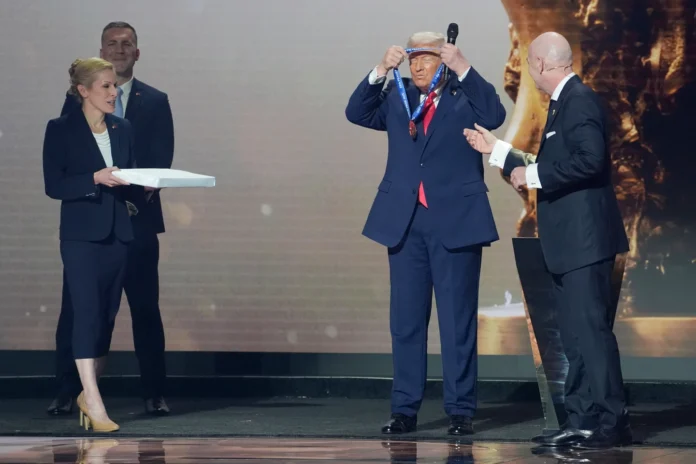
Infantino draped a gold medal around Trump’s neck, calling it “a beautiful medal for you that you can wear everywhere you want to go.” The formal certificate cited Trump’s actions to “promote peace and unity around the world.” He also received a custom gold trophy featuring hands lifting the globe.

“You definitely deserve the first FIFA Peace Prize for your action, for what you have obtained in your way,” Infantino declared, following a tribute montage showing Trump in meetings with officials from nations where he has claimed credit for reducing conflict.

Trump, who once openly campaigned for the Nobel, accepted the award with visible enthusiasm.

“This is truly one of the great honors of my life,” he said, thanking First Lady Melania Trump, his family and praising cooperation with World Cup co-hosts Canadian Prime Minister Mark Carney and Mexican President Claudia Sheinbaum, calling coordination among the three nations “outstanding.” He added, “The world is a safer place now.”

A Prize With No Public Criteria

FIFA has offered no explanation for how the inaugural peace prize was conceived or selected. Some federation officials were reportedly unaware of its creation until learning about it through media coverage. The original reporting notes that the honor appears to have emerged from Infantino’s own initiative rather than a formal committee process.

The award’s debut also coincides with Infantino’s unusually close relationship with Trump, which has included repeated visits to the Oval Office, VIP attendance at Trump’s presidential inauguration, and FIFA’s decision to establish an office in Trump Tower in Manhattan.

The ceremony followed Trump’s appearance the previous day at the newly renamed Donald J. Trump Institute of Peace in Washington, where he and the leaders of Rwanda and the Democratic Republic of Congo signed an agreement aimed at reducing violence in eastern Congo — an event Infantino also attended.

A Week of Diplomacy and Controversy

FIFA’s recognition comes as Trump’s administration is deeply involved in shuttle diplomacy over the war in Ukraine, even as it faces scrutiny for lethal operations targeting suspected drug-smuggling boats in the Caribbean and as Trump intensifies his rhetoric on immigration.

The award also arrives shortly after the Nobel Peace Prize was given to Venezuelan opposition figure Maria Corina Machado, who said she dedicated part of the honor to Trump for “his decisive support of our cause,” according to the original reporting.

A Prize That Raises Questions About FIFA’s Identity

FIFA’s decision to award a peace prize — and to present the inaugural honor to a sitting U.S. president — marks a significant shift for an organization long criticized for corruption, political entanglements and opaque governance.

The move highlights Infantino’s strategy of elevating FIFA as a diplomatic player, not merely a sports governing body. For Trump, the award functions as an international validation at a moment when his administration is juggling geopolitical negotiations and domestic political pressures.

Yet the lack of transparency around selection raises concerns within the sports world about the politicization of an institution that has traditionally insisted on neutrality. Analysts note that while sports diplomacy is powerful, FIFA risks eroding public trust if its awards appear tied to personal alliances rather than clear criteria.

The gesture also reflects a growing trend of global leaders using sporting events to amplify their political messaging — a strategic evolution of “sports diplomacy” that may redefine how major federations engage with world affairs.

Original Source: AP

Argentina, Messi to Begin World Cup Title Defense Against Algeria as U.S. Opens Versus Paraguay

0

Argentina’s path to defending its World Cup crown took shape Friday as Lionel Messi and the Albiceleste were paired with Algeria in their first match of next year’s expanded tournament, while the United States learned it will begin its campaign against Paraguay. The draw brought global attention to a stage filled with political leaders, former sports greats and the spectacle of FIFA’s largest tournament yet.

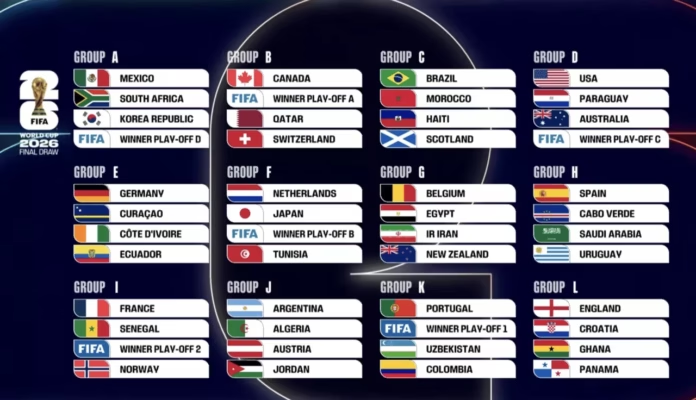
The ceremony, held at the Kennedy Center for the Performing Arts, confirmed matchups for the 48-nation, 104-game World Cup opening June 11 across the United States, Canada and Mexico. Argentina, a three-time champion, begins on June 16 with its Group J opener before eventually meeting Austria and Jordan. It will be Argentina’s first World Cup start since its shocking loss to Saudi Arabia in 2022 — a stumble that preceded its run to the title.

The U.S. men’s team, a semifinalist in the inaugural 1930 tournament and a quarterfinalist in 2002, launches Group D on June 12 in Inglewood, California, against Paraguay. The Americans will later meet Australia in Seattle and close group play back at SoFi Stadium against a playoff winner — either Turkey, Romania, Slovakia or Kosovo. U.S. coach Mauricio Pochettino said the familiarity among group opponents from recent friendlies means both sides enter with “a shared understanding” of each other’s styles.

Brazil, a five-time world champion, joined Morocco, Haiti and Scotland in Group C, while England — still chasing its first title since 1966 — drew Croatia, Ghana and Panama in Group L. Top-ranked Spain landed in a Group H that includes Cape Verde, Saudi Arabia and Uruguay, and four-time champion Germany will meet Curaçao, Ivory Coast and Ecuador in Group E.

Mexico will host the tournament’s opening match at Azteca Stadium on June 11, a Group A rematch of its 2010 opener against South Africa. Additional opponents include South Korea and a playoff qualifier from Europe. Forty-two teams have already secured berths; the remaining six will be decided in playoffs concluding on March 31.

Friday’s draw also included a surprise moment as FIFA President Gianni Infantino presented President Donald Trump with a gold-colored peace prize. Trump, along with Mexican President Claudia Sheinbaum and Canadian Prime Minister Mark Carney, participated in drawing their nations’ group placements. Sheinbaum’s selection drew noticeably louder applause from the audience.

Celebrities including Tom Brady, Shaquille O’Neal, Aaron Judge and Wayne Gretzky handled the bowl selections that finalized group compositions. U.S. midfielder Tyler Adams said from England that the production already “felt like an American event,” predicting a World Cup infused with halftime shows, star cameos and the entertainment-driven flair typical of U.S. sports culture.

France opens its campaign on June 16 against Senegal at either East Rutherford, New Jersey, or Foxborough, Massachusetts, renewing memories of its stunning 2002 opener when Senegal upset the defending champions. Les Bleus will later face Bolivia, Iraq or Suriname, and end the group against Norway in what many analysts already consider one of the tournament’s most competitive brackets.

Portugal’s Cristiano Ronaldo — expected, like Messi, to appear in a record sixth World Cup — will lead his nation through Group K against Uzbekistan, Colombia and a playoff qualifier among Congo, Jamaica or New Caledonia. If both Portugal and Argentina win their groups, the draw positions the long-time rivals for a quarterfinal showdown in Kansas City.

Snow fell outside the Kennedy Center as officials marked 189 days until the tournament’s opening whistle. Infantino, standing beside Trump as he offered him the FIFA award, praised the president before Trump described the honor as “one of the great moments of my life.”

The draw marks a turning point for FIFA’s largest and most commercially ambitious World Cup. The 48-team field, up from 32, brings unprecedented complexity to scheduling, travel and competitive balance. Analysts say powerhouse nations will face far more varied opponents — from emerging footballing programs such as Uzbekistan and Curaçao to traditional heavyweights — creating the possibility for more early-round surprises.

The expanded format also adds strategic pressure. With third-place teams eligible for the knockout stage, coaches may manage minutes and rotations differently across three group matches, particularly with a grueling tournament built across three countries and multiple climate zones.

For the U.S., hosting knockout-round games exclusively on domestic soil offers a rare advantage: reduced travel, familiar stadiums and likely large home crowds. For Argentina, the draw’s geographic uncertainty — with multiple venues still to be assigned — could influence how Messi and a veteran squad manage recovery and logistics.

Commercially, FIFA expects record viewership and revenue, building on the sport’s surging U.S. popularity, and Friday’s presentation — part political pageant, part entertainment showcase — signaled how heavily global football will lean into American-style production in 2026.