A man died Saturday after he entered a tiger enclosure at Yorkshire Wildlife Park and was attacked by the animal, South Yorkshire Police said, according to The Guardian.
Emergency services were called shortly after 1:30 p.m. He was pronounced dead at the scene, and police said his family has been informed. Officers said there is no wider risk to the public.
The park, near Doncaster, closed after what it called a “serious incident” and said it will stay shut until Sunday.
What We Know So Far
A police spokesperson said the tiger inflicted “serious injury” on the man. Paramedics and doctors tried to save him, but he died at the enclosure, police said.
Videos circulating online appear to show a man being pawed at and grappled by a tiger. Police urged people not to share the “distressing” footage on social media.
Police also addressed rumors about the animal’s condition. The tiger was uninjured and stayed in its enclosure after the incident, they said.
The Yorkshire ambulance service said it sent two ambulances, the Yorkshire air ambulance and a doctor to the scene.
Police have not released the man’s name or age, or said how he got into the enclosure. The park said it is working with authorities to find out exactly what happened.
What Authorities Are Saying
“The man’s family is aware and is being supported by specialist officers,” South Yorkshire Police said in a statement, adding that their thoughts are with the family at a distressing time.
The park said it activated its emergency response procedures right away. Its statement said the “safety and wellbeing of visitors, staff and animals remain our highest priority.”
Why This Matters
The park opened in 2009, and its Land of the Tigers attraction followed in 2011. The attraction sits on a purpose built two acre reserve for Amur tigers, an endangered subspecies with about 500 left in the wild, The Guardian reported.
Photos on the park’s website show a high walkway for visitors and fencing above the section where the tigers roam. How the man gained access despite those barriers is likely to become a central question for investigators and for the park’s licensing and safety reviewers.
Deaths from tiger attacks at zoos are rare in Britain, so the case is expected to draw scrutiny of enclosure design and visitor safeguards at wildlife attractions. The viral spread of video from the scene has also prompted the police appeal, adding an issue of respect for the man’s family.
What Happens Next
Police are expected to investigate the circumstances, and the park has said it will cooperate. It will not reopen before Sunday, and any further closure will depend on the inquiry. Officials have not said whether the tiger will face any restrictions or whether outside safety inspectors will review the enclosure.
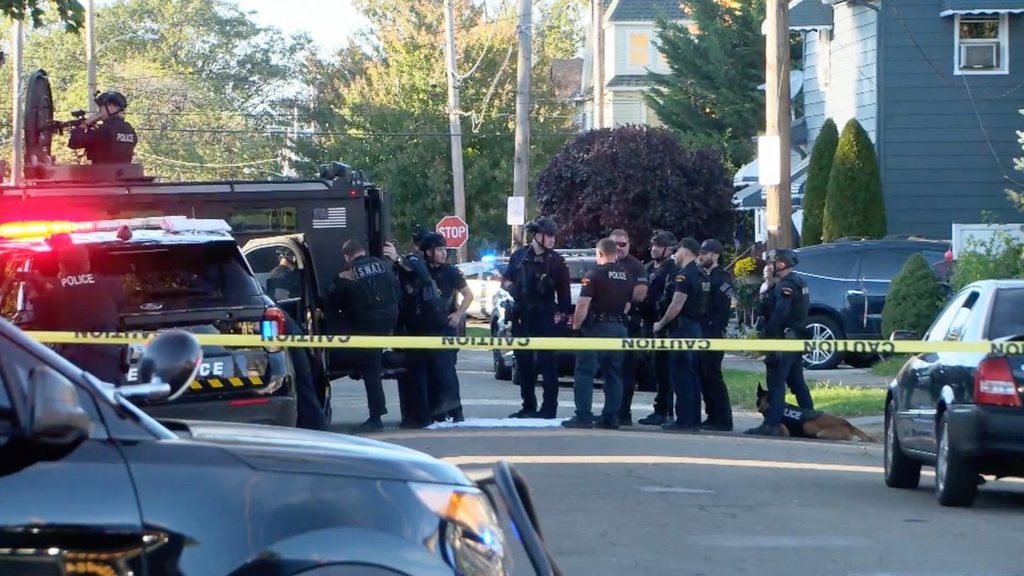
Nine people are dead after a shooting at a home in a residential neighborhood of Erie, Pennsylvania, on Friday, and the suspected gunman died by suicide, authorities said.
Two children and a pregnant woman were among the dead, police said, according to the Associated Press. The victims have not been publicly identified, and investigators have not established a motive.
Gov. Josh Shapiro called it a “tragic mass shooting” and said he offered the state’s full support to Erie Mayor Daria Devlin.
What We Know So Far
Police responded to 911 calls about a shooting at a residence on Perry Street, near 7th and Perry streets, the city said in a news release. People reported the calls came around 5 p.m. local time Friday, Oct. 9. Reuters described the shooting as occurring late Friday.
Officers arrived within minutes of an alert from ShotSpotter, a gunshot detection system that uses microphones and artificial intelligence, the AP reported. The city said all nine deaths occurred before officers arrived and that no further shots were fired after that. It said sounds heard during the police response that might have been mistaken for gunfire were flash bangs used in the tactical response.
Erie News Now and KBTX News 3, citing the Erie Police Department, reported that two women were found dead outside the home and several other victims were found inside. The outlets said the suspect entered the home after striking the two women, shot at several people inside, and then barricaded himself, setting off a standoff with SWAT teams.
Police Chief Rick Lorah said the suspect died from a self inflicted gunshot wound and that, based on current information, there is no ongoing threat to the public. Erie sits about 120 miles north of Pittsburgh.
What Authorities Are Saying
Lorah called the scene one of the most difficult and heartbreaking of his tenure. “The circumstances we are working through are deeply disturbing,” he said. He told a local station he had not seen anything like it in more than 28 years on the force.
He said investigators are working to establish the full circumstances and that “it’s going to take some time to put this all together.” Authorities said they were still working to determine a motive.
The city said in a Facebook statement that the situation was contained and offered condolences to victims and families. It said updates would follow once information is verified. A news conference was scheduled for Saturday afternoon.
Erie News Now photographer Chris Peterson, who witnessed part of the standoff, described chaos as people ran from the area.
Differing Accounts
The sources framed the death toll in different ways. The AP said nine people died, including the suspected shooter. Shapiro, as quoted by Reuters, described nine fellow Pennsylvanians killed, and People and the local outlets reported at least nine people shot dead, with the suspect’s death reported separately. Authorities had not clarified Saturday whether the nine includes the gunman.
The accounts of timing and sequence also differ. The local outlets described a standoff with SWAT officers and reported footage with gunfire and screams, while the city said all deaths occurred before officers arrived and that the sounds police response produced were flash bangs. Officials had not reconciled the two descriptions.
Why This Matters
A shooting that kills this many people, including two children, is rare for a city the size of Erie, and Lorah said he did not believe the city had seen such loss of life before. The case is likely to draw close attention to how early information was handled. The city issued its statement specifically to correct inaccurate information that circulated overnight.
The use of ShotSpotter in the response also puts a technology that has drawn criticism in other cities back in focus. Officers reached the scene within minutes of the alert, though the city said the deaths had already occurred.
What Happens Next
Police and city officials were expected to provide more details at Saturday’s news conference, including, they hope, victim identities once families are notified. Investigators will continue to work on a motive and a timeline of events, and the county medical examiner is expected to confirm causes of death. Lorah has said the process will take time.
Reporting drawn from Reuters, the Associated Press, People, Erie News Now and KBTX News 3
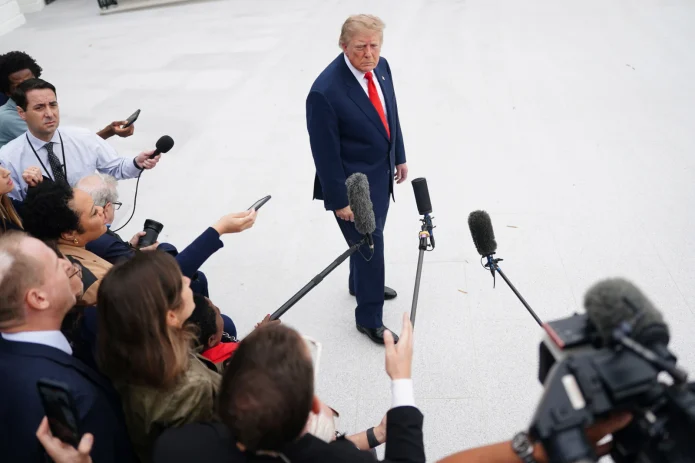
President Donald Trump said Saturday that Ukraine should choose a new leader, arguing Volodymyr Zelenskyy has not done enough to end the war with Russia and blaming him for high diesel prices in the United States, according to the Associated Press.
“I suggest they get a new leader who can make a deal because he could have made many deals,” Trump said, adding that Zelenskyy “for some reason” never does.
The comments came a day after Trump announced a deal with Russian President Vladimir Putin to buy Russian diesel, and hours after Russian strikes killed at least 20 people in Zaporizhzhia, Ukrainian officials said.
What We Know So Far
Trump spoke before leaving for Tennessee, where he was scheduled to rally Republican voters. He said Zelenskyy “wants to make problems for our farmers, our ranchers, with diesel fuel.”
Trump has pressed Zelenskyy for weeks to stop Ukrainian strikes on Russian energy infrastructure, which he says have pushed up global fuel prices. He has also pointed at Ukraine, rather than the U.S. led war in Iran, as a cause of record American diesel prices. Diesel costs have climbed on several fronts, including the difficulty of moving Middle East oil to market since the Iran war began.
Trump also said the war “would have never started” had he been president in 2022, calling it a product of “incompetence.” He said Zelenskyy has “lost 30% of your country” and that more than 2 million people have been killed.
Those figures differ from outside estimates. Independent assessments put the share of Ukrainian territory under Russian control at about 20%. British defense officials recently estimated that about half a million Russian soldiers have been killed, and there are no reliable recent estimates of Ukrainian deaths.
Trump announced Friday that Russia would immediately supply more than 300,000 tons of diesel, followed by 500,000 tons in November and 1 million tons “immediately thereafter.” Another 3 million tons would follow “within a short period of time,” he wrote.
Zaporizhzhia Strike Kills at Least 20
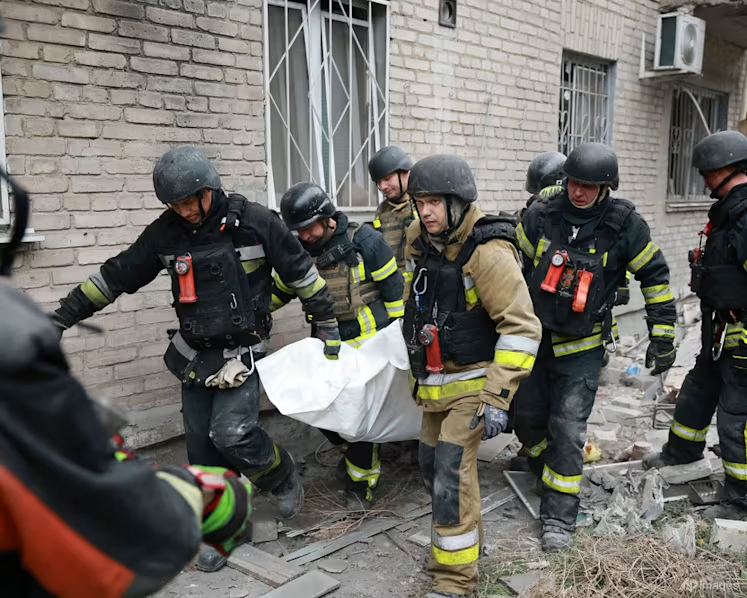
Russian aerial bombs hit residential buildings in the southern city of Zaporizhzhia on Saturday, killing at least 20 people, including three children, and wounding 18, Ukraine’s State Emergency Service said. Senior regional official Mykhailo Semikin said Russia struck several locations at once in the early hours.
Reuters reported that a 6 year old girl was among the dead after a strike reduced part of an apartment block to rubble. Her grandfather, Anatoliy Chumniy, sobbed over her body as rescuers lifted it from the wreckage. Her birthday “would have been at the end of the month,” he said.
Nataliia Malysheva, 49, whose parents died in a hospital after being pulled from the rubble, said that if Russia has money, “they’ll be able to carry on fighting us.”
Reuters also reported that a missile hit a restaurant in Kyiv on Saturday afternoon, wounding seven people, and that Russian drones flew over the capital throughout the day. Parts of Kyiv and the surrounding region lost power, halting the city’s metro for the second time this week. Russia’s Defense Ministry said its drones hit a data processing center in Kyiv and a cargo ship carrying military supplies to Odesa.
Anger in Kyiv, Doubt in Europe
Zelenskyy wrote on X that Russia had “expressed its thanks” for the lifted diesel sanctions by dropping five glide bombs on Zaporizhzhia homes. Each added billion dollars in Russian export income, he said, helps pay for weapons components, drone upgrades, missile production and mercenary recruitment. He said he spoke with French President Emmanuel Macron about strengthening air defenses and warned of more missile strikes in the coming days.
In Kyiv, people at a memorial on Independence Square reacted with anger and resignation. “Trump has once again shown his true face,” said Oleksandr Petrenko, 26. Financial adviser Oksana Yakunina said the deal “didn’t really come as a surprise.”
European governments said they would keep their sanctions in place. Swedish Prime Minister Ulf Kristersson said Stockholm regretted the deal because energy revenue is central to Russia’s war chest, and noted that the European Union would adopt its largest sanctions package yet on Monday, with 1,600 listings aimed at Russia’s military industrial complex. German government spokesperson Stefan Kornelius said Berlin remains committed to sanctions on Russia.
Polish Foreign Minister Radoslaw Sikorski questioned whether Russia could deliver at all, citing fuel shortages in Moscow and reports that Ukraine has damaged about half of Russia’s refining capacity. “So where will the surpluses for export come from?” he asked on X.
What Authorities Are Saying
A senior Ukrainian official, speaking to the AP on condition of anonymity, said Kyiv did not know of the diesel deal before Trump announced it and that it was unrelated to talks in Florida. Trump’s envoy Steve Witkoff and son in law Jared Kushner met Ukrainian officials in Miami on Friday on a proposal to end the war. The Ukrainian delegation has since left for home, presidential aide Dmytro Lytvyn said, according to Interfax Ukraine.
Putin said after a call with Trump that an immediate return to peace talks was unlikely, citing Ukrainian drone attacks on Moscow. Russia’s state news agency TASS, citing a source, reported that Witkoff and Kushner may visit Moscow within two weeks.
Russia’s installed governor in Luhansk said four civilians were killed and five wounded in Ukrainian attacks on the Russian controlled region. Reuters said it could not verify the report, and Ukraine did not immediately comment.
Differing Accounts
The sources gave different tolls for the week’s Russian strikes. The AP said bombardments have killed more than 60 people over the past four days. Reuters said nearly 80 civilians died in strikes on Wednesday and Thursday alone, including at least 30 in Kramatorsk and 22 in Pryluky.
Why This Matters
Calling publicly for another country’s president to be replaced is highly unusual for a sitting U.S. leader, and it lands as Washington and Kyiv try to agree on a path to end the war. It also follows the diesel deal, which cuts against a sweeping Russia sanctions law Trump signed last month to choke off Russian oil and gas revenue.
The domestic backdrop matters. An AP NORC poll published Oct. 1 found Americans disapprove of Trump’s handling of Iran and blame him for higher prices. Pointing to Zelenskyy as the cause of high diesel costs shifts attention from the Iran war just weeks before the midterm elections.
For Ukraine, the sequence has been punishing: a sanctions relief announcement, a mass casualty strike the next day, and a presidential call for new leadership. Kyiv has asked Washington to raise pressure on Moscow and has proposed a mutual halt to energy strikes while Russia pounds Ukraine’s power grid.
What Happens Next
The EU is set to adopt its new sanctions package Monday, setting up a contrast with Washington’s move. A possible Witkoff and Kushner trip to Moscow would show whether the U.S. peace effort is shifting toward the Kremlin. Whether Russia can actually deliver the promised diesel volumes, a point Sikorski raised, will determine how much the deal changes anything for American fuel prices or Russian revenue.
Reporting drawn from the Associated Press and Reuters
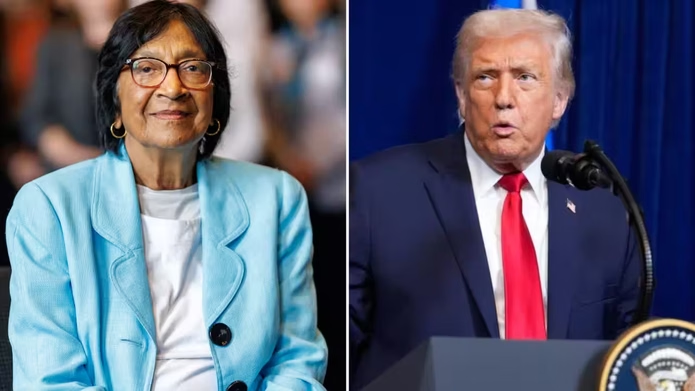
The Trump administration imposed sanctions Friday on the International Criminal Court itself, hours after former ICC judge Navi Pillay was named a winner of the Nobel Peace Prize, according to Reuters.
The ICC called the move “an assault on the rule of law” and urged its 125 member states to respond. Secretary of State Marco Rubio said President Donald Trump “will never allow” the court to prosecute Americans.
What the Sanctions Do
The Treasury Department set a six month grace period before the penalties take full effect, with exemptions for telecommunications, software, pensions and transactions involving detainees. The measure targets the court as an institution rather than only individual officials, as earlier U.S. actions did.
Court officials said they have spent months preparing for this step. They moved from Microsoft products to open source software and rearranged banking and health insurance arrangements for staff.
Deputy Prosecutor Nazhat Shameem Khan said the court’s work will continue.
Why Washington Targeted the Court
Rubio said experts have called for prosecuting Americans before the court, and that Trump will not permit it. ICC officials have said they have taken no steps toward such cases. The court’s Afghanistan investigation, which once touched on the conduct of U.S. forces, is now deprioritized, they said.
The ICC has issued more than 70 arrest warrants, including for Israeli Prime Minister Benjamin Netanyahu, Russian President Vladimir Putin, Sudan’s former leader Omar al-Bashir and Libya’s Moammar Gadhafi. Charges against Kenya’s William Ruto and Uhuru Kenyatta were withdrawn.
Allies Weigh a Response
EU foreign policy chief Kaja Kallas said the six month period “offers a window for dialogue.” Belgium called for an EU blocking statute to shield European institutions and companies from the sanctions’ reach.
The court’s members include every EU country and every NATO member except the United States and Turkey.
A Nobel for an International Justice Advocate
Pillay, a South African jurist who served as an ICC judge and later as the U.N. high commissioner for human rights, was honored by the Nobel committee, which said “judges and institutions of international law are under political attack.”
Trump Lashes Out at the Nobel Committee
At a rally in Syracuse, New York, for Republican gubernatorial nominee Bruce Blakeman, Trump attacked the Nobel Committee, calling its decision “an indelible stain on the country of Norway” and saying he “should have received the Nobel Peace Prize,” the Associated Press reported.
He described Pillay as “a liberal person who works at the United Nations who nobody has ever heard of.” He also attacked New York Attorney General Letitia James and repeated his claim that he “ended eight wars,” a figure the AP noted is disputed.
An AP-NORC poll published Oct. 1 found 71% of U.S. adults disapprove of his handling of Iran and 26% approve of his handling of the economy. Gov. Kathy Hochul’s campaign mocked the visit as “an extremely boring puppet show.”
Differing Accounts
Rubio’s statement that experts are urging prosecutions of Americans conflicts with ICC officials, who said the court has taken no steps toward such cases and has deprioritized its Afghanistan probe.
Why This Matters
Sanctioning a court as a whole, rather than individual officials, raises practical risks for any bank, software vendor or insurer that serves it. The exemptions and the six month window suggest Washington is leaving room for negotiation, a reading Kallas’s remarks support.
The timing also sharpened the political edge. The sanctions landed as the Nobel committee honored a former ICC judge, and Trump used a campaign stage to dispute the award. For European governments, the question is whether to treat the move as a bilateral dispute or a threat to a treaty based institution they helped build.
What Happens Next
The grace period gives the court and its members roughly six months to adjust or negotiate. Belgium’s push for an EU blocking statute will test whether the bloc can agree on a joint response. The ICC has said its work will go on, and further steps by Treasury could follow if talks stall.
Reporting drawn from Reuters and the Associated Press.
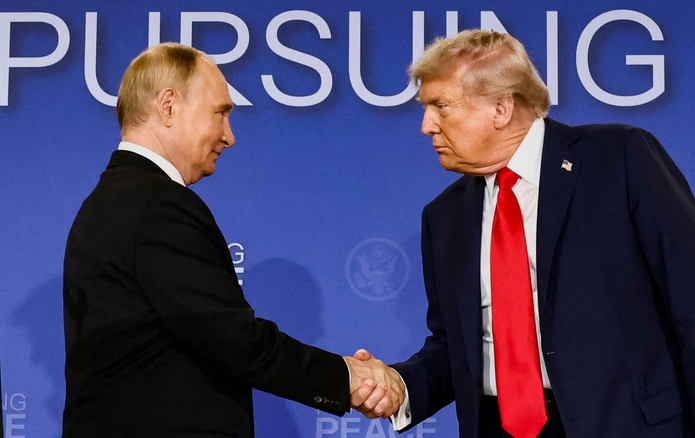
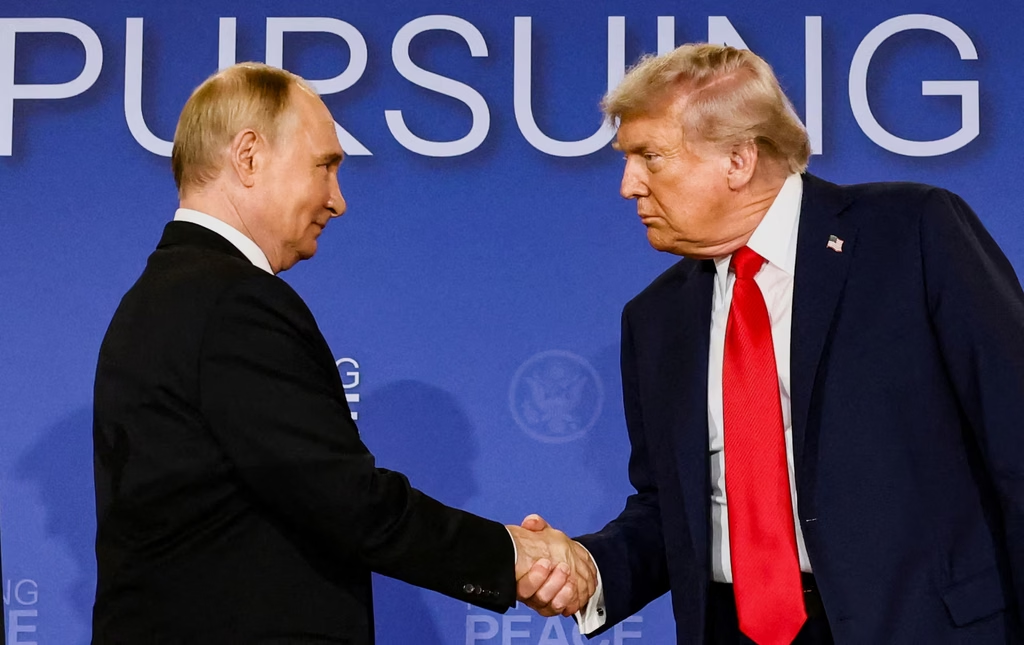
President Donald Trump said Friday he has struck a deal with Russian President Vladimir Putin to obtain Russian diesel, a stunning reversal of years of U.S. pressure on Moscow over its war in Ukraine and an effort to ease high fuel prices weeks before the midterm elections, the Associated Press reported.
Trump announced the agreement on social media after a phone call in which he had been expected to discuss a suspected case of plague in Russia. He said Russia will immediately supply more than 300,000 tons of diesel, followed by another 500,000 tons in November and 1 million tons “immediately thereafter,” with 3 million more tons to come “within a short period of time.” More would follow, he said, “based on the condition of their diesel refineries,” which Ukrainian attacks have damaged.
The announcement contrasts sharply with a sweeping Russia sanctions law Trump signed last month, which aims to choke off the oil and gas revenue that funds Moscow’s war. Shortly after Trump’s post, the Treasury Department said it was immediately issuing a temporary license easing sanctions on Russian diesel. It is the first such license since the Ukraine war began in February 2022 to run longer than the standard 30-day window, the AP noted, and it keeps U.S. sanctions from applying until April 2027 to diesel loaded onto tankers as of Friday.
What We Know So Far
The White House did not say who would pay for the diesel or when it would arrive. Trump did not address sanctions or the war in his post. “Lower prices for Americans, especially our Great Farmers, Ranchers, and Truckers, is my Greatest Priority,” he wrote. Leaving the White House for a campaign rally, he thanked Putin and said the country has “massive amounts of oil coming into our country, and it’s diesel, which is what we want.”
Trump’s announcement came as his envoy Steve Witkoff and son-in-law Jared Kushner were meeting Ukrainian officials in Miami about a proposal to end the war.
A Kremlin statement said the two leaders gave “significant attention” to resolving the Ukrainian crisis and also discussed Iran and bilateral ties. Putin said Russia “confirmed its readiness to supply oil and oil products to the American and global markets.” Kremlin aide Yuri Ushakov would not say whether Washington made concessions or what Moscow was promised. Deputy Prime Minister Alexander Novak told the state news agency Tass that Russia is lifting diesel export restrictions ahead of schedule and could begin supplies to the United States this month while keeping its domestic market fully supplied.
Reuters reported that Putin envoy Kirill Dmitriev asked U.S. officials during a Washington visit last month to grant export licenses to all major Russian oil companies, according to sources familiar with the situation. Russia has banned diesel exports since July because Ukrainian strikes on refineries have strained domestic supply, and the International Energy Agency says its diesel output has fallen about 30%.
Reaction
Ukrainian President Volodymyr Zelenskyy, in a statement released by his embassy in Washington, called the deal “a weak decision by strong partners.” He said he believed Ukraine’s team was being used as a smokescreen and argued that the deal allows Russia to prolong the war and will be repaid with more attacks.
Senate Democratic leader Chuck Schumer, Sen. Jeanne Shaheen and Sen. Elizabeth Warren called the announcement a betrayal of Ukraine, European allies and U.S. national security. “Enough is enough,” they wrote, urging Trump to end the Iran war instead of funding Russia’s war machine. Sen. Richard Blumenthal, a co-sponsor of the sanctions law, which is named for Sen. Lindsey Graham, said the agreement is contrary to Congress’s intent and makes the United States complicit in Putin’s war. Rep. Don Beyer, the senior House Democrat on the Joint Economic Committee, called the announcement “infuriating.”
Rep. Don Bacon, a Republican, said the sanctions should be used to squeeze Putin’s war machine and not to put “more money in his hands,” Reuters reported.
The law envisions sanctions on Russian officials, banks and a shadow fleet of tankers, bans new U.S. investment in Russia, and directs tariffs of up to 100% on the top five importers of Russian oil or gas, with exceptions for some countries. The AP said Trump’s move raises doubts about whether the White House will impose new sanctions. The United States has not imported Russian oil or gas since 2022, according to the Energy Information Administration.
Prices and Analysts
Diesel prices are near a record, with the national average at $6.28 a gallon, according to AAA, after a record $6.52 on Sept. 22. Reuters said prices are up 70% since the U.S.-Israeli war on Iran began Feb. 28, and that diesel futures fell almost 5% to $4.64 a gallon after the news. The 300,000 tons Trump cited equal roughly 2.25 million barrels, while the U.S. exports about 1.5 million barrels of diesel a day, Reuters noted.
Analysts were skeptical the deal would lower prices much. “What does this do to prices? I think probably not much,” said Clayton Seigle of the Center for Strategic and International Studies, who added that the arrangement is a great benefit to Russia, which is trying to move summer-grade diesel before winter. Jim Mitchell of Wood Mackenzie called it “clearly not a fix,” but another stream for a very tight market.
Separately, three industry sources told Reuters that Trump plans to direct department heads in the coming days to find ways to control diesel prices, possibly through a presidential memo that would push officials to bypass state and local rules blocking energy production and use the Defense Production Act to boost output. Trump has also pressed allies to release emergency reserves and widened access to tax-exempt red-dyed diesel, steps that have not yet brought prices down.
Differing Accounts
The Kremlin’s description of the call does not mirror Trump’s. Trump framed it as a deal for Russia to supply diesel to the U.S. and global markets, while the Kremlin spoke of readiness to supply oil and products to American and global markets and did not say what, if anything, was exchanged. The two outlets also described the Treasury license differently, with the AP calling it a license for Russian diesel to be supplied to the global market and Reuters describing it as allowing importation of Russian diesel until April 7. Zelenskyy’s remark was rendered as “a weak decision by strong partners” by the AP and “a weak decision on the part of strong partners” by Reuters.
Why This Matters
Diesel prices, a key driver of inflation, are a political risk for Republicans ahead of the Nov. 3 elections that will decide control of Congress, and the war in Iran and the war in Ukraine have tightened global supply. The deal sets the administration’s effort to lower prices against the sanctions regime Congress passed overwhelmingly and Trump signed only last month.
What Happens Next
The White House has not said when Russian diesel could reach the United States, and Moscow said supplies could begin this month. The Treasury license runs into April, and Trump is expected to issue his diesel-price directive in the coming days.
Reporting drawn from the Associated Press and Reuters
Three people were killed in attacks on two Saudi airports claimed by Yemen’s Houthi rebels, deepening the kingdom’s entanglement in the latest front of the Iran war, as Israeli settlers opened fire on Palestinian olive harvesters in the occupied West Bank, the Associated Press reported.
Saudi Arabia’s General Authority for Civil Aviation said the attack on Abha airport killed two residents, a Moroccan and an Algerian, and wounded 28 other people, while the strike on King Khalid International Airport in Riyadh killed a Sudanese national and wounded eight. The Saudi statement did not name who was responsible, but the Houthis took credit for both strikes earlier.
Yemen’s War Spills Further Into Saudi Arabia
Houthi military spokesperson Yahya Saree said the group targeted the Riyadh airport with several drones. The Saudi-led coalition’s spokesperson, Maj. Gen. Turki al-Malki, said forces intercepted a ballistic missile north of the capital and destroyed a platform in Sanaa used to launch attacks on Riyadh. The AP said it could not independently verify those claims.
The Houthis also said they fired a missile at the port city of Aden, seat of Yemen’s internationally recognized government. Reuters, citing Yemen’s Transport Ministry, said the group hit Aden’s international airport with ballistic missiles and explosive-laden drones, with one missile landing near the runway minutes before a flight from Cairo was due to land.
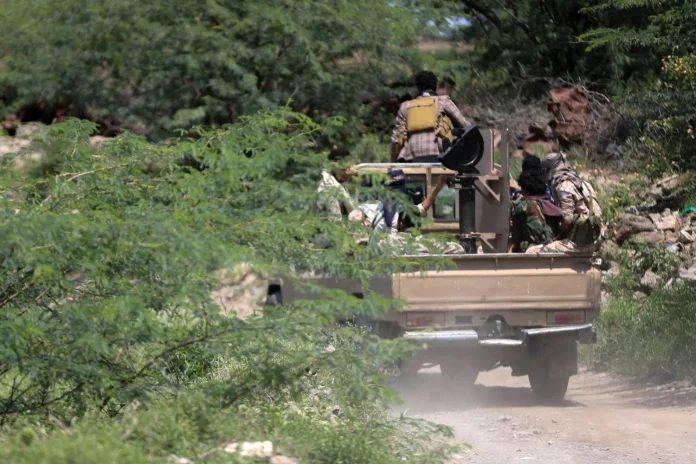
Yemeni government forces, backed by Saudi-led coalition air support, launched a counteroffensive this week to retake strategic ground near the Bab el-Mandeb Strait and around Mocha, which the Houthis seized in September, Reuters said. It remains unclear whether the advance will hold. The government said Monday that it had reached Mocha, but Yemeni military officials and analysts said the claim was premature. Fighting on the western front is concentrated in the Dhubab district overlooking the strait, where pro-government forces are trying to advance in the hills to the east, according to Yemeni military and government sources.
The International Organization for Migration said more than 200,000 people have been displaced since the latest fighting began. “People are running for their lives and finding nowhere safe to go,” said the agency’s director general, Amy Pope, who called for more funding for food and shelter. Both sides claim hundreds have been killed without giving details, and the U.N. says three in four families are going hungry in parts of Yemen.
Saudi Arabia has been seeking outside help. Two officials told Reuters that Turkey is sending mainly defensive and technical support, after Turkey and Pakistan pledged to carry out a collective defense commitment under a newly formed alliance. A U.S. official and a Syrian military official said Syria is weighing military assistance, from defensive aid to deploying forces to help Saudi-backed Yemeni troops, and the U.S. official said Riyadh asked Damascus to send forces. A Syrian diplomat said Syria stands firmly with Saudi Arabia but is focused on recovery from its own civil war.
Settlers Fire on Olive Harvesters
Israeli settlers opened fire on olive harvesters in the village of Burqa in the West Bank on Wednesday, killing a Palestinian security officer who responded and wounding 16 people, Palestinian officials said. The officer, Ali Hassan Yasser al-Bazzari, 44, was a member of the Palestinian National Security Forces who went to the village when news of the attack spread, according to his cousin Abdul Latif al-Bazzari, who was also hurt.
Sami Daghlas, a Burqa village council member, said the Israeli military kept emergency medical teams from reaching the wounded for more than an hour. The military said it went to the area after reports that an Israeli civilian had been injured by a rock, and that several Palestinians suspected of throwing rocks were detained for questioning. The military and police did not say whether the person who shot al-Bazzari had been arrested. Arrests after settler violence in the West Bank are rare, and convictions rarer still, the AP noted.
In a second attack Wednesday, dozens of settlers chased harvesters from groves near the village of Marda, forcing them to shelter in a house, said Bassam Abdah, a former village council head. He said soldiers fired tear gas at residents and detained three people. Palestinian officials say five Palestinians have been killed and more than 100 injured this week in such attacks, which they say have also damaged thousands of olive trees and cost farmers hundreds of thousands of dollars.
Rubio Restates Iran Goal
Secretary of State Marco Rubio said Wednesday there should be no confusion about the administration’s aim in the Iran war, which is to keep Iran from ever developing a nuclear weapon. His comments followed Vice President JD Vance telling Reuters that the administration might accept a deal that sharply cuts Iran’s capacity for nuclear enrichment. “Iran cannot have a nuclear weapon. Simple, period, end of story,” Rubio said.
Gaza Strikes
Israeli strikes in northern and southern Gaza killed three Palestinians and wounded at least a dozen, according to health officials. One strike near Kamal Adwan hospital killed a civil defense worker, officials said, while the Israeli military said the man was a Hamas militant it called a “terrorist” presented to the world as a civil defense worker. Two other strikes in southern Gaza each killed one person, according to Nasser hospital officials. The Israeli military said one targeted a military operative and that it was not aware of the other. Gaza’s Health Ministry says at least 1,467 Palestinians have been killed since the ceasefire nearly a year ago.
Differing Accounts
Several points remain unsettled. The coalition’s description of the Sanaa launch platform differed by outlet, with the AP reporting it was destroyed and Reuters reporting the coalition said it was tracking the platform and would destroy it. Saudi aviation authorities said one airport attack happened Tuesday and the other Wednesday without saying which, according to Reuters. The Houthis and the Yemeni government each claim battlefield gains that independent sources have not confirmed.
Why This Matters
Strikes on the international airports in Abha and Riyadh show the Houthis reaching deeper into Saudi territory, and the fight over Bab el-Mandeb matters more now that the U.S.-Iran conflict has restricted trade through the Strait of Hormuz, Reuters said. In the West Bank, the harvest season has brought a string of violent attacks, and Palestinian officials say the toll is rising. Rubio’s remarks, set beside Vance’s, show the administration’s public line on what a nuclear deal would require is being sharply debated.
What Happens Next
The coalition and the Houthis are expected to keep trading strikes while the Yemeni government presses its counteroffensive near the strait. Aid agencies are asking for more funding as displacement grows, and Saudi Arabia is weighing offers of military help from Turkey and possibly Syria. Palestinian officials say harvest-season attacks continue, and Gaza’s Health Ministry says strikes there are ongoing despite the ceasefire.
Reporting drawn from the Associated Press and Reuters
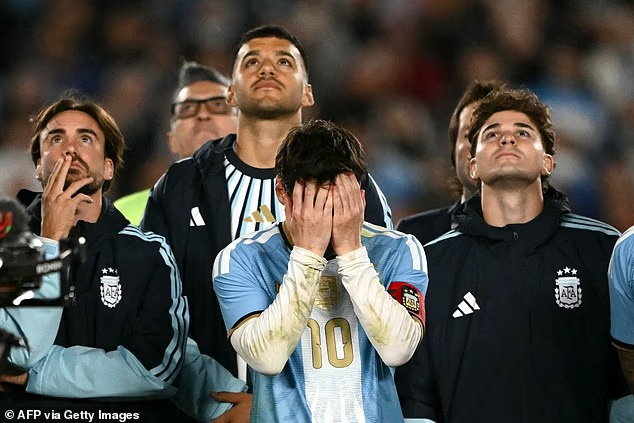
Lionel Messi said goodbye to international soccer Tuesday night, scoring a penalty and setting up Argentina’s other two goals in a 3-0 victory over Benin, closing a 21-year national team career that left Argentina facing a once-unimaginable future without him, the Associated Press reported.
Messi, 39, ended his time in sky blue and white with 126 goals in 208 appearances, two Copa América titles and a World Cup championship. What would otherwise have been an unremarkable friendly became a national event in a soccer-obsessed country that had long dreaded the day.
Photo: dailymail
“It feels like an era is ending, knowing he won’t play for the national team anymore,” said Valentino Ruso, 17, who was heading to a friend’s house in Buenos Aires to watch the game. “I’m sad. I think everyone is upset today.”
What Happened on the Pitch
The match was goalless at halftime. Four minutes after the restart, Messi swung in a corner that Nicolás Otamendi, who was also playing his last game for Argentina, put away for the opener, the Daily Mail reported. Otamendi had shared 17 years and four World Cups with Messi on the national team, according to Reuters. Messi then set up Nico Paz, one of the players seen as a possible heir to the No. 10 shirt, for the second goal, and he finished the night by converting a penalty for 3-0, his 126th international goal.
Messi also came close earlier, with a sliding shot from a Rodrigo De Paul pass that rolled just wide and a free kick that was tipped away, the Daily Mail said.
When the final whistle blew, teammates, opponents and the referee gathered around Messi as his eyes glistened. A drone show lit the sky, and singer Soledad Pastorutti performed as part of the tribute. A banner at midfield called him the “Eternal Captain,” and fans in the stands chanted his name and bowed toward him. Goalkeeper Emiliano “Dibu” Martínez had shaved Messi’s “M” logo into the back of his head for the occasion, the Daily Mail reported.
“I don’t want to leave this field,” Messi told the crowd, which roared as if he had scored. “I’m grateful to God to be Argentine.” He said in remarks reported by Reuters that his first thought was of his father, who died recently, and that playing for Argentina was the most beautiful thing that can happen to a player. The Daily Mail quoted him calling it perhaps the saddest day of his career.
A Nation’s Farewell
The Argentine soccer federation billed the game, Messi’s 208th for the national team, as “the last tango.” More than 85,000 tickets to the Monumental, Buenos Aires’ largest stadium, sold out in 90 minutes and later resold for more than $2,500 each. Players from Argentina’s 1978, 1986 and 2022 World Cup-winning squads returned to see him off, and his family watched from the stands.
Hours earlier, thousands lined the route as the team bus left the training center that bears his name, and Messi was seen wiping away tears, according to Reuters. A giant No. 10 shirt reading “Gracias” was unfurled in his hometown of Rosario, and the Obelisk in Buenos Aires glowed sky blue and white. In recent weeks newspapers have run tributes, murals have appeared across the country, and a 26-meter (85-foot) statue of Messi kneeling with the World Cup trophy has stood over motorists in Patagonia since June, AP said.
Rodrigo De Paul wrote on Instagram that he did not know if a player and a nation had ever shared a love story as great as Messi’s with Argentina.
A Complicated Relationship
Argentines had an intense and often unforgiving relationship with the shy boy who left Rosario at 13 for Barcelona’s youth academy. As he became a global icon, many compatriots questioned his commitment to his home country. Some saw an outsider who had never played professionally in Argentina and who seemed to buckle under their expectations, and crowds chanted the name of Diego Maradona, the hero of the 1986 World Cup victory, as a reminder of a standard he had yet to meet.
“There’s some resentment by the people that stay in Argentina for those who leave,” said Andrés Rabinovich, a University of Chicago scholar who studies soccer’s place in Argentine culture. After Argentina lost a third straight final in 2016, Messi briefly quit the national team.
The turning point came in 2021, when Argentina beat Brazil to win the Copa América for the first time in 28 years and Messi collapsed on the turf in tears. “Winning clearly disarmed his critics. That’s how soccer works in Argentina,” said Diego Murzi, a sports sociologist at Conicet, the national scientific research council. The World Cup victory in Qatar the following year cemented his status as a national hero, with millions of Argentines pouring into the streets.
Life After Messi
Messi’s contract with Inter Miami runs through the 2028 season, so he will keep playing in Major League Soccer. His announcement on Aug. 31 that he would retire from the national team, made weeks after Argentina lost the World Cup final to Spain, set off an outpouring of gratitude and grief.
“I don’t think we’ll have somebody like him again,” said Pablo Brescia, a University of South Florida professor who writes about Argentine culture and soccer. “Like Maradona, he’ll be unique.”
As the crowd lingered after the match, Messi took a final lap of the stadium, was joined at the center circle by his family and then raised his arms toward the stands at the tunnel before leaving the field.
Differing Accounts
Reports differed slightly on attendance, with the AP and Reuters citing more than 85,000 fans and the Daily Mail saying more than 80,000. Messi’s speech was also rendered differently across outlets. The AP had him saying he was grateful to God to be Argentine, while the Daily Mail quoted him as saying he was proud to be Argentinian. The Daily Mail also counted an Olympic gold medal among his honors, which the AP’s career summary did not list.
What Happens Next
Argentina now begins a new chapter without its most decorated player. Paz and other younger players are expected to be tested as potential successors, while Messi turns his attention fully to Inter Miami.
Reporting drawn from the Associated Press, Reuters and the Daily Mail
A Nigerian Air Force plane flying from Benin City to Lagos crashed Monday in southwestern Ondo state, killing all 25 passengers and seven crew members aboard, Reuters reported, in one of the deadliest air disasters in the country in recent years.
President Bola Tinubu confirmed there were no survivors and expressed “profound sadness,” extending condolences to the families of those on board. He directed the Air Force to open a thorough investigation into the cause of the crash to prevent future accidents, according to a statement from his office.
The twin-engine ATR-42, tail number NGR 931, was on a routine mission when air traffic controllers lost contact with it at 8:13 a.m. GMT, or 9:13 a.m. local time, Aviation Minister Festus Keyamo said. The wreckage was later found near a naval base in Igbokoda, where search and rescue teams were deployed.
What We Know So Far
Keyamo said controllers tried repeatedly to raise the aircraft on the radio without success before learning it had crashed. Preliminary information put 25 passengers and seven crew members aboard, for a total of 32. The Air Force confirmed the plane belonged to the service and said it had activated an immediate search and rescue operation in coordination with other authorities and emergency agencies. Air Force spokesperson Ehimen Ejodame said further details would be released in due course.
Locals told the Associated Press the aircraft came down near a river and that part of it was sinking in the water. “We heard something like a thunder strike,” said Akinbulejo Pius, a witness. He said the plane cleared some trees before it crashed and that residents found human remains, clothing and shoes at the site.
The Nigerian military has used the ATR-42 for intelligence, surveillance and reconnaissance as well as for carrying personnel and supplies, the AP noted.
Differing Accounts
Early reports left the toll unclear. The AP’s first account said there was no immediate word on casualties, and the Air Force’s own statement, as quoted by Punch Nigeria, did not give a casualty count or describe the condition of those aboard. The confirmation that all 32 people died came later, in Tinubu’s statement as reported by Reuters.
The time of lost contact appears differently across accounts but refers to the same moment. Reuters gave 8:13 a.m. GMT and the aviation ministry said 9:13 a.m., which are the same time in Greenwich Mean Time and Nigerian local time. The AP, citing Keyamo, described the plane as disappearing from radar at around 9 a.m. Reports also characterized Igbokoda differently, with the AP calling it a riverside town and Reuters a coastal one.
What Officials Are Saying
Tinubu’s office, in a statement signed by Special Adviser on Information and Strategy Bayo Onanuga, said the president mourns the Air Force personnel who died and ordered a thorough investigation. Tinubu said he was briefed by the Chief of Air Staff, Air Marshal Sunday Aneke.
Keyamo said he had spoken with Aneke and pledged the aviation ministry’s cooperation and help with rescue work. He noted that his ministry and the Nigerian Civil Aviation Authority have no regulatory authority over military aircraft.
Why This Matters
The crash is among the deadliest in Nigeria in recent years, Reuters said, and it involved a military aircraft that falls outside the civil aviation regulator’s oversight, as Keyamo pointed out, so the Air Force is leading the inquiry. Investigators have not stated a cause, and officials have not said how the aircraft came down so close to a naval base.
What Happens Next
The Air Force has begun the investigation Tinubu ordered and said search and rescue efforts are continuing. It has not released the names of those killed or said when its findings might be made public.
Reporting drawn from Reuters, the Associated Press and Punch Nigeria
Iran-backed Houthi rebels captured the town of Turbah in southwestern Yemen on Sunday and pushed toward the strategic provincial capital of Taiz on Monday, a blow to Saudi-backed government forces that came shortly before the government announced a major military operation against the rebels, the Associated Press reported.
Turbah sits on the main road linking Taiz with the port city of Aden, the interim seat of Yemen’s internationally recognized government, and has long been a key post for government troops defending Taiz, the AP said. The fighting has revived Yemen’s civil war after a four-year ceasefire.
Rashad al-Alimi, whom the AP described as head of the ruling Presidential Leadership Council and Reuters called Yemen’s president, said in a televised speech from neighboring Saudi Arabia that the operation aims at “recovering the remaining territories” held by the Houthis. Reuters reported that he said forces would press the offensive until the country is freed from what he called the terrorist militia, and that a military spokesman later urged the Houthis to lay down their weapons.
What We Know So Far
Before Turbah fell, the Houthis had taken several villages and areas on Taiz’s outskirts, which the AP said could pave the way for the rebels to encircle the city, Yemen’s third largest. In its Middle East roundup, the AP said the Houthis have besieged Taiz for more than a decade and that their latest offensive has disrupted a major road to Aden.
Hours after al-Alimi’s announcement, Saudi military spokesperson Maj. Gen. Turki al-Malki promised “full operational support” to Yemeni forces until the Houthis are eliminated, the AP reported. He also stressed Saudi Arabia’s right to take all necessary measures against rebels who continue to fire missiles and drones at the kingdom.
The Institute for the Study of War, a Washington-based think tank, said in a Sunday analysis cited by the AP that losing Turbah “will likely severely constrain” government-aligned forces’ ability to reinforce and resupply front-line positions in Taiz province. The group added that control of all roads in and out of areas north of the town also keeps government forces from retreating out of the city.
The Houthis have held the capital, Sanaa, and much of the populous northwest since 2014, and they have withstood years of attacks by Saudi Arabia, the United Arab Emirates and Western allies while upgrading their weapons with Iranian help, Reuters said.
How the Escalation Unfolded
The AP traced the latest flare-up to mid-July, when the Houthis accused Saudi Arabia of bombing the Sanaa airport to stop an unauthorized Iranian flight from landing. The rebels answered with missile and drone attacks on Saudi Arabia and Yemeni government forces, announced a blockade on Saudi shipping in the Red Sea and attacked several Saudi-linked vessels.
In early September the Houthis made a swift push down the Red Sea coast, capturing the city of Mokha and several Red Sea islands, which gave them control of the Yemeni side of the Bab al-Mandab Strait, a chokepoint through which 12% of global trade passes, according to the AP. Reuters described the offensive as capturing the strait and about 150 kilometers (90 miles) of coastline in a matter of weeks, and said it opened a new front in the wider U.S.-Israeli war launched against Iran in February.
The United Nations says the latest violence has killed more than 800 people and wounded more than 3,600, the AP reported. The U.N. migration agency said over 145,000 people have fled their homes inside Yemen and more than 3,000 others have crossed the water into Djibouti. The wider civil war, which began in 2014, has killed more than 150,000 people, the AP said.
Separately, the Houthis said overnight airstrikes hit Sanaa. The Saudi-backed Yemeni military claimed responsibility, saying it struck “vital targets” in Sanaa and in Saada province on the Saudi border, according to the AP.
Other Developments in the Region
Iran and the U.S. Iran’s parliament speaker, Mohammad Bagher Qalibaf, told an open session of Parliament that Washington recently put forward proposals through a mediator, without offering details, the AP reported. He said Iran’s seven conditions for fully reopening the Strait of Hormuz remain. Foreign Minister Abbas Araghchi told foreign diplomats in Tehran that Iran remains ready for a fair solution through diplomacy but that renewed military confrontation would bring a stronger response, and he rejected a U.S. claim that Iran’s delegation was expelled from the United States after the U.N. General Assembly, saying it left on a previously arranged schedule, according to the AP.
Shipping. A British military monitor, the United Kingdom Maritime Trade Operations Center, said a commercial tanker reported explosions “in close proximity” about 60 nautical miles south of Mokha, with the crew reported safe, per the AP. The UKMTO also said a projectile struck a tanker in the Strait of Hormuz and damaged its engine room, though it was unclear who launched it or when. In a separate report the U.S. Navy-overseen Joint Maritime Information Center said three tankers were struck Saturday while transiting the strait, the AP reported.
Iran’s oil ministry. State television reported that Oil Minister Mohsen Paknejad resigned and that President Masoud Pezeshkian accepted it, naming Hamid Bovard, chief executive of the National Iranian Oil Company, as caretaker, per the AP. No reason was given.
Gaza. Health officials at Aqsa Martyrs Hospital said an Israeli strike on a civilian vehicle killed one Palestinian and wounded at least 11, while Israel’s military said it targeted a known Hamas militant, the AP reported. Accounts of a second incident differed: the Turkish aid group Deniz Feneri Association said one of its volunteers was killed, while Israel’s military said it killed a Hamas militant it described as the group’s director. Gaza’s Health Ministry says Israeli strikes have killed at least 1,445 Palestinians since the ceasefire nearly a year ago, and the AP noted that seven Israeli soldiers have died in Gaza in that time.
Saudi Arabia. Houthi military spokesperson Brig. Gen. Yahya Saree claimed in a prerecorded statement that the group fired missiles and drones at Saudi Aramco facilities in Riyadh and the Kurais area, about 150 kilometers southeast of the capital. He gave no date or evidence, and the AP noted that a fire broke out at an Aramco refinery Saturday with no cause given.
Why This Matters
The fall of Turbah, which ISW’s analysis says tightens the squeeze on Taiz’s supply and retreat routes, comes as the government declares its most ambitious campaign against the Houthis in the current escalation and as Riyadh publicly commits support. Reuters said the Houthis’ September gains also gave them new leverage over the shipping route through Bab el-Mandeb, linking Yemen’s battlefield to the wider confrontation with Iran.
What Happens Next
The government said it is mobilizing troops across the areas it holds and has asked the international community for support, the AP reported. The Houthis have not publicly responded to the announcement, and the AP said Saudi Arabia continues to face missile and drone fire from the rebels.
Reporting drawn from the Associated Press and Reuters
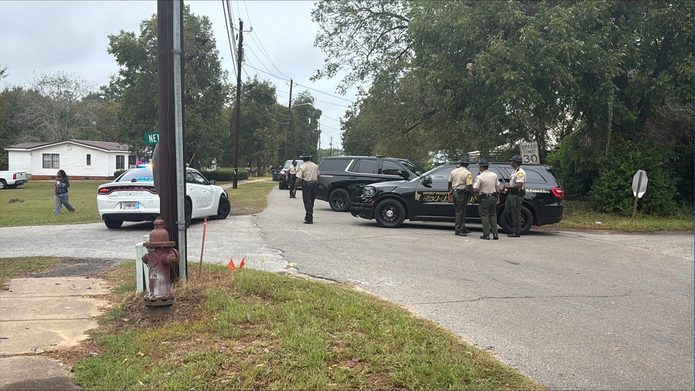
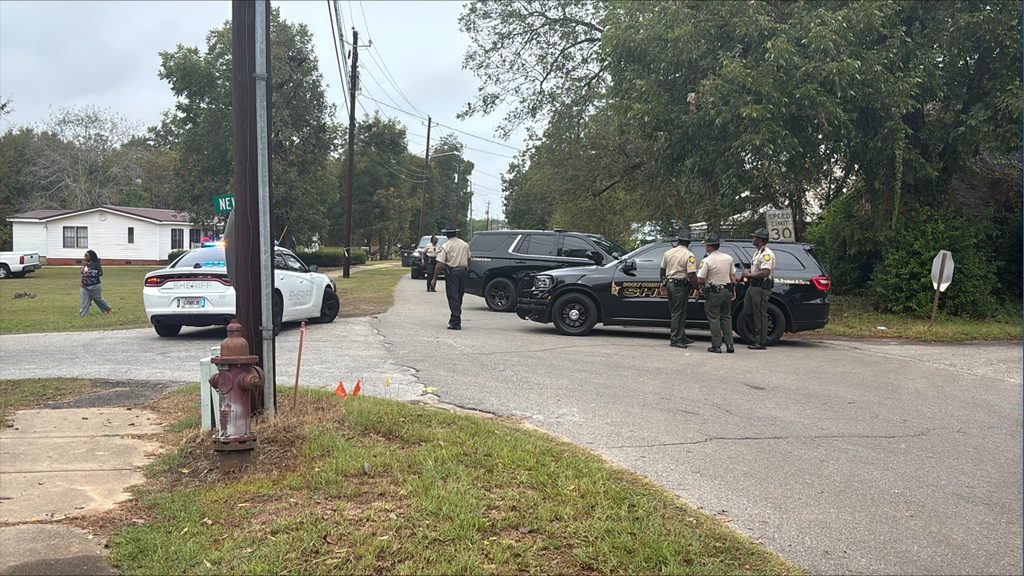
Two men were shot to death and dozens of other people were injured when gunfire broke out at a neighborhood block party early Sunday in southern Georgia, state law enforcement officials said.
Deputies from the Dooly County Sheriff’s Office were on patrol at the party around 1:25 a.m. when shots were fired, the Georgia Bureau of Investigation said in a statement. Vienna sits about 130 miles (209 kilometers) south of Atlanta and about 100 miles (160 kilometers) north of the Florida border, the AP reported.
Authorities had not said whether any suspects were in custody or being sought, and they had not offered a motive. The GBI and the sheriff did not immediately respond to the AP’s requests for more details.
What We Know So Far
Deputies found two people dead and several others who had been shot, the GBI said. Dooly County Coroner Brett Walls told the AP the dead were men ages 20 and 23, both pronounced dead at the scene with fatal gunshot wounds, and he called the scene “horrific.” The Guardian, writing earlier, said the pair had not yet been identified.
Counts of the injured differed by source. The GBI statement, as relayed by the AP, put the number of injured at 35 and did not say how many of them had been shot or how seriously they were hurt. The Guardian reported at least 25 injured. Dooly County Sheriff Craig Peavy told the local outlet WMAZ that about 25 people were taken to the hospital and that as many as 35 may have been wounded, according to the Guardian. Victims were taken to several regional hospitals, the GBI said.
The crowd was large, Peavy told WMAZ: more than 1,000 people had gathered, and shots were fired toward about 50 people in two locations roughly a block apart just after 1 a.m., with deputies monitoring the gathering when it happened, the Guardian reported. The GBI’s account places the gunfire at the 900 block of Pine Street and the two bodies at the 600 block of Pine Street, which sits farther apart than the sheriff’s description of locations about a block from each other. The Guardian described the event as a homecoming block party, while the GBI and AP called it a neighborhood block party.
The Dooly County Sheriff’s Office asked the GBI to assist with the investigation, the bureau said. The two victims will be taken to the GBI Medical Examiner’s Office for autopsies, and when the investigation is finished the case file will go to the Cordele Judicial Circuit District Attorney’s Office for review and prosecution.
Separate Shooting in Baltimore
The Guardian also reported on a second shooting this weekend, in which a 12-year-old girl was killed and three other people were wounded Saturday at Leon Day Park in Baltimore, near a youth football event.
Police Commissioner Richard Worley said two suspects were being sought after two types of cartridges were found at the scene, and that investigators believe an argument over a parking space escalated into an exchange of gunfire between two people, per the Guardian. The girl was a bystander at a nearby field who was hit when one of the shooters fired multiple rounds, Worley said. A 25-year-old woman with the girl and two men, ages 23 and 28, were also wounded; police said none of the three was believed to have life-threatening injuries, according to the Guardian.
Baltimore Mayor Brandon Scott said the shooting began with an argument between adults. “Two grown men got into an argument, and now a 12-year-old is gone,” he told reporters, as quoted by the Guardian.
Why This Matters
The Gun Violence Archive, a nonpartisan reference resource, counted at least 355 mass shootings in the United States through Sunday, the 277th day of 2026, the Guardian reported. The archive defines a mass shooting as an incident in which at least four people are killed or wounded, a threshold that is broader than the definitions some other databases use for mass killings.
The Guardian noted that the United States has long had high rates of such shootings, which has fueled calls from some quarters for stronger federal gun control, while Congress has not passed such measures over the years.
What Happens Next
The GBI said its investigation is continuing and that autopsies on the two dead will be conducted. Authorities have not announced arrests in the Vienna shooting or said when they will release more information about the victims, the suspects or the motive. In Baltimore, police are still looking for the two suspects they believe exchanged gunfire.
Reporting drawn from the Associated Press, the Georgia Bureau of Investigation and the Guardian