

Iran launched a drone assault targeting Bahrain and a tanker was struck in the Strait of Hormuz on Saturday, in what U.S. and regional officials described as Tehran’s retaliation for overnight American airstrikes, pushing the fragile interim peace agreement between Washington and Tehran to its most serious test since it was signed less than two weeks ago.
The exchanges marked the first direct military violence between the United States and Iran since the two countries signed their memorandum of understanding, a historic if fragile accord that set a 60-day window for negotiating a lasting end to their four-month war.

What We Know So Far
Bahrain’s Foreign Ministry confirmed that a number of Iranian drones targeted the country Saturday, calling the assault “a flagrant threat to the security of citizens and residents.” No immediate reports of casualties or structural damage emerged.
Bahrain is home to the U.S. Navy’s Fifth Fleet and had just hosted U.S. Secretary of State Marco Rubio for a meeting of Gulf Cooperation Council foreign ministers that concluded with a formal call for Iran to end its attacks and allow the strait to operate freely.
Iran’s Islamic Revolutionary Guard Corps issued a statement carried by state-run IRNA news agency saying it had targeted several locations of what it called the “U.S. terrorist army in the region,” without specifying which sites were struck.
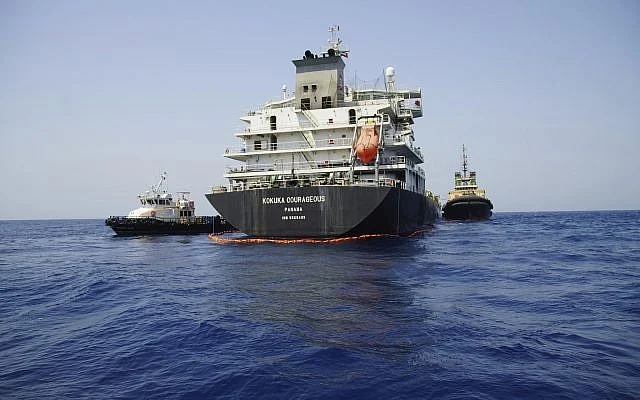
Britain’s United Kingdom Maritime Trade Operations center separately confirmed that a tanker was attacked in the Strait of Hormuz on Saturday, with the crew reported safe and no environmental damage detected. No group immediately claimed responsibility for the ship strike, though suspicion fell on Iran, the Associated Press noted.
The U.S. military’s Central Command said American forces had launched overnight strikes targeting Iranian missile and drone locations and coastal radar sites, describing the action as a response to an Iranian drone attack on a container ship that had been attempting to leave the strait on Thursday.
The tit-for-tat sequence of strikes, as Reuters confirmed, represented the worst escalation since the memorandum of understanding was signed, with each side accusing the other of having violated the agreement first.
Just after the tanker attack was reported, the Joint Maritime Information Center, overseen by the U.S. Navy, announced it would expand a shipping route near Oman’s coastline in the strait to allow both inbound and outbound traffic simultaneously.
The move is likely to sharpen tensions with Tehran, which has insisted that ships must obey Iranian orders in the waterway and has repeatedly framed its control over the strait as a central card in its negotiations with Washington.
The Joint Maritime Information Center warned that the threat to vessels remained “substantial,” adding that mariners should be aware of mines in the area and should expect a naval presence as clearance operations continued.
The International Maritime Organization halted its evacuation effort for ships stranded in the strait on Friday, saying it would not resume operations until guarantees were in place that participating vessels would not be attacked. The organization said approximately 115 ships had been successfully moved out of the waterway in recent days, while others remained stranded, some for months.
What Authorities Are Saying
U.S. Vice President JD Vance, who has led negotiations with Iran, posted a pointed warning on social media Friday night. Iran should “pick up the phone” if it had disagreements about the ceasefire terms, Vance wrote, but “violence will be met with violence.”
Ebrahim Azizi, who heads the Iranian parliament’s national security commission, took a sharply different tone, writing Friday that “the Strait of Hormuz is governed by Iran, so: Respect the rules.”
The U.S. and Gulf Arab states have rejected Iran’s claims of authority over the strait, which is considered an international waterway under international maritime law despite running through the territorial waters of both Iran and Oman.
In Lebanon, a separate but interconnected diplomatic front also deteriorated Saturday. Hezbollah rejected a 14-point framework agreement reached Friday in Washington between Israel and the Lebanese government, with Hezbollah leader Naim Qassem describing it as a “surrender to Israel” and declaring it “null and void,” the Guardian confirmed.
The framework laid out a phased withdrawal of Israeli troops from southern Lebanon in exchange for deployment of Lebanese army forces tasked with ensuring Hezbollah did not return to the area and with dismantling the group’s infrastructure.
Qassem said the disarmament conditions would legitimize Israel’s continued presence in Lebanese territory and accused the Lebanese government of making needless concessions that undermined the country’s sovereignty.
Israel currently occupies more than 600 square kilometers of southern Lebanon, an area it has said it will not leave. Israeli forces have demolished dozens of villages in occupied areas and displaced more than one million residents, primarily from the south.
The Israeli military carried out a drone strike Saturday in the Nabatieh area of Lebanon, killing one person. Israel said it targeted an individual who posed a threat to its forces, without providing supporting evidence. Lebanon’s health ministry confirmed the death.
Despite these tensions, a U.S.-brokered ceasefire between Hezbollah and Israel reached the previous week had largely been held, with the Saturday strike representing one of the few recorded exceptions.
Why This Matters
The violence Saturday exposed the structural fragility at the center of the U.S.-Iran peace process. The memorandum of understanding signed between Washington and Tehran was the first formal agreement between the two countries since Iran’s 1979 revolution, yet it rests on several assumptions that Saturday’s events called directly into question.
The most fundamental assumption is that Iran can be held responsible for activities in and around the strait during a period of negotiation.
Tehran’s position is that the strait is governed by Iranian rules, that ships must comply with its directives, and that it retains the right to respond with force when it believes American commitments are being violated.
Washington’s position is that the strait is an international waterway, that Iran has no authority to impose tolls or restrictions on transit, and that any Iranian attack is a violation of the interim agreement.
Those two positions are not merely different negotiating stances. They reflect incompatible legal frameworks and strategic interests that the 60-day negotiating window will need to somehow reconcile.
Iran has linked its compliance with the Lebanon ceasefire directly to Israel’s behavior there, insisting that Israeli military operations in Lebanon constitute a violation of the agreement’s requirement that fighting end on all fronts.
Israel is not a party to the U.S.-Iran deal and has made clear it considers itself free to continue operations against Hezbollah regardless of what Washington and Tehran agree.
That triangle of competing commitments, with the United States caught between its obligations to Israel and its agreement with Iran, is the central fault line running beneath the entire peace process.
The economic stakes are substantial. Energy prices have remained elevated throughout the conflict, and the disruption of Strait of Hormuz traffic has imposed ongoing costs on the global economy.
Trump faces U.S. midterm elections in a matter of months, and the domestic political pressure to demonstrate that the deal is producing tangible relief for American consumers adds urgency to Washington’s desire to see the strait fully operational.
The Guardian noted that the strait’s postwar governance framework is still being negotiated by Iran, Oman, and regional mediators, meaning the fundamental question of who controls the waterway and on what terms remains legally and practically unresolved even as ships attempt to transit it.
What Happens Next
The 60-day negotiating window established by the memorandum of understanding continues, with U.S. and Iranian teams working through the technical elements of a final agreement covering the strait, Iran’s nuclear program, its stockpile of highly enriched uranium, and the future of its support for armed proxy groups across the region.
Vance and his negotiating team, including Steve Witkoff and Jared Kushner, remain engaged in Switzerland. Pakistan and Qatar are continuing their mediation roles alongside the direct talks.
The expansion of the Oman-adjacent shipping route by the U.S. Navy’s multinational maritime body will be closely watched as a potential flashpoint. Iran’s response to that move, whether it tolerates the expanded traffic or moves to obstruct or attack ships using the new route, will offer the clearest early signal of whether Tehran is genuinely committed to reopening the waterway or continues to regard it as leverage to be withheld until its broader demands are met.
In Lebanon, Hezbollah’s rejection of the Washington framework agreement leaves the ceasefire there dependent entirely on informal restraint rather than any binding accord. If Israeli strikes continue and Hezbollah responds, Iran has repeatedly indicated it will regard those exchanges as violations of the U.S.-Iran deal’s all-fronts ceasefire requirement, potentially triggering further escalation in the Gulf.
The coming days will determine whether Saturday’s exchanges were an aberration in an otherwise stabilizing situation or the opening of a new and more dangerous phase of a conflict that neither side has yet fully put down.
AP/Reuters/TheGuardian





