

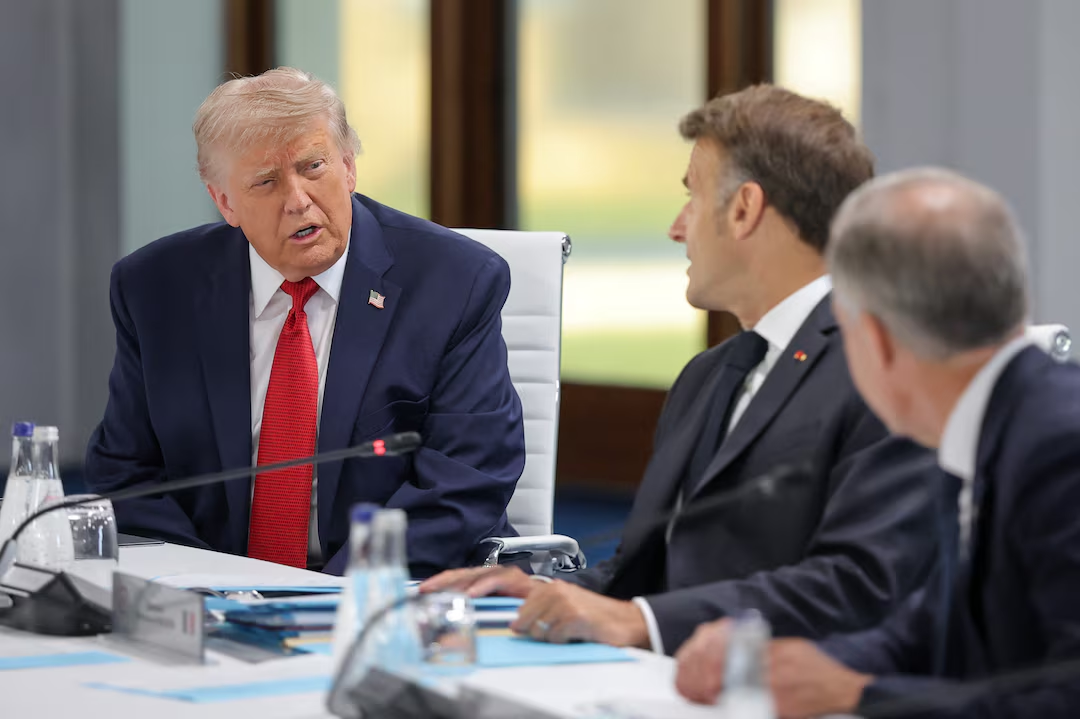
President Donald Trump told fellow world leaders “I’m the boss” during a Group of Seven summit session Wednesday, underscoring U.S. influence as he signaled a notable shift toward stronger support for Ukraine in its war against Russia.
The remark came as G7 leaders issued a unified statement backing Kyiv and acknowledging its improving position on the battlefield, a development that could reshape the dynamics of any future peace negotiations with Moscow.
Trump asserted U.S. leadership at the G7 while aligning more closely with Ukraine’s position, as Western allies rallied behind Kyiv with renewed support and pressure on Russia.
What we know so far
Leaders of the G7 nations, meeting from June 15 to 17 in the French resort town of Evian-les-Bains, agreed on a joint position supporting Ukraine and introducing additional sanctions against Russia.
Trump’s comment came as he arrived for a session on global economic security, where he addressed both leaders and reporters. The statement from the summit marked a shift from the previous year’s meeting in Canada, which ended without a unified stance on Ukraine.
Ukrainian President Volodymyr Zelenskyy attended the summit seeking to convince allies, particularly the United States, that Ukraine’s recent battlefield gains have strengthened its negotiating position.
Trump told reporters that Russia is suffering heavier troop losses than Ukraine and described Moscow as the offensive force in the conflict, signaling a departure from his earlier skepticism about Kyiv’s prospects.
What authorities are saying
French President Emmanuel Macron described Trump’s posture as a “real change in approach,” noting that the United States appeared more aligned with European allies on Ukraine.
Other leaders echoed that assessment, pointing to the joint statement as evidence of renewed unity among Western powers.
Trump, however, indicated that future pressure on Russia will depend heavily on U.S. decisions, leaving some uncertainty about how far Washington is prepared to go.
On a separate issue, G7 leaders expressed cautious support for a preliminary agreement between the United States and Iran, though Trump warned that military action could resume if Tehran fails to comply.
Why this matters
Trump’s evolving stance on Ukraine carries significant implications for the war’s trajectory. As the largest military and financial backer of Kyiv, the United States plays a decisive role in shaping both battlefield outcomes and diplomatic efforts.
A more supportive U.S. position strengthens Ukraine’s leverage and signals to Russia that Western unity may be consolidating rather than weakening.
At the same time, Trump’s assertive tone reinforces the reality that U.S. leadership remains central to G7 decision making, particularly on security issues. His influence could determine whether sanctions intensify and whether peace talks gain traction.
The summit also highlighted broader geopolitical concerns, including reliance on China for critical minerals and the regulation of emerging technologies such as artificial intelligence.
What happens next
Attention now turns to how the G7’s commitments will translate into concrete actions, including additional sanctions and military support for Ukraine.
Diplomatic efforts to end the war remain uncertain, with Russia showing little willingness to concede ground despite mounting pressure.
Meanwhile, negotiations with Iran are expected to continue, with Western allies watching closely to see whether a more comprehensive agreement can be reached.
Trump’s remarks and the G7 outcome suggest a recalibration rather than a complete policy overhaul. His acknowledgment of Ukraine’s battlefield progress indicates growing recognition in Washington that Kyiv can sustain resistance against Russia.
However, his emphasis on U.S. authority also reflects a transactional approach to alliances, where support may hinge on strategic calculations rather than long standing commitments.
For Ukraine, the shift offers a short term boost but does not eliminate uncertainty. Much depends on whether U.S. backing remains consistent or fluctuates with political considerations.
For Russia, the renewed unity among Western powers presents a challenge, particularly if sanctions deepen and military aid to Ukraine expands. Yet Moscow may also interpret Trump’s unpredictability as an opportunity to test the limits of that unity.
The summit ultimately underscores a central reality of the conflict: while Ukraine’s resilience is shaping the battlefield, the decisions made in Washington continue to shape the broader course of the war.
Source: Reuters





