Home Blog Page 144

Trump ethics nominee Paul Ingrassia withdraws after losing GOP support

0

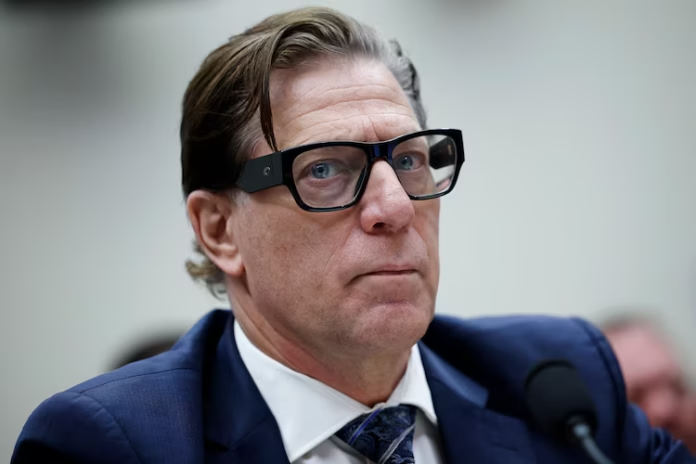
Washington (BN24) – Paul Ingrassia, President Donald Trump’s nominee to lead the Office of Special Counsel, withdrew his name from consideration Tuesday after losing key Republican backing amid controversy over past remarks and allegations of misconduct.

“I will be withdrawing myself from Thursday’s HSGAC hearing to lead the Office of Special Counsel because unfortunately I do not have enough Republican votes at this time,” Ingrassia said in a statement.

Trump had nominated Ingrassia to head the OSC, an independent federal agency responsible for protecting government employees from prohibited personnel practices, including retaliation against whistleblowers. But the nomination quickly drew scrutiny following reports from Politico detailing alleged offensive messages and past behavior that sparked bipartisan concern.

The most recent Politico report cited messages Ingrassia allegedly sent in a private text chat, in which he said he had a “Nazi streak” and called Martin Luther King Jr. Day something that should be “tossed in the seventh circle of hell.” The same outlet had earlier reported that he was accused of sexual harassment by a colleague, citing multiple administration officials.

Ingrassia’s attorney, Edward Paltzik, denied the harassment allegations and questioned the authenticity of the reported text messages. Paltzik argued that even if the messages were real, they were meant as “self-deprecating and satirical humor,” not serious statements.

Despite the defense, Ingrassia faced a growing wave of opposition within his own party. Senate Majority Leader John Thune of South Dakota said Monday that the nomination was “not going to pass” and advised the White House to pull it. “I think they’ll have something official to say about that,” Thune told reporters Tuesday, hinting that the withdrawal was imminent.

Other Republican senators voiced similar concerns. Sen. James Lankford of Oklahoma said he would vote against Ingrassia’s nomination, citing comments about Jews and Indians that he said undermined Ingrassia’s credibility. “I think it’d be very difficult for a lot of federal employees to be able to say he’s impartial,” Lankford said. Sen. Ron Johnson of Wisconsin agreed, saying, “They ought to withdraw him.”

Sen. Joni Ernst of Iowa, another Republican on the Homeland Security and Governmental Affairs Committee, stopped short of declaring her position but admitted Ingrassia faced “an uphill battle.”

The issue reportedly came up during Trump’s lunch with Senate Republicans in the Rose Garden on Tuesday, where several senators raised concerns about the potential fallout of keeping Ingrassia’s nomination alive.

Even before this controversy, Ingrassia had drawn criticism for inflammatory public statements. The former podcaster once called the Jan. 6, 2021, attack on the U.S. Capitol a “peaceful protest against a great injustice” and suggested the day should be made a national holiday. He also described Hamas’ Oct. 7, 2023, attack on Israel as a “psyop.”

Ingrassia’s decision to withdraw spares the White House a contentious confirmation battle and underscores the challenges Trump has faced filling senior administration positions amid scrutiny of nominees’ past statements and conduct.

Putin-Trump summit on hold after Russia rejects ceasefire

0

Washington (BN24) – A planned summit between the U.S. President Donald Trump and Russian President Vladimir Putin was put on hold Tuesday after Moscow rejected an immediate ceasefire in Ukraine, casting doubt on prospects for the high-stakes talks and shifting diplomatic momentum to European capitals pressing for a firmer line.

A senior White House official told Reuters there were no immediate plans for Trump to meet with Putin after Secretary of State Marco Rubio and Russian Foreign Minister Sergei Lavrov held what the U.S. described as a “productive call” but decided against an in-person meeting for now. Trump had announced last week that he and Putin would meet in Hungary as part of an effort to end the war in Ukraine, but Russia’s insistence that Kyiv cede additional territory undercut the centerpiece of Washington’s proposal: a ceasefire that would freeze front lines where they stand.

The Kremlin circulated a private communique, described by two U.S. officials and two people familiar with the matter, that reiterated Moscow’s demand for full control of the eastern Donbas region. That position effectively rejected a Trump idea that the truce begin with the current battle lines. Russia controls all of Luhansk province and roughly three-quarters of neighboring Donetsk, which together comprise the Donbas.

Trump, who met privately with Ukrainian President Volodymyr Zelenskiy last week and spoke by phone with Putin, said he did not want a “wasted meeting” but suggested developments could follow soon. “We’ll be notifying you over the next two days,” he told reporters. Kremlin officials, meanwhile, said there was no fixed date and that “serious preparation” would be required before any summit.

European leaders urged Washington on Tuesday to hold firm in demanding an immediate ceasefire based on the present lines of contact. Dutch Prime Minister Mark Rutte was in Washington to present European views to the U.S. president, European officials said, and a Western diplomat said Mr. Rutte planned to press for a ceasefire and for any future negotiations to start from current positions on the battlefield.

Two senior European diplomats said the postponement of a planned preparatory meeting between Rubio and Lavrov, expected in Budapest on Thursday, signaled U.S. reluctance to proceed unless Moscow moderated its demands. “I guess the Russians wanted too much and it became evident for the Americans that there will be no deal for Trump in Budapest,” one diplomat said, while another added that Moscow had “not at all changed their position, and are not agreeing to ‘stop where they are.’”

Russia’s apparent unwillingness to accept a freeze of front lines complicates Trump’s bid for another summit after an August meeting in Alaska produced little progress. Lavrov told reporters that the timing and place of a meeting were less important than implementing understandings reached earlier, and a Kremlin spokesman said neither leader had set exact dates.

Ukraine’s European allies have warned that any encounter between Trump and Putin without concrete concessions from Moscow would be damaging. In a joint statement Tuesday, leaders from Britain, France, Germany and the European Union said they “strongly support President Trump’s position that the fighting should stop immediately, and that the current line of contact should be the starting point of negotiations.”

The contested choice of Budapest as a venue adds diplomatic complications: Hungary’s Prime Minister Viktor Orban has cultivated warmer relations with Moscow than most EU peers and has said he would ensure Putin could enter and leave Hungary. But any flight to Budapest would require passage through other European airspace; Poland has warned it could be legally compelled to detain Putin on an International Criminal Court warrant if his plane crossed Polish territory, while Bulgaria indicated it might allow passage if it advanced peace efforts.

With Europeans preparing to host Zelenskiy at an EU summit and in discussions among nations considering an international stabilization force for Ukraine, the fate of the Trump-Putin summit now hinges on whether Moscow will relent on territorial demands or whether the United States and its allies will accept an alternative roadmap to talks.

PSG scores 7, Barcelona nets 6 on goal-filled Champions League night as Arsenal thrashes Atletico Madrid 4-0

0

PARIS (BN24) — Paris Saint-Germain scored seven, Barcelona hit six and Erling Haaland struck his twenty-fourth goal of the season on an action-packed night in the Champions League on Tuesday that produced forty-three goals across nine matches.

Six teams scored four or more goals on a night of attacking dominance that saw defending champion PSG lead the way at the top of the standings after a wild 7-2 victory against Bayer Leverkusen in a match that saw both teams reduced to ten men in the first half.

Arsenal had to be patient but eventually thrashed Atletico Madrid with four goals in thirteen minutes for a 4-0 victory at Emirates Stadium. Mikel Arteta’s side was unlucky not to score in the first half but eventually broke through with a set piece in the fifty-seventh minute, which opened the floodgates.

Gabriel Martinelli made it 2-0 in the sixty-fourth minute, marking his third goal in three Champions League games this season. Viktor Gyokeres added the final two goals to cap off a perfect night for Arsenal, ending his seven-game scoring drought for the club.

Arsenal, with nine points, currently sits third in the league phase table behind only PSG and Inter Milan.

Barcelona’s 6-1 win against Olympiakos saw the Spanish club bounce back from a loss to PSG at the start of the month. Fermin Lopez scored a hat trick, his first of his career, and Marcus Rashford, on loan from Manchester United, hit two goals as Barcelona blew away ten-man Olympiakos.

Barcelona took full advantage when the Greek champion saw Santiago Hezze shown a contentious red card in the fifty-seventh minute. The visitors had gotten back into the game at 2-1 three minutes earlier after Ayoub El Kaabi’s penalty, but with the extra man Barcelona overwhelmed Olympiakos with four goals in eleven minutes.

Lamine Yamal also got on the scoresheet from the penalty spot. Rashford now has four goals in three Champions League games this season. “Sometimes it’s difficult to break opponents down, but we have so many goalscoring players in different areas that getting goals is the least of our worries,” he said.

By halftime at the BayArena, PSG was 4-1 up, but that did not come close to telling the full story of a chaotic first half which included a red card for each team and two penalties for Leverkusen.

Two goals for Desire Doue put the French champion well in control and the action continued after the break with Nuno Mendes extending the lead within five minutes of the restart. Ousmane Dembele also came off the bench to make a scoring return after injury.

Aleix Garcia scored a spectacular swerving long-range effort in the second half, though it was merely a footnote to PSG’s dominant performance. He also converted a first-half penalty.

Haaland’s goal helped Manchester City to a 2-0 win at Villarreal. The Norway international’s opener was his twenty-fourth in fourteen games this season and extended his current scoring streak to twelve games in a row. He now has fifty-three goals in the Champions League in just fifty-one appearances.

The only game he did not score in this season was City’s 2-0 defeat to Tottenham in August. Bernardo Silva was also on target as City moved up to fifth in the standings.

PSV Eindhoven routed Italian champion Napoli 6-2 in the biggest shock of the night. That marked back-to-back losses for Antonio Conte’s team following Saturday’s 1-0 defeat at Torino. The heavy loss in Europe will be particularly humbling for the Italian champion, with three goals conceded in the last ten minutes after going down to ten men when Lorenzo Lucca was sent off in the seventy-sixth minute.

Inter Milan maintained a perfect record after three games and comfortably overcame Union Saint-Gilloise 4-0, with Lautaro Martinez scoring for the third time in the Champions League this season. Last season’s Champions League runner-up has yet to concede a goal in the competition.

Harvey Barnes scored twice in Newcastle’s 3-0 win against Benfica and Borussia Dortmund won 4-2 in Copenhagen.

Kazakhstani team Kairat picked up its first point in European soccer’s elite club competition with a 0-0 draw against Pafos.

The forty-three goals scored across nine matches represented one of the highest-scoring nights in Champions League history. The attacking spectacle showcased the offensive firepower of Europe’s elite clubs and provided thrilling entertainment for fans worldwide.

Top of the Premier League and perfect in Europe, Arsenal is flying high under Arteta. A powerful second half at the Emirates saw the team brush aside Atletico with Gyokeres sealing the victory with two goals in three minutes. Gabriel Magalhaes and Gabriel Martinelli had already given the Londoners a 2-0 lead by then.

The night’s results significantly impacted the Champions League standings, with PSG, Inter and Arsenal all maintaining perfect records through three matches. The expanded league phase format has produced entertaining matches with teams competing for favorable playoff positions.

Trump nominee Paul Ingrassia faces scrutiny over leaked texts containing racist language and Nazi references – Dailymail

0

Donald Trump’s nominee, Paul Ingrassia, to lead a federal anti-corruption watchdog sent text messages admitting he has a “Nazi streak,” according to leaked communications published by Politico that have sparked controversy ahead of his Senate confirmation hearing.

Ingrassia, who is Trump’s pick to lead the Office of Special Counsel, is accused of making racist statements in a group chat with Republican friends, according to the report. The messages include calling for Martin Luther King Jr. Day to be “tossed into the seventh circle of hell where it belongs,” adding that there should be “no moulignon holidays,” using an Italian slur for Black people.

Ingrassia, who is set to appear before the Senate Thursday for a confirmation hearing, also reportedly stated that people should “never trust an Indian” in a message referring to former presidential candidate Vivek Ramaswamy.

One of the chat’s participants who leaked the messages had done so out of a desire for “government to be staffed with experienced people who are taken seriously,” according to Politico.

Ingrassia’s lawyer said the messages were intended to mock liberals who call Trump supporters Nazis and suggested they were manipulated to show his candidate in the worst possible light.

“Looks like these texts could be manipulated or are being provided with material context omitted. However, arguendo, even if the texts are authentic, they clearly read as self-deprecating and satirical humor making fun of the fact that liberals outlandishly and routinely call MAGA supporters ‘Nazis,'” Edward Paltzik said.

His lawyer went on to allege that there were people who wanted to hurt the Trump nominee. “In this age of AI, authentication of allegedly leaked messages, which could be outright falsehoods, doctored, or manipulated, or lacking critical context, is extremely difficult,” he said. “What is certain, though, is that there are individuals who cloak themselves in anonymity while executing their underhanded personal agendas to harm Mr. Ingrassia at all costs. We do not concede the authenticity of any of these purported messages.”

The White House and Department of Homeland Security did not respond to requests for comment.

Ingrassia, if confirmed for the special counsel role, would be tasked with handling whistleblower complaints, discrimination cases and other high-stakes federal matters.

He is already under pressure after it was revealed earlier this month that he had faced a sexual harassment probe while working at DHS. The investigation found no wrongdoing. “Mr. Ingrassia has never harassed any coworkers — female or otherwise, sexually or otherwise — in connection with any employment,” Paltzik said.

In February 2024, the group chat discussed why some Republicans believe that Democrats portray Black people as victims. “Blacks behave that way because that’s their natural state… You can’t change them,” Ingrassia wrote, according to the leaked messages. “Proof: all of Africa is a shithole, and will always be that way,” he added.

In May 2024, Ingrassia’s friend wrote in the group chat: “Paul belongs in the Hitler Youth.” The Trump official replied: “I do have a Nazi streak in me from time to time, I will admit it,” according to the leaked texts.

In some of the exchanges, participants pushed back against Ingrassia, including one who warned: “Paul you are coming across as a white nationalist which is beneficial to nobody.” Another said: “You’re gunna be in private practice one day this shit will be around forever brother.”

Concerns were raised about Ingrassia in the Senate after he attended a gathering last year hosted by Nick Fuentes, a Holocaust denier and white nationalist. Fuentes held the impromptu rally after being kicked out of a Turning Point USA conference. Ingrassia called it an “awful decision” by Charlie Kirk’s foundation.

The controversy comes after another Trump loyalist was dragged into scandal last week over allegations he had leaked racist texts about his colleagues. Gavin Wax, a Department of State staffer, found himself at the center of a crisis which reached the highest echelons of the White House, sources said.

He is accused of pressuring another administration official to share text messages with Politico in which members of the New York Young Republican club said “I love Hitler” and referred to Black people as monkeys. A source close to Wax denied that he was the source of the leak, but this was rejected by multiple senior Republicans who said the White House had been aware of his links to the Politico story.

The leaked texts have set off turmoil inside the White House as the administration grapples with questions about vetting processes for political appointees. The Office of Special Counsel plays a critical role in protecting federal whistleblowers and investigating allegations of prohibited personnel practices in government.

Ingrassia’s confirmation hearing Thursday will provide senators an opportunity to question him directly about the leaked messages and his fitness to lead an office tasked with upholding ethical standards in federal employment.

The nomination faces an uncertain path as some senators have expressed concerns about both the leaked texts and Ingrassia’s attendance at the Fuentes gathering. Democrats are expected to press him aggressively on both issues during the confirmation process.

The controversy highlights ongoing challenges for the Trump administration in managing personnel selections and responding to damaging leaks from within Republican circles.

Poland warns Putin against crossing its airspace for Trump summit in Hungary

0

Poland warned Russian President Vladimir Putin on Tuesday not to fly through its airspace for an upcoming summit with U.S. President Donald Trump in Hungary, saying Warsaw could be legally obligated to act on an international arrest warrant against the Russian leader if he did.

Foreign Minister Radoslaw Sikorski said Poland, as a member of the International Criminal Court (ICC), could not guarantee that its judiciary would ignore the warrant if Putin’s plane entered Polish airspace en route to Budapest. “I cannot guarantee that an independent Polish court won’t order the government to escort such an aircraft down to hand the suspect to the court in The Hague,” Sikorski told Radio Rodzina.

The warning came after Trump announced plans last week to meet Putin in Budapest in a renewed diplomatic effort to broker an end to Russia’s war in Ukraine. The proposed summit has drawn global attention, given Putin’s standing arrest warrant from the ICC over alleged war crimes involving the illegal deportation of hundreds of Ukrainian children to Russia — accusations the Kremlin denies.

The ICC warrant requires all member states, including Poland, to arrest Putin if he enters their territory or airspace. “If this summit is to take place, hopefully with the participation of the victim of the aggression, the aircraft will use a different route,” Sikorski said, referring to Ukraine’s involvement in potential peace talks.

Hungary, which has maintained notably warmer relations with Moscow than most European Union states, has said it will ensure Putin can safely attend the summit and return home. Budapest has also been moving to withdraw from the ICC, potentially shielding Putin from arrest while on Hungarian soil.

To reach Hungary without crossing Ukrainian territory, Russia’s delegation would have to travel through at least one EU country’s airspace. All EU members, including Poland and Bulgaria, are ICC signatories.

In contrast to Warsaw’s firm stance, Bulgarian Foreign Minister Georg Georgiev indicated his country would be open to granting airspace access to Putin if it would advance peace efforts in Ukraine. “If the condition for this is to have a meeting, it is most logical for such a meeting to be mediated in every possible way,” Georgiev said, according to the Bulgarian News Agency BTA. Bulgaria’s foreign ministry said it had not yet received any formal flight request from Moscow.

The Trump-Putin summit, which would mark one of the most significant diplomatic meetings since the invasion of Ukraine began, remains under scrutiny amid questions about the logistics — and legality — of the Russian leader’s travel through European airspace.

Reuters

American Chess Grandmaster Daniel Naroditsky dies at 29

0

Daniel Naroditsky, a chess grandmaster who started as a child prodigy and quickly became one of the most influential American voices in the sport, died Monday. He was twenty-nine.

The Charlotte Chess Center in North Carolina, where Naroditsky trained and worked as a coach, announced his death on social media, calling him “a talented chess player, educator, and beloved member of the chess community.”

“Let us remember Daniel for his passion and love for the game of chess, and for the joy and inspiration he brought to us all every day,” his family said in a statement shared by the center.

The cause of death was not immediately known.

Naroditsky became a grandmaster, the highest title in chess aside from World Chess Champion, at the age of eighteen. Years earlier, the California-born player won the Under 12 world championship and spent his teenage years writing chess strategy books as he climbed the world rankings.

He was consistently ranked in the top two hundred worldwide for traditional chess and also excelled at a fast-paced style called blitz chess, maintaining a top twenty-five ranking throughout his adult career. Most recently Naroditsky, known to many as Danya, won the U.S. National Blitz Championship in August.

Fellow grandmasters credited Naroditsky with introducing the sport to a wider audience by livestreaming many of his matches and sharing live commentary on others. Thousands of people regularly tuned in on YouTube and the interactive streaming platform Twitch to watch Naroditsky play.

“He loved streaming, and he loved trying to be educational. The chess world is very grateful,” Hikaru Nakamura, an American grandmaster, said on a livestream Monday.

In a final video posted to his YouTube channel Friday titled “You Thought I Was Gone!?” Naroditsky tells viewers he’s “back, better than ever” after taking a creative break from streaming. He talks viewers through his moves as he plays live chess matches on the computer from a cozy home studio.

Other elite chess players from around the globe took to social media to express their shock and sadness.

Dutch chess grandmaster Benjamin Bok reflected on his lifelong friendship with Naroditsky, whom he said he has known since the Under 12 world championship that Naroditsky won in 2007.

“I still can’t believe it and don’t want to believe it,” Bok said on X. “It was always a privilege to play, train, and commentate with Danya, but above all, to call him my friend.”

Naroditsky was the son of Jewish immigrants to the United States from Ukraine and Azerbaijan. He was born and raised in San Mateo County, California, and was described by his parents as a very serious child with an impressive attention span and memory. He went on to study history at Stanford University, earning a bachelor’s degree in 2019 after taking a year off to play in chess tournaments.

After college, he moved to Charlotte, North Carolina, where he coached the area’s top junior chess players.

Naroditsky’s impact on chess extended far beyond his competitive achievements. His educational approach to streaming made complex chess concepts accessible to players of all skill levels, helping to democratize chess instruction and inspire a new generation of players.

His livestreams typically featured detailed explanations of strategic thinking and tactical patterns, delivered in an engaging and patient teaching style. This approach earned him a devoted following among both serious students of the game and casual fans.

The timing of his death, just days after posting an enthusiastic return to streaming, shocked the chess community. Many had watched his final video without any indication that he was facing health challenges.

Naroditsky’s contributions to chess literature also left a lasting mark on the sport. His strategy books, written during his teenage years, demonstrated both his deep understanding of chess and his ability to communicate complex ideas clearly.

The chess community has lost one of its most effective ambassadors to the broader public. Naroditsky’s combination of elite playing strength, teaching ability and media savvy made him uniquely positioned to grow the game’s popularity in the digital age.

His success in blitz chess, which requires players to make moves within seconds, showcased not only his tactical brilliance but also his ability to perform under intense time pressure. His August victory in the U.S. National Blitz Championship represented one of the highlights of his competitive career.

Memorial tributes continued to pour in from players, coaches and fans around the world who credited Naroditsky with inspiring their love of chess or helping them improve their game through his educational content.

AP

Japan’s parliament elects Sanae Takaichi as nation’s first female prime minister

0

TOKYO (BN24) — Japan’s parliament on Tuesday elected ultraconservative Sanae Takaichi as the country’s first female prime minister, a historic appointment that concludes months of political turmoil following the Liberal Democratic Party’s (LDP) consecutive election defeats. At 64 years old, Takaichi, head of the struggling ruling party, succeeds Shigeru Ishiba, who resigned along with his Cabinet after only one year in office, triggered by the party’s poor electoral performance in July.

Takaichi’s rise to power comes on the heels of a last-minute coalition agreement forged between the LDP and the Osaka-based Japan Innovation Party (JIP), also known as Ishin no Kai. This alliance, while crucial in securing her premiership, falls short of an outright majority in both houses of Japan’s bicameral legislature. As a result, her governing bloc must seek support from other opposition parties to pass any significant legislation, raising concerns about the durability and stability of her administration.

At the coalition signing ceremony on Monday, held in Tokyo, Takaichi and JIP leader and Osaka Governor Hirofumi Yoshimura underscored the urgency of political stability. Takaichi declared, “Political stability is essential right now. Without stability, we cannot push measures for a strong economy or diplomacy.” This statement reflects her administration’s immediate priorities: to address economic challenges and navigate delicate foreign relations amid a shifting global environment.

The coalition deal signals a clear rightward tilt in Japanese politics. It comes just ten days after Komeito, the Buddhist-backed centrist party that had been a steady coalition partner of the LDP for decades, withdrew from the government. Komeito’s departure stemmed from frustrations with the LDP’s inadequate response to recent political scandals involving illicit slush funds, which contributed to the party’s electoral setbacks. Additionally, Komeito expressed deep unease with Takaichi’s nationalist views and actions, particularly her revisionist interpretation of Japan’s wartime past and her controversial visits to the Yasukuni Shrine—a shrine dedicated to Japan’s war dead, including convicted war criminals. These visits have drawn sharp rebukes from neighboring China and South Korea, who view them as a failure to acknowledge Japan’s wartime aggression.

Takaichi’s Cabinet is expected to include several close allies of Taro Aso, a prominent and influential figure within the LDP, as well as supporters who backed her during the party leadership contest. However, Yoshimura clarified that the Japan Innovation Party will not immediately accept ministerial posts in Takaichi’s Cabinet, opting instead to observe the stability of the coalition before fully committing to governance roles.

The new prime minister faces a pressing timeline. Within days, she is scheduled to deliver a major policy speech outlining her government’s agenda. She is also expected to hold discussions with U.S. President Donald Trump and participate in critical regional summits. Addressing Japan’s rising inflation and economic stagnation will be urgent priorities, with the government aiming to implement effective stimulus measures by late December in response to growing public dissatisfaction over living costs.

While Takaichi’s appointment marks a significant milestone as Japan’s first female prime minister, she is not seen as an advocate for progressive gender policies. Throughout her career, she has resisted initiatives aimed at advancing women’s rights and gender equality in Japan. She opposes reforms to the imperial succession laws that would allow women to ascend the throne, as well as efforts to legalize same-sex marriage or permit married couples to retain separate surnames. These positions highlight the conservative and traditionalist values she espouses, setting her apart from global trends toward greater inclusion and diversity.

A longtime protege of the late former Prime Minister Shinzo Abe, Takaichi is expected to continue Abe’s policy agenda. This includes efforts to strengthen Japan’s military capabilities, reinvigorate the economy, and pursue constitutional revision—particularly regarding Article 9, which renounces war. However, with a tenuous parliamentary majority and a coalition fraught with uncertainty, the extent to which Takaichi will be able to realize these ambitions remains unclear.

Takaichi’s nationalist rhetoric and controversial stances have exacerbated political divisions domestically and complicated Japan’s relations with its neighbors. Her visits to the Yasukuni Shrine have been a source of diplomatic tension, though she recently moderated her approach by sending a religious ornament in lieu of personally visiting the shrine, signaling a cautious attempt to ease frictions.

Moreover, Takaichi’s recent xenophobic remarks have further alienated moderate and centrist forces in Japanese politics, contributing to the fracturing of the governing coalition. As she steps into office, she must balance the competing demands of a divided parliament, an unsettled electorate, and complex regional dynamics that include tensions with China and North Korea. In this critical moment, Takaichi’s government will be closely watched for its ability to restore political stability, revitalize Japan’s economy, and navigate the country’s evolving geopolitical landscape.

Nicolas Sarkozy begins prison sentence amid final family farewell

0

PARIS (BN24) — Former French President Nicolas Sarkozy arrived at La Santé prison in Paris this morning to begin serving his five‑year sentence, following a dramatic and emotional departure from his private residence in the city’s 16th arrondissement. Accompanied by his wife, Carla Bruni, and surrounded by family members and supporters chanting his name, he left his home in a moment fraught with both personal and political significance.

Before the public farewell, his two sons made impassioned pleas: one urged supporters to gather outside the residence, and the other asked for messages of “nothing else but love, please.” Outside the prison, over a hundred people had congregated early, waving hopes of solidarity even as the former president moved toward incarceration.

As he stepped into the car that would convey him to La Santé, voices echoed from windows behind bars at the prison: “Welcome, Sarkozy!” and “Sarkozy’s here.” Once inside, officials say, he is expected to be held under heightened security in isolation, likely in a nine‑square‑metre cell in the prison’s high‑profile secure wing, permitted only limited access to outdoor exercise and activity rooms, always alone. Prison authorities described his arrangements as consistent with protocols for “vulnerable” inmates who must be separated from the general population.

The sentence stems from the court’s conclusion that Sarkozy had authorised close associates to solicit funds from the Libyan regime of the late Muammar Gaddafi to help finance his victorious 2007 presidential campaign. Although the judges found insufficient proof that the funds were ever delivered or directly received by Sarkozy, they determined the criminal association charge carried sufficient weight to justify a custodial sentence. He was acquitted on several other counts, including passive corruption and direct illegal campaign financing. Meanwhile, prosecutors had earlier sought a seven‑year term and a large fine.

In his farewell message posted on social media just hours before his arrival, Sarkozy reiterated his innocence, accusing the justice system of vengeance. “It is not a former President of the Republic who is being locked up this morning, it is an innocent person,” he wrote. He expressed “deep sorrow for France,” which he said had become humiliated by what he described as “hatred taken to an unprecedented level.” He vowed that “the truth will triumph,” though he acknowledged the “price to pay will have been crushing.”

His legal team said he had brought practical items for his confinement: pullovers to contend with the cold and earplugs to guard against the racket of cell life. He also reportedly packed three books for his first week behind bars, including Alexandre Dumas’ The Count of Monte Cristo, the classic tale of innocence, imprisonment, and revenge, a symbolic choice, many observers noted.

Before his transfer, Sarkozy had a private meeting with President Emmanuel Macron at the Élysée Palace, which Macron later characterized as a human gesture toward a predecessor facing extreme circumstances. Macron also reiterated his respect for the independence of the judiciary, even as he conveyed what he called “a basic human courtesy.”

The case represents the highest point in a series of legal battles that have shadowed Sarkozy since leaving office in 2012. He had already been convicted in previous cases involving corruption and campaign financing, but had avoided actual jail time until now. With his arrival at prison today, he became the first French president in the modern era to serve a custodial sentence, a development that has sent ripples across French politics, raising questions about accountability at the highest level.

As the nation watches, the path ahead for Sarkozy remains uncertain. Though incarcerated, he retains the right to appeal the conviction; his legal team is expected to seek provisional release and to continue fighting his case. Meanwhile, his departure today marks a watershed moment for France’s judicial and political institutions.

10 South Koreans arrested in Cambodia scam crackdown

0

PHNOM PENH, Cambodia (BN24) — Ten South Korean nationals have been arrested in Cambodia as part of an ongoing transnational crackdown on organized cyber scam operations that have entrapped thousands of victims across Asia. The announcement was made Monday by South Korean Foreign Minister Cho Hyun, underscoring growing regional cooperation to combat increasingly sophisticated fraud syndicates operating from Southeast Asia.

The arrests occurred last Thursday, days after Cambodian authorities deported 64 other South Koreans who had been implicated in large-scale online fraud schemes. Known widely as “pig butchering” scams, these operations involve scammers who cultivate trust with unsuspecting victims through fake romantic relationships, investment offers, or job opportunities only to defraud them of their savings once emotional or financial dependency is established.

Cho confirmed that the ten arrested individuals are currently in Cambodian custody and will be repatriated to South Korea later this week. He also revealed that two additional South Korean nationals were rescued during the operation. The Foreign Ministry continues efforts to locate and repatriate approximately 80 more South Koreans who remain unaccounted for in Cambodia and may be held against their will in scam compounds.

Authorities in Seoul estimate that roughly 1,000 South Koreans may currently be working either voluntarily or under duress in Cambodia’s underground scam industry, which reportedly employs over 200,000 people, many trafficked or coerced through deceptive job offers. Since early last year, more than 550 South Korean nationals have been reported missing or held involuntarily in Cambodia after being lured into scam operations under false pretenses.

The repatriation of the 64 suspects over the weekend marked a dramatic turn in South Korea’s response. Upon landing at Incheon International Airport, the individuals were met by South Korean police and taken into custody. Many were handcuffed and escorted off the plane in full view of waiting media. South Korea’s National Police Agency stated that it is seeking arrest warrants for 59 of the 64 repatriated individuals, citing their alleged involvement in a range of cyber-enabled crimes including voice phishing, fraudulent cryptocurrency investment schemes, romance scams, and “no-show” job frauds.

Park Sung-joo, Commissioner General of the National Office of Investigation, said authorities had gathered extensive digital and testimonial evidence linking the suspects to organized scam rings based in Cambodia’s urban and rural areas. According to Park, some of the arrested individuals were identified through tip-offs from rescued victims, while others were caught through international coordination between South Korean and Cambodian law enforcement agencies.

National Security Adviser Wi Sung-lac added that not all individuals returned to South Korea were willing participants in the scams. “Among the deportees are victims who were lured with the promise of legitimate employment and then trapped inside compounds under threat of violence,” Wi told reporters. “We must distinguish between perpetrators and those coerced into illegal activity.”

The crackdown has gained political urgency following the murder of a South Korean university student earlier this year in Cambodia. The student was reportedly killed by members of a scam organization after responding to a fake job listing. His death triggered public outrage in South Korea and prompted Seoul to ramp up diplomatic pressure on Phnom Penh.

In the months that followed, South Korean officials held multiple meetings with Cambodia’s Prime Minister Hun Manet and senior Cambodian police officials, demanding stronger oversight of suspected scam compounds, many of which are believed to be operated by international criminal syndicates across border regions with Myanmar, Laos, and Thailand.

Efforts to dismantle these scam hubs have also involved cooperation with Interpol and ASEAN member states, as regional governments confront a growing crisis involving the trafficking of skilled workers into cybercrime.

Human rights organizations have documented testimonies from victims who report being locked inside guarded facilities, denied access to communication with the outside world, and physically assaulted when attempting to escape. Some compounds are disguised as legitimate tech startups or call centers, adding further complexity to law enforcement operations.

South Korea’s Foreign Ministry reiterated its commitment to continuing rescue operations and providing legal and psychological support to returning nationals, whether they are identified as suspects or victims. The government is also launching a nationwide awareness campaign warning young citizens against overseas job scams, particularly in Southeast Asia.

The situation remains fluid as investigations continue in both countries. Cambodian officials have pledged to expand joint operations to uncover more trafficking rings and prosecute foreign nationals involved in illegal online fraud activities.

Blast kills 3 police officers during eviction of siblings at farmhouse in northern Italy

0

VERONA, Italy (BN24)— A devastating explosion at a farmhouse near Verona, Italy, has claimed the lives of three Carabinieri officers and injured at least 15 others, including fellow police officers and firefighters, as authorities attempted to evict three siblings from the property early Sunday morning.

The blast, believed to have been deliberately triggered by the occupants, occurred around 3 a.m. local time when police and emergency personnel entered the rural farmhouse to enforce an eviction order. The order targeted two brothers and a sister, aged in their late 50s and mid-60s, who had accumulated substantial debts linked to the dilapidated property. The explosion was so powerful it was audible up to 5 kilometers (approximately 3 miles) away, leaving the building reduced to rubble and creating a scene of utter destruction.

Authorities confirmed the three deceased victims were members of Italy’s Carabinieri, the country’s military police force. In addition to the fatalities, the blast caused injuries to 11 other Carabinieri officers, three members of the state police, and one firefighter, highlighting the dangerous and chaotic nature of the eviction operation.

Two suspects—a man and a woman—were immediately arrested at the scene following the explosion. A third individual, a man who initially fled the site, was apprehended shortly after. All three suspects were hospitalized for treatment and are currently under investigation.

Veneto regional governor Luca Zaia stated that the eviction was carried out due to mounting debts the siblings owed, emphasizing the farmhouse’s precarious condition. Prosecutor Raffaele Tito described the building as “derelict” with no electricity, underscoring the neglected state of the property.

Interior Minister Matteo Piantedosi expressed sorrow over the tragic loss of life and noted that previous eviction attempts had been made. “It was clear we were dealing with people who would resist in some way,” he said, explaining that mediators had been sent to negotiate with the siblings, who had barricaded themselves inside the farmhouse in a prolonged standoff.

Claudio Papagno, provincial police commander, detailed the horrific scene. Speaking to the Ansa news agency, he said officers encountered “an act of absolute madness” as they entered the home. Investigations revealed that a gas cylinder had been ignited to cause the blast, and petrol bombs were also discovered on the premises, indicating the siblings were prepared to violently resist eviction.

The prosecutor confirmed the blast was a “premeditated and voluntary homicide,” noting that officers heard the sound of gas cylinders being opened moments before the explosion. Neighbors recounted that the siblings had previously threatened to “blow themselves up” rather than surrender the property.

The incident has sparked widespread mourning across Italy. Defense Minister Guido Crosetto and other political leaders paid tribute to the fallen officers, describing their deaths as a heartbreaking sacrifice made in the line of duty.

Authorities have launched a thorough investigation into the circumstances leading up to the explosion and are working to provide support to those injured in the blast. The tragic event has reignited debates on the handling of forced evictions and the risks faced by law enforcement during such operations.