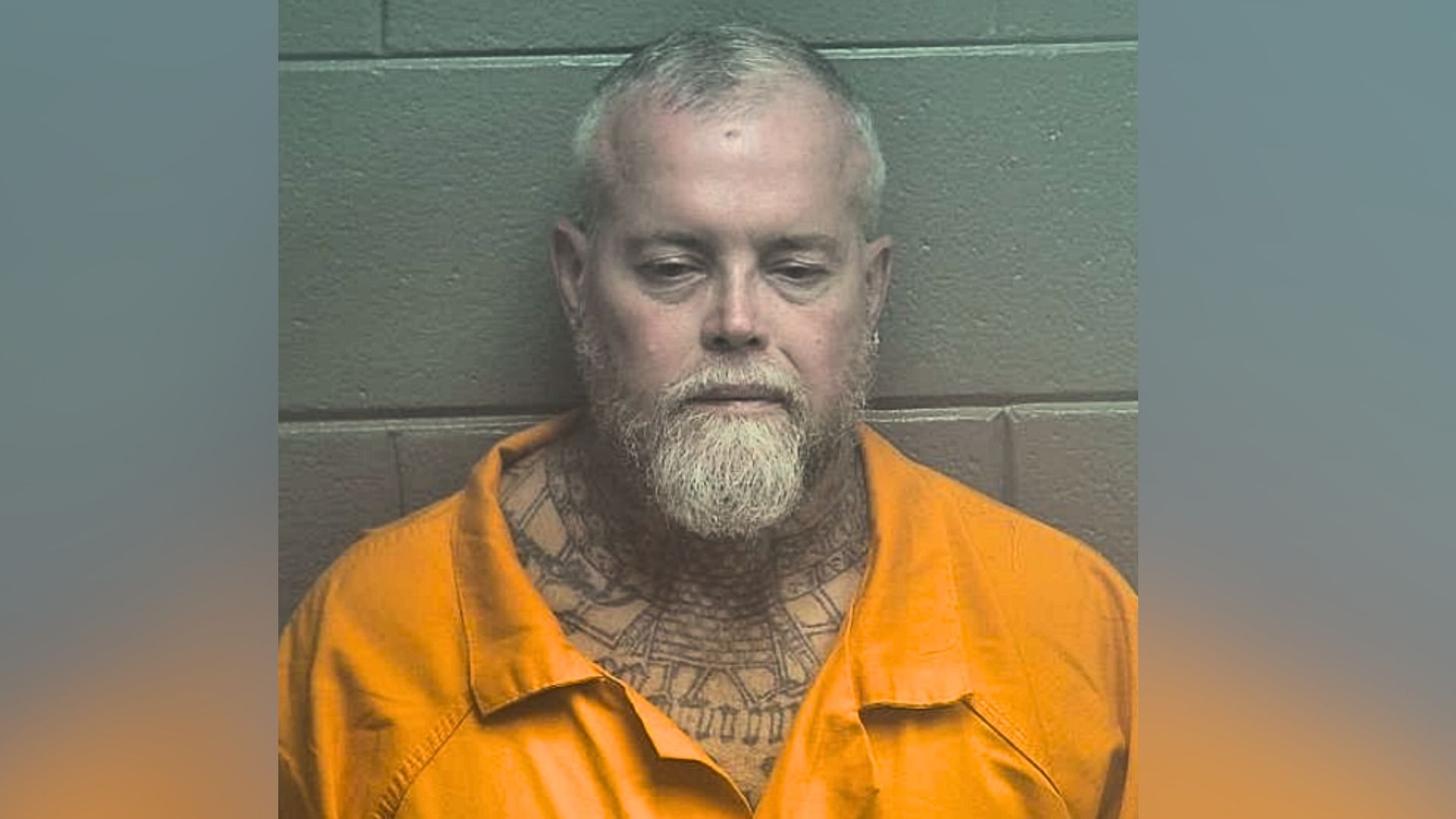
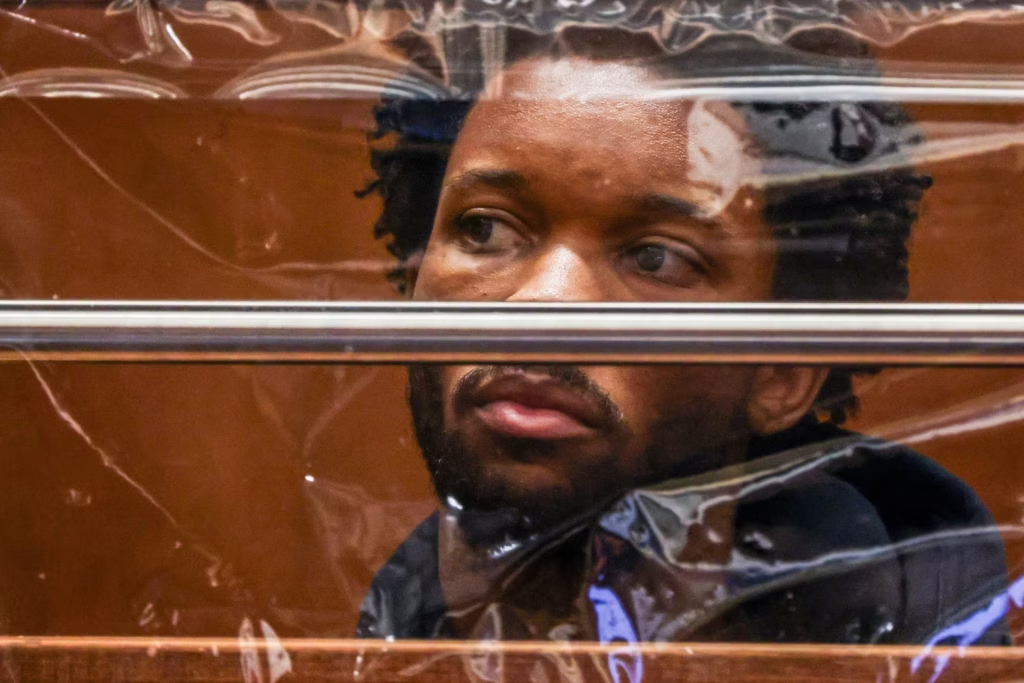
ames Farthing, the Kentucky man who won a $167.3 million Powerball jackpot in April 2025, was arrested Sunday for the fourth time since claiming the largest lottery prize in the state’s history, this time on charges of strangling a woman following a boating trip.
Farthing, 51, of Georgetown, was booked into Scott County Jail and is being held on charges of first-degree strangulation, domestic violence related, and fourth-degree assault causing minor injury, jail records confirmed.
What We Know So Far
The unidentified woman told police she and Farthing argued after returning from a boating trip. She said Farthing placed both hands around her neck and restricted her breathing, WKYT confirmed.
Farthing appeared in Scott County District Court on Tuesday and entered a not guilty plea. A judge set his bond at $15,000 and ordered him to have no contact with the alleged victim. He must also wear an electronic monitoring device that alerts authorities if he violates the order, People confirmed.
It is his fourth arrest since winning the Powerball in April 2025.
His first arrest came just four days after claiming his prize. On April 30, 2025, Farthing was arrested at the TradeWinds Resort in St. Pete Beach, Florida, after allegedly punching another guest at the hotel and then kicking a Pinellas County sheriff’s deputy in the face when officers arrived to break up the fight. He was charged with battery on a law enforcement officer and resisting arrest. He later pleaded guilty and received a sentence of time served and $1,000 in fines.
In February 2026, Farthing was arrested in Georgetown on an intimidation charge after a woman called 911 saying she feared for her life. Officers found the woman hiding under a desk. She told investigators Farthing had allegedly pressured her to take a drug. A search of the home uncovered a handgun, ammunition, marijuana, and drug paraphernalia.
In March 2026, Farthing was arrested a third time on charges of second-degree burglary and marijuana possession. Police alleged security footage showed him entering a Lexington home and stealing approximately $12,000 in cash. He was booked into the Fayette County Detention Center and later released on bond.
Sunday’s domestic violence arrest is his fourth.
What Farthing Said After His Earlier Arrests
After his Florida arrest in 2025, Farthing spoke to WKYT about making better choices.
“I’ve caused a lot of stress on her, my mom, you know, I’ve made some bad decisions in life, and you know, God’s been good because I’ve kept my faith and done right, and something’s happened good for me,” he said in May 2025.
When he won the jackpot in April 2025, Farthing said he planned to split the prize with his mother, Linda Grizzle.
“It’s going to be a good Mother’s Day,” Grizzle told WHAS at the time. “This is going to pay off my debt.”
Why This Matters
Farthing’s criminal record predates his lottery win by decades. It dates to 1994 and includes arrests in multiple Kentucky counties on charges including burglary, drug offenses, engaging in organized crime, and escaping from a detention facility, WKYT confirmed.
Under Kentucky law, anyone 18 or older may legally purchase a lottery ticket regardless of their criminal history, unless the terms of their probation or parole specifically prohibit it.
The series of arrests since April 2025 illustrates a pattern that has become a recurring media story: lottery winners whose sudden wealth does not resolve pre-existing behavioral or legal problems and in some cases appears to accelerate them.
Farthing won the $2 Powerball ticket that produced Kentucky’s largest-ever lottery prize on April 26, 2025, in Georgetown. He and his mother collected the prize and posed with an oversized check two days later. Four days after that, he was in a Florida jail.
What Happens Next
Farthing remains in Scott County Jail on the domestic violence charges. His bond is set at $15,000.
He faces active legal proceedings in multiple jurisdictions, including the Florida case, the Georgetown intimidation charge, and the Lexington burglary case, in addition to Sunday’s arrest.
A no-contact order and electronic monitoring are now in place as conditions of his release once bail is posted.
Russia’s Federal Security Service charged Pavel Durov, the billionaire founder and chief executive of the Telegram messaging app, with aiding terrorism on Wednesday and placed him on an international wanted list, in the latest escalation of the Kremlin’s campaign to bring digital communications under state control.
The charges against Durov, 41, who was born in Russia but lives in Dubai and holds citizenship in France, the United Arab Emirates, and the Caribbean nation of St. Kitts and Nevis, could carry a sentence of up to life in prison if he is convicted in a Russian court.
What We Know So Far
The FSB said in a statement that Telegram’s administration had failed to remove channels, chats, and bots allegedly used by Ukrainian intelligence agencies and extremist organizations to plan and coordinate terrorism, sabotage, mass murder, and cyberfraud inside Russia, resulting in what it described as numerous human casualties, the Associated Press confirmed.
The FSB also accused Ukrainian security services of using a popular dating chatbot on Telegram called Daivinchik, which has 13.6 million monthly active users, to lure and recruit Russians for what it called sabotage and terrorist activities. It said 46 users of the chatbot, aged between 12 and 22, had been detained across Russia over the past year for assaulting law enforcement officers and committing arson.
Durov had said earlier this year that Russian authorities had already opened a criminal investigation against him. He accused them of fabricating pretexts to restrict Telegram as part of an effort to suppress privacy and free speech.
Telegram did not respond to a request for comment. Its official account on X posted an image of Durov raising a middle finger to the camera.
Telegram boasts more than one billion monthly active users worldwide. Its company is based in Dubai, where Durov has resided since leaving Russia in 2014.
Durov’s History With Russia And France
Durov founded VKontakte, Russia’s largest social network, with his brother Nikolai in 2006. The platform came under pressure following mass anti-Kremlin protests in 2011 and 2012, eventually prompting Durov to sell his stake and leave the country.
He and Nikolai launched Telegram in 2013. Russia tried and failed to block the platform between 2018 and 2020.
In August 2024, French authorities arrested Durov in Paris on allegations that Telegram was being used for drug trafficking and the distribution of child sexual abuse material. He was released after four days of questioning on five million euros bail. French investigators have questioned him repeatedly since then, including as recently as this month, the Paris prosecutor’s office told the Associated Press. He remains under formal investigation in France.
Durov said in March 2025 that he had returned to Dubai after spending several months in France.
What Authorities Are Saying
The FSB called Telegram’s failure to moderate harmful channels a direct enabler of violence inside Russia.
Durov has consistently rejected that framing, describing Russian pressure on Telegram as politically motivated censorship rather than legitimate law enforcement.
The Kremlin’s position has shifted notably. When French authorities arrested Durov in 2024, Putin’s spokesman Dmitry Peskov criticized the action as selective. He said at the time that terrorists also use cars and asked why no one was arresting the CEO of Renault or Citroen. Peskov did not respond to questions Wednesday about what had changed in Russia’s own position.
Despite the charges and restrictions, Russian government agencies continue to use Telegram regularly. The Kremlin’s own Telegram channel had more than 284,000 followers as of Wednesday, the Associated Press confirmed.
Why This Matters
Wednesday’s charges represent a significant escalation in Russia’s long-running effort to control the internet, timed as the country prepares for parliamentary elections in September amid public fatigue with the Ukraine war and growing economic strain.
Under Putin, Russia has systematically restricted or banned platforms that declined to comply with state demands. Facebook, Instagram, and X have all been banned. YouTube has been throttled. Signal and Viber have been blocked. WhatsApp and Telegram have been restricted. In their place, Russian authorities actively promote a state-aligned messaging app called MAX, which openly states it will share user data with authorities on request and does not use end-to-end encryption.
Russia’s move against Telegram carries an additional irony. Russian military bloggers have repeatedly criticized the platform’s restriction, arguing Telegram is an indispensable tool for Russian troops in Ukraine and for activists running crowdfunding campaigns to support Russian forces. The government initially promised not to restrict Telegram on the battlefield. That promise was later walked back.
Russia itself has faced accusations from the United Kingdom, the Netherlands, and Ukraine of using Telegram to recruit individuals for sabotage operations across Europe. A British man was recruited through the platform to organize a plot to set fire to a warehouse in London containing satellite equipment for Ukraine. Dutch teenagers were contacted by Russian hackers on Telegram to map Wi-Fi networks in The Hague near the International Criminal Court and other sensitive institutions. Moscow has denied involvement in those incidents.
Telegram has long faced criticism in both Russia and the West for insufficient content moderation. Its architecture, allowing group chats of up to 200,000 users, significantly outpaces rivals and creates conditions where misinformation and criminal coordination can spread quickly. Its end-to-end encryption is available only for individual conversations and must be manually activated, unlike Signal and Facebook Messenger where it is on by default.
What Happens Next
Durov faces an international wanted notice issued by Russia. Whether that notice will have practical effect depends on which countries choose to honor it. Durov lives in Dubai and holds UAE citizenship, and the UAE has not been part of Russian extradition arrangements historically.
The Paris prosecutor’s office confirmed Durov remains under formal investigation in France, with questioning continuing as recently as this month. He faces potential charges in France covering alleged criminal activities linked to Telegram’s operations.
Both legal processes are proceeding simultaneously and independently. Durov’s response to the Russian charges, delivered via a middle finger photograph on his own platform, suggests he has no intention of engaging with Russian judicial proceedings from abroad.
Iran launched a new wave of missile attacks against United States military positions in the Middle East on Wednesday, while American and Saudi forces carried out coordinated airstrikes against Tehran backed militias in Iraq, sharply escalating tensions across the region.
The renewed fighting comes after several days of relative calm and threatens to derail diplomatic efforts aimed at restoring a ceasefire between Washington and Tehran.
The Associated Press said the coordinated military operations killed at least 20 militia fighters and six Iranian military advisers in eastern Iraq, according to Iraqi militia officials.
Iran’s latest missile barrage targeted Muwaffaq Salti Air Base in Jordan, a major United States military installation supporting regional operations.
Iran’s Revolutionary Guard said it launched ballistic missiles against the base in retaliation for recent American military actions.
Jordan’s armed forces said air defense systems intercepted five incoming missiles before they reached their targets. Authorities reported no casualties or significant damage.
Shortly afterward, the United States military announced that American and Saudi fighter aircraft had struck multiple logistics centers and weapons storage facilities linked to Iran backed militias in eastern Iraq.
Saudi Arabia said the operation followed recent drone attacks targeting its oil infrastructure.
The Saudi Defense Ministry said the kingdom does not seek further escalation but would respond to attacks threatening its national security.
The Popular Mobilization Forces, a coalition of largely Shiite armed groups aligned with Iran, said the overnight strikes killed at least 20 fighters and wounded 32 others.
Two militia officials also confirmed that six Iranian military advisers died during the attacks. They spoke on condition of anonymity because they were not authorized to discuss military operations publicly.
The Iraqi government condemned the airstrikes, describing them as a violation of national sovereignty.
President Nizar Amidi’s office said the attacks breached Iraq’s territorial integrity, while the National Security Council said the government had already been working with American and Saudi officials to investigate earlier drone incidents.
The renewed violence forced the postponement of Iraqi Prime Minister Ali al Zaidi’s planned visit to Saudi Arabia, highlighting the growing diplomatic fallout.
The fighting extended beyond Iraq.
Two commercial vessels carrying natural gas caught fire after drone strikes at Egypt’s Damietta port, maritime security company Ambrey said.
One vessel is owned by a United States company while the other belongs to a Greek operator.
No injuries were reported, and investigators have not identified those responsible for the attacks.
The latest military exchanges have renewed concerns over energy security across the Middle East.
Saudi Arabia accused Iran backed militias operating from Iraq of launching drones against key oil facilities over the past two days.
An umbrella organization representing several Iraqi militias denied involvement.
Meanwhile, Yemen’s Houthi movement claimed responsibility for separate drone strikes targeting Saudi energy infrastructure, describing the attacks as part of its ongoing confrontation with the kingdom.
France24, citing Agence France Presse, said Saudi authorities intercepted several drones launched from Iraqi territory before they reached petroleum facilities in eastern Saudi Arabia and the capital, Riyadh.
Saudi officials urged Iraq to prevent armed groups from using its territory to launch attacks against neighboring countries.
The Houthis separately announced strikes on Saudi oil infrastructure, saying they were responding to alleged Saudi drone operations over Yemen.
Saudi authorities have not publicly confirmed the Houthi claims.
The latest exchanges threaten to deepen an already fragile regional security environment.
The Houthis have also declared a blockade targeting Saudi shipping routes through the Bab el Mandeb Strait, a critical maritime corridor connecting the Red Sea with the Gulf of Aden.
Earlier this week, satellite imagery analyzed by The Associated Press showed apparent damage to Saudi Aramco’s Abqaiq oil processing complex following previous attacks.
Regional officials also confirmed that a refinery in Jazan temporarily halted production after sustaining significant damage during recent strikes.
The refinery processes about 400,000 barrels of crude oil each day.
The renewed fighting has also complicated efforts to restore commercial shipping through the Strait of Hormuz.
Iran’s Deputy Foreign Minister Kazem Gharibabadi said Tehran rejected a proposal from Oman to jointly manage vessel traffic through the strategic waterway.
Instead, Iran proposed temporary shipping arrangements through its territorial waters while maintaining tighter control over maritime traffic.
Gharibabadi said Tehran does not intend to return the strait to its prewar operating conditions.
The Strait of Hormuz remains one of the world’s most important energy corridors, carrying roughly one fifth of global oil shipments.
Continued disruptions have fueled concerns about supply shortages and higher fuel costs worldwide.
Financial markets reacted quickly to the latest military escalation.
Brent crude oil rose 3.1 percent to $84.58 per barrel as traders assessed the potential impact on global energy supplies.
Diplomatic efforts continue despite the renewed fighting.
Regional mediators said negotiations remain active, although officials acknowledged that restoring a ceasefire has become increasingly difficult following renewed clashes around the Strait of Hormuz.
One regional official familiar with the talks said discussions are continuing with both Washington and Tehran but declined to provide details because of the sensitivity of the negotiations.
President Donald Trump signaled that additional military action remains possible.
“It is going to be straightened out,” Trump said. “In the meantime, we are going to be hitting them very hard because it is our turn to hit them.”
What we know so far
Iran launched ballistic missiles toward a United States military base in Jordan, where all reported missiles were intercepted.
American and Saudi aircraft struck Iran backed militia positions in Iraq, killing at least 20 fighters and six Iranian advisers, militia officials said.
Drone attacks also damaged two natural gas vessels at Egypt’s Damietta port, though responsibility has not been established.
Saudi Arabia says it intercepted additional drones targeting oil facilities, while Yemen’s Houthis claimed separate attacks on Saudi energy infrastructure.
Oil prices climbed as concerns grew over potential disruptions to global energy supplies.
What authorities are saying
Jordan’s military said its air defenses successfully intercepted all incoming missiles.
Saudi Arabia said it acted in self defense and called on Iraq to prevent armed groups from launching attacks from its territory.
Iraq condemned the airstrikes, calling them a violation of its sovereignty.
Iran defended its missile launches as part of its broader military response and rejected proposals that would reduce its control over shipping through the Strait of Hormuz.
Why this matters
The latest escalation illustrates how quickly localized military actions can spread across multiple countries in the Middle East.
The involvement of Iran, the United States, Saudi Arabia, Iraq, Jordan and Yemen increases the risk that isolated confrontations could develop into a broader regional conflict involving additional state and nonstate actors.
The attacks also threaten global energy markets. Any prolonged disruption to oil exports through the Strait of Hormuz or the Bab el Mandeb Strait could drive higher energy prices, increase inflation and place additional pressure on economies already coping with geopolitical uncertainty.
Diplomatic efforts now face greater challenges as military operations continue alongside stalled negotiations.
What happens next
Military officials are expected to assess the effectiveness of the latest operations while strengthening defenses around key regional bases and energy infrastructure.
Diplomatic mediators are likely to continue efforts to restore negotiations between Washington and Tehran, although further retaliation by either side could complicate those talks.
Energy markets will remain focused on developments around the Strait of Hormuz and Saudi oil facilities, where any additional disruption could have immediate global economic consequences.
Sources: This report is based on reporting by The Associated Press and France24, which cited Agence France Presse (AFP)
A powerful earthquake that struck southwestern Japan has killed at least 13 people and left dozens injured as emergency crews continue searching for survivors trapped beneath collapsed buildings.
The magnitude 7.1 earthquake struck Tuesday afternoon in Kumamoto Prefecture on Japan’s southern island of Kyushu. The shallow quake caused widespread structural damage, disrupted transportation and triggered a brief tsunami advisory that was later lifted.
Prime Minister Sanae Takaichi said rescue operations remain the government’s highest priority.
“People are still waiting to be rescued, and this is a race against time,” Takaichi said. “We will use every available resource to save as many lives as possible.”
Thousands of military personnel, firefighters and disaster response teams have been deployed across the affected region as authorities work to reach victims trapped beneath rubble.
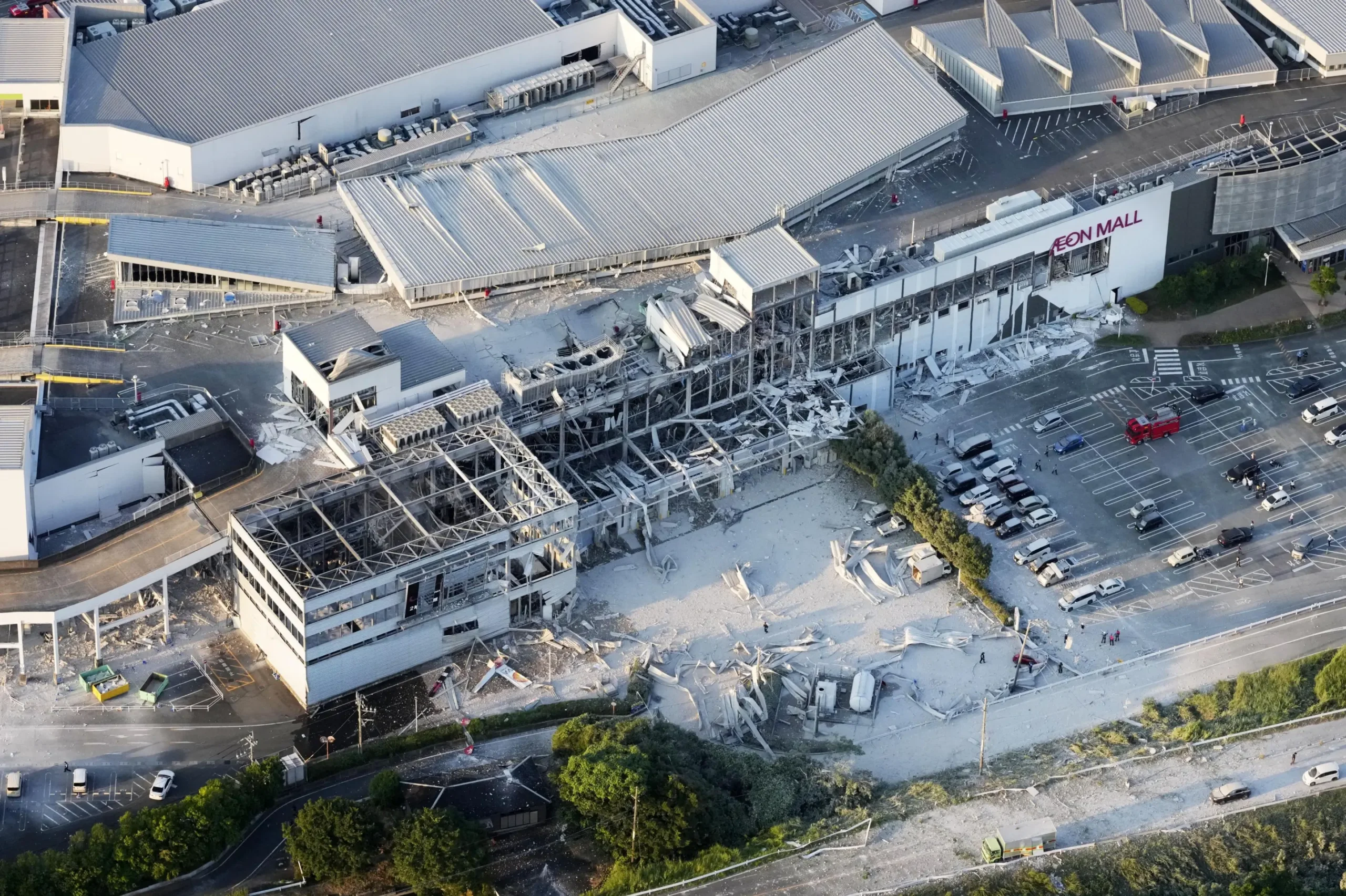
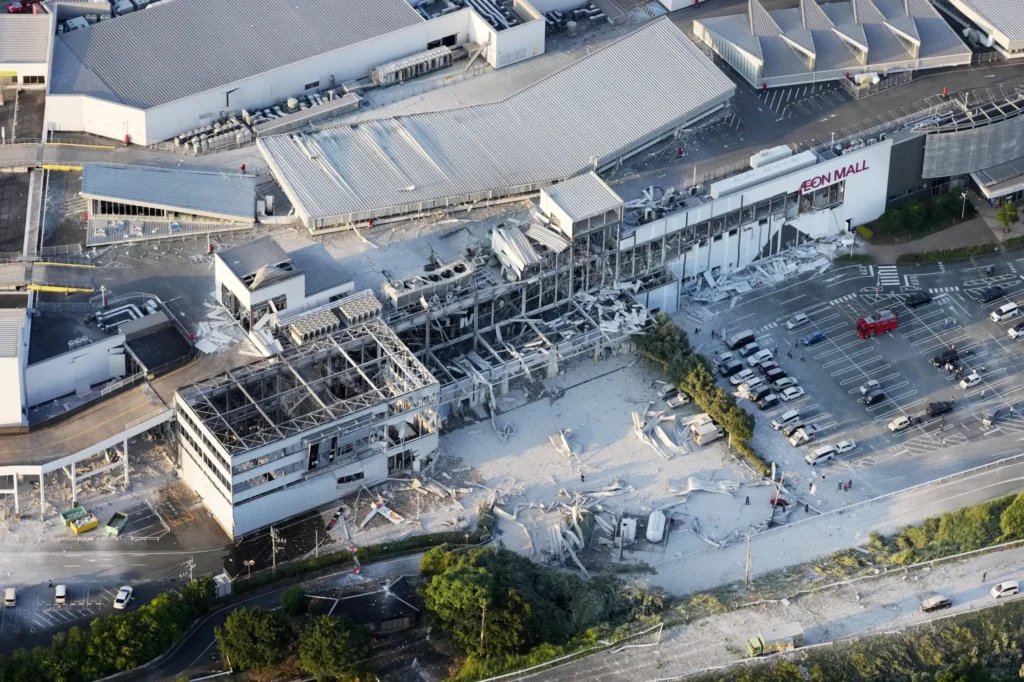
One of the deadliest incidents occurred at an Aeon shopping mall in Kashima Town, where part of the second floor collapsed following what investigators believe may have been a gas explosion triggered after the earthquake.
Two women in their twenties were among those killed inside the shopping complex. Rescue teams pulled several survivors from the debris, while search efforts continued for others believed trapped beneath the collapsed structure.
Witnesses said they detected the smell of gas before hearing a powerful explosion nearly an hour after customers had begun evacuating.
A shop employee told Japanese broadcaster TBS that staff returned briefly after helping customers leave the building when they noticed a strong gas odor before the explosion occurred.
Another major rescue operation is underway at Nippon Paper Industries’ factory in Yatsushiro, where a massive chimney collapsed during the quake.
Officials said multiple workers became trapped beneath debris. Emergency crews continued searching throughout Wednesday after recovering several victims.
The earthquake also damaged roads, bridges and residential neighborhoods across Kumamoto Prefecture.
Historic Kumamoto Castle, which continues to undergo restoration following the devastating 2016 earthquake, sustained additional structural damage as sections of stone walls collapsed.
Power outages affected approximately 35,000 households across Kyushu, while ruptured water lines and damaged infrastructure complicated emergency operations.
Authorities urged residents to remain alert for extreme heat as temperatures climbed into the upper 90s while many communities remained without electricity.
Transportation across southern Japan also suffered significant disruption.
Bullet train services throughout Kyushu were suspended while engineers inspected railway lines for structural damage.
A freight train derailed at Yatsushiro Station during the violent shaking, while flights at Aso Kumamoto Airport remained suspended as officials assessed runway conditions.
Several major manufacturers temporarily halted production.
Toyota suspended operations at three factories in Kyushu for safety inspections. Honda Motor Co., Nippon Paper Industries and other companies also paused operations while damage assessments continued.
Delivery services into affected communities were disrupted as damaged roads slowed transportation.
Hospitals across Kumamoto and neighboring cities treated dozens of injured residents, including passengers hurt aboard high speed trains during the earthquake.
More than 260,000 residents were advised to evacuate vulnerable coastal and low lying areas after tsunami advisories were issued for parts of western Kyushu.
The Japan Meteorological Agency later canceled the advisory after determining that tsunami risks had subsided.
Officials, however, warned that powerful aftershocks remain likely.
The agency cautioned residents to prepare for additional earthquakes of similar intensity over the coming week, particularly during the next two to three days.
Japan’s Nuclear Regulation Authority said inspections found no abnormalities at nearby nuclear power stations, including the Sendai nuclear plant.
The International Atomic Energy Agency said it had been informed of the inspections and would continue monitoring developments.
The safety of nuclear facilities remains a major concern in Japan following the 2011 earthquake and tsunami that triggered reactor meltdowns at the Fukushima Daiichi nuclear power plant.
Japan sits along the Pacific Ring of Fire, one of the world’s most seismically active regions where multiple tectonic plates converge.
The country experiences nearly one fifth of all earthquakes worldwide measuring magnitude 6.0 or greater, making strict building standards and rapid emergency response central to disaster preparedness.
What we know so far
At least 13 people have died.
Dozens of others were injured.
Several people remain missing beneath collapsed structures.
Part of an Aeon shopping mall and a chimney at a paper factory collapsed.
More than 260,000 residents received evacuation advisories.
Around 35,000 households lost electricity.
Rail services, airport operations and manufacturing were disrupted.
No damage has been reported at nearby nuclear power plants.
What authorities are saying
Prime Minister Sanae Takaichi said the government has mobilized all available emergency resources to locate survivors and restore essential services.
Japan’s Meteorological Agency warned residents to expect potentially strong aftershocks during the coming days and urged continued caution around weakened buildings.
The Nuclear Regulation Authority said inspections found no operational problems at nearby nuclear facilities.
Why this matters
The earthquake underscores Japan’s continued vulnerability to powerful seismic events despite decades of investment in earthquake resistant infrastructure and emergency preparedness.
Although modern engineering has significantly reduced casualties compared with past disasters, aging buildings, industrial facilities and densely populated commercial centers remain vulnerable when powerful shallow earthquakes strike near urban areas.
The disaster also serves as a reminder that recovery from previous earthquakes, including the devastating 2016 Kumamoto disaster, remains an ongoing challenge as historic landmarks and public infrastructure continue to undergo reconstruction.
What happens next
Rescue teams will continue searching collapsed buildings while engineers inspect roads, bridges and public infrastructure for additional damage.
Authorities are expected to maintain evacuation shelters until utilities are restored and structural inspections determine that affected neighborhoods are safe for residents to return.
Seismologists will closely monitor aftershock activity over the coming days, while government agencies begin assessing long term reconstruction costs and financial assistance for affected communities.
Sources: This story is based on reporting by The Associated Press and NBC News
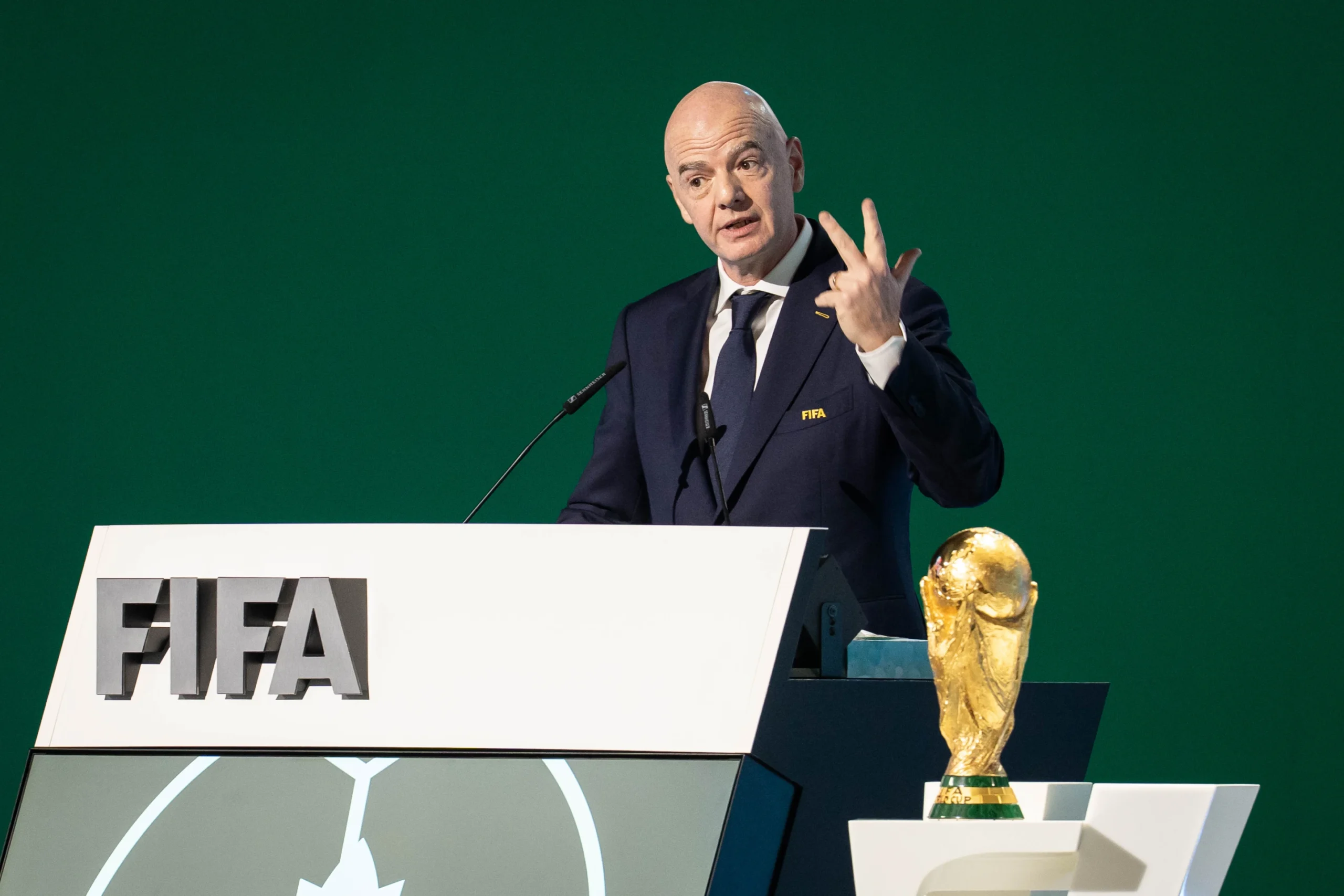
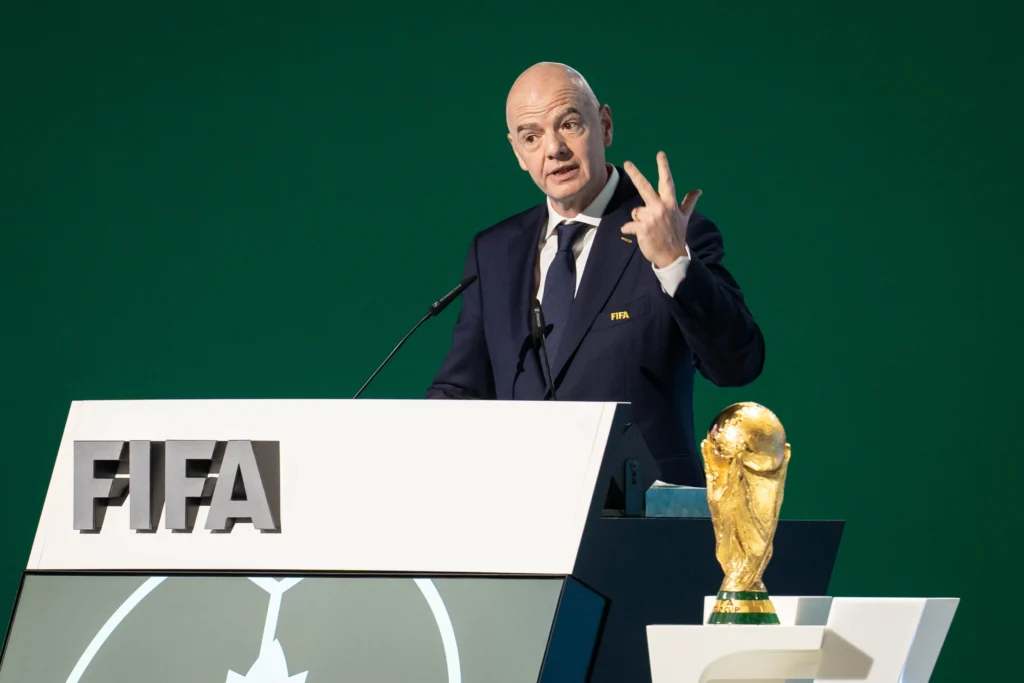
FIFA announced plans Tuesday to sell a minority stake in a new commercial subsidiary that would control the World Cup and its other major competitions to private investors, in a proposal that would raise up to $4.2 billion and potentially set FIFA president Gianni Infantino on course to earn as much as $64 million a year running the new entity.
The announcement drew immediate and fierce condemnation from European football’s governing body UEFA, which called it a betrayal of the game’s fundamental principles, and from political figures including British Prime Minister Andy Burnham.
What We Know So Far
Under the plan, FIFA would create a new entity called FIFA Forward Enterprise, or FFE, to oversee all commercial and event operations including the World Cup, Club World Cup, and associated competitions. FIFA would retain majority control of FFE but sell up to 21 percent of the subsidiary to private investors, Reuters confirmed.
Thrive Eternal, a long-term investment vehicle founded by Joshua Kushner, is expected to lead the proposed investor group, FIFA confirmed. Kushner, 41, is the brother of Jared Kushner, President Donald Trump’s son-in-law. Jared Kushner is not a potential investor, a source told Reuters. The Trump administration was reportedly aware of Infantino’s plan, according to the Times of London.
Apollo Sports Capital, the long-term sports investment vehicle set up by private equity firm Apollo Global Management, is another likely backer, the Athletic reported.
FIFA said it is working with JPMorgan as its chief financial adviser on the project. Former Liberty Media chief executive Greg Maffei and Rome-based consultancy OpenEconomics are also serving as advisers. Former Walt Disney CEO Bob Iger serves as an adviser to Thrive Eternal.
The $4.2 billion raised from the minority stake sale would be immediately released to FIFA’s 211 member associations through a new funding stream called the FIFA Fast-Forward Programme. Each member association would be allowed to draw an optional $20 million for special projects, infrastructure, coaching, national teams, and grassroots and women’s football. Regular Forward Programme grants would also increase from $8 million to $20 million per nation in the next four-year cycle, rising to $24 million by 2035 to 2038, the New York Times confirmed.
FIFA said outside investors would have no operational role in FFE and would not have any say in football governance, competition rules, the match calendar, or regulatory decisions.
“Outside investors will have only a minority stake in FFE and will not play any operational role,” FIFA said. “For FIFA, nothing changes.”
FIFA, a not-for-profit organization, generated approximately $15 billion in revenue during the 2022 to 2026 World Cup cycle, Reuters confirmed, beating its $13 billion target and doubling the amount earned in the previous cycle.
The Times of London reported that Infantino would run FFE as its commissioner after his FIFA presidency ends in 2031 with a salary comparable to NFL commissioner Roger Goodell’s reported $64 million annually, a tenfold increase from his current earnings. When asked about that claim, a FIFA spokesperson told the Athletic that the matter had never been formally discussed but that the FIFA president “must have a leading role in this entity.”
Infantino framed the proposal in terms of global equity.
“Football is the world’s most popular sport and an extraordinary engine of human and social development,” Infantino said in a statement. “Our job is to make sure the rest of football grows with it. This is about the democratisation of football worldwide.”
The proposal will be presented to FIFA’s 211 member associations and its 37-member council, which would make the final decision on whether it proceeds.
Kushner is close to FIFA’s plans, and is also bidding for the Las Vegas NBA franchise with Bob Iger.Jamie McCarthy / Getty Images
What UEFA And Others Are Saying
UEFA responded with a statement of unusual severity.
“This crosses a line that football’s governing institutions should never cross,” UEFA said. “The soul and governance of football are not assets to trade, especially with zero transparency as to who gains financially. None of us are the owners of football. It is not FIFA’s to sell.”
Relations between UEFA and FIFA have deteriorated significantly in recent years. UEFA president Aleksander Ceferin refused to attend the 2026 World Cup final following disagreements over disciplinary procedures, refereeing logistics, and match operations.
British Prime Minister Andy Burnham was equally blunt.
“The World Cup is not a product,” Burnham wrote on X. “It is the greatest competition in world sport, and it was never anyone’s to sell. Dress the deal up however you like. Once you have sold a piece of it, you have sold out. Football belongs to the fans. It always has, and it always will.”
U.S. Congressman Jamie Raskin, a Democrat from Maryland who has requested Infantino appear before the House Judiciary Committee over FIFA’s ties to the Trump administration, said: “Soccer fans were already priced out of the World Cup by FIFA’s corrupt price gouging before. More oligarch corruption just means more corporate tarnishing of the beautiful game.”
Richard Sheehan, a finance professor at the University of Notre Dame who studies the economics of sport, called the proposal a money grab.
“From the perspective of a not-for-profit organization, theoretically raising money to make soccer available to everyone, this move is a farce,” Sheehan said.
Not all observers were opposed. Some pointed out that similar commercial structures have been created by the French and Spanish football leagues, and that the German and Italian leagues have debated comparable moves. Formula One and golf’s PGA Tour have pursued equivalent strategies with private equity.
Why This Matters
The FIFA proposal represents the most significant attempt to commercialize the governance structure of world football since the sport’s modern administrative framework was established.
The World Cup is the most-watched sporting event on earth. Its commercial value, concentrated in broadcasting rights and sponsorship, generates revenue that dwarfs most other sporting competitions. Placing a minority stake in the entity that controls that revenue in the hands of private investors fundamentally changes the incentive structure that governs decisions about the tournament’s format, frequency, and accessibility.
Critics, led by UEFA, argue that private investors motivated by returns will inevitably push for a larger World Cup, more frequent editions, and expanded commercial exploitation of the event in ways that benefit shareholders rather than the global development of the sport. A 64-team World Cup and a more frequent or enlarged Club World Cup are widely regarded as likely outcomes if FFE is approved and private investors seek to maximize the value of their stake.
The involvement of Joshua Kushner also raises questions that go beyond the technical merits of the proposal. His brother Jared’s central role in securing the 2026 World Cup for the United States and in particular for MetLife Stadium in New Jersey, combined with Infantino’s close relationship with President Trump during the tournament, places the FFE investor structure at the intersection of sports governance and American political connections in ways that the Athletic noted have already raised eyebrows across the global game.
This is not Infantino’s first attempt to bring external investment into FIFA’s operations. A $25 billion proposal in 2018 involving SoftBank and Saudi Arabia’s sovereign wealth fund fell apart due to lack of support. A FIFA streaming service discussed with former U.S. Treasury Secretary Steven Mnuchin also never materialized.
What Happens Next
The proposal will be formally presented to FIFA’s 211 member associations and its 37-member council. A majority of member associations must approve it for the plan to proceed.
FIFA’s pitch to member associations will center on the expanded development funding the capital raise would unlock. For smaller and developing football nations that rely heavily on FIFA grants for most of their income, the prospect of accessing $20 million in one-off capital funding for infrastructure and development projects will make the proposal genuinely attractive, regardless of UEFA’s objections.
Whether UEFA’s fierce opposition translates into enough resistance among member associations to block the plan, or whether the development funding offer wins enough votes to carry the proposal, will determine whether Infantino’s most ambitious commercial initiative since taking office becomes reality or joins his earlier investment proposals as another idea that failed to gain sufficient support.
Sources: The New York Times; Reuters; Yahoo Sports
Kenya’s High Court has ruled that the government’s ban on shisha is no longer legally enforceable after authorities failed to correct procedural flaws identified in the regulations years ago, handing a significant legal victory to traders and users of the tobacco product.
Justice Bahati Mwamuye ruled Tuesday that the Public Health (Control of Shisha Smoking) Rules, 2017 ceased to have legal effect after the government failed to amend the regulations within a nine month period ordered by the court in an earlier judgment.
The ruling prevents government agencies from relying on the 2017 regulations to arrest traders, close businesses or enforce the nationwide prohibition on shisha.
The case was brought by the Novel Tobacco Products Association, which challenged continued government enforcement of the ban despite a previous High Court ruling that identified procedural defects in the regulations.
Justice Mwamuye found that the government failed to address those legal shortcomings after Justice Roselyne Aburili, in July 2018, allowed the regulations to remain in force for nine months to give the Ministry of Health time to correct them.
When that deadline expired without the required amendments, the regulations automatically lost legal force, the judge ruled.
“The Public Health Control of Shisha Smoking Rules, 2017, ceased to have effect upon the expiry of nine months from July 26, 2018,” Justice Mwamuye said in his judgment.
The court also struck down two government notices issued this year that sought to continue enforcing the prohibition.
Those included a February 3, 2025, statement declaring the shisha ban remained in force and an April 14, 2025, directive ordering a crackdown on shisha outlets in Nairobi.
Justice Mwamuye declared both notices unlawful and unconstitutional, saying they relied on regulations that no longer had legal standing.
He further issued a conservatory order preventing the Ministry of Health and other government agencies from enforcing the two directives against members of the Novel Tobacco Products Association.
The judgment also held that tobacco products cannot be prohibited through subsidiary legislation that does not comply with the Statutory Instruments Act, 2013.
The court further ruled that the current legal framework treats some tobacco products differently without constitutional justification, violating Article 27 of Kenya’s Constitution, which guarantees equality before the law.
The dispute dates back to Legal Notice No. 292 of 2017, which imposed a blanket prohibition on the importation, manufacture, sale, advertising, promotion, distribution and use of shisha across Kenya.
In the earlier 2018 decision, Justice Aburili found procedural defects in the way the regulations had been introduced but allowed them to remain temporarily while the government corrected those deficiencies.
The government never completed that process.
Justice Mwamuye also rejected arguments challenging the association’s legal standing, ruling that it was entitled to file the petition on behalf of its members and that the case had not been brought after an unreasonable delay.
The court found that continued enforcement of the expired regulations infringed constitutional protections relating to equality, property rights, fair administrative action and the right to a fair hearing.
The decision effectively removes the legal basis that authorities have relied upon in recent years to enforce the shisha ban.
Government officials have not publicly indicated whether they will appeal the ruling or introduce new legislation to regulate or prohibit shisha under a legally compliant framework.
The judgment does not prevent Parliament or the Ministry of Health from pursuing future restrictions. It requires that any such measures comply with constitutional procedures and Kenya’s statutory law.
The ruling is expected to have immediate implications for businesses that sell shisha, many of which had faced repeated enforcement operations despite the unresolved legal questions surrounding the 2017 regulations.
Legal analysts say the decision also reinforces judicial oversight of delegated legislation, signaling that government agencies must comply with statutory rule making procedures before restricting commercial activities or public conduct.
The case is likely to influence future legal challenges involving regulations enacted without full compliance with Kenya’s legislative requirements.
What We Know So Far
Kenya’s High Court ruled that the 2017 shisha regulations are no longer legally enforceable.
The government failed to amend the regulations within the nine month period ordered by the court in 2018.
Authorities can no longer rely on the expired regulations to arrest traders or close shisha businesses.
The court also invalidated two 2025 government notices used to continue enforcing the ban.
What Authorities Are Saying
Justice Bahati Mwamuye ruled that the regulations expired after the government failed to regularize them within the court ordered period.
The court also held that banning tobacco products through regulations that do not comply with the Statutory Instruments Act is unlawful and that unequal treatment of tobacco products violates constitutional guarantees of equality.
Why This Matters
The ruling represents one of Kenya’s most significant judicial decisions on delegated legislation in recent years.
Beyond shisha, the judgment reinforces the principle that government regulations must follow constitutional and statutory procedures before they can limit business activities or individual rights. The decision could influence future legal challenges involving regulations introduced without full legislative compliance.
What Happens Next
The government may appeal the decision or introduce fresh legislation that complies with constitutional requirements if it wishes to continue regulating or banning shisha.
Until then, authorities cannot lawfully enforce the expired 2017 regulations or rely on the invalidated 2025 directives against affected traders.
A Georgia judge on Tuesday sentenced the teenager who admitted killing two students and two teachers at Apalachee High School to life in prison without the possibility of parole, concluding that the attack was carefully planned and that the defendant had shown no genuine remorse.
Colt Gray, 16, pleaded guilty to 55 criminal charges, including murder, in connection with the Sept. 4, 2024, shooting at Apalachee High School in Barrow County, northeast of Atlanta. Under Georgia law, the murder convictions required a life sentence, leaving the court to determine whether Gray would ever be eligible for parole. Judge Nicholas Primm ruled that he would not.
“You do not seem to be tormented by what you did,” Primm told Gray during sentencing. “You seem to relish following in the footsteps of the murderers you idolize.”
What we know so far
The attack claimed the lives of teachers Richard “Ricky” Aspinwall, 39, and Cristina Irimie, 53, along with 14 year old students Mason Schermerhorn and Christian Angulo. Another teacher and eight students were wounded, seven of them by gunfire.
Victims’ relatives spent days addressing the court, describing the lasting emotional impact of the shooting and urging the judge to ensure Gray would never be released.
District Attorney Brad Smith argued that the teenager remained a continuing danger, telling the court investigators found no evidence suggesting he could fully value human life in the future.
Defense attorney W. Charlton Allen acknowledged Gray’s troubled upbringing but asked the judge to leave open the possibility of parole, arguing that the teenager was capable of rehabilitation and deserved hope for the future.
Investigators detailed months of planning
During the sentencing hearing, prosecutors presented evidence showing Gray had become deeply fascinated with notorious mass killers through online communities devoted to violent crimes.
Investigators testified that he admired previous school shooters, collected thousands of images of them and discussed gaining similar notoriety through a school attack. They also played recorded telephone conversations in which Gray appeared pleased by the attention his crimes had received online.
Prosecutors said the shooting was only one part of a broader plan to achieve lasting notoriety.
Family described years of instability
Gray’s maternal grandmother testified that her grandson experienced an unstable childhood marked by family conflict, substance abuse within the household and repeated pleas for mental health treatment that were never fully pursued. She said she regularly visited him in detention and believed he had improved with counseling and medication.
A defense psychologist described Gray as a lonely teenager who struggled with a chaotic upbringing and became immersed in online communities focused on school shootings.
Judge Primm acknowledged those failures but said they did not excuse Gray’s deliberate decisions.
“The failure does not absolve you from who you chose to idolize, worship and become,” the judge said.
What authorities are saying
District Attorney Brad Smith said the sentence reflected what victims’ families had sought throughout the proceedings.
“This is not a happy day. This is a relief day,” Smith told reporters after the hearing, adding that prosecutors hoped they had honored those affected by the shooting.
Judge Primm said the sentence could never erase the pain suffered by survivors and families but concluded that permanent imprisonment was necessary because of the calculated nature of the attack.
Why this matters
The Apalachee High School shooting renewed national debate over school security, youth mental health, firearm access and parental responsibility.
The case also drew attention because Gray’s father was separately convicted after prosecutors argued he knowingly provided his son with the rifle used in the attack despite warning signs about his behavior.
Legal experts say the sentence reinforces Georgia courts’ willingness to impose life without parole on juvenile defendants convicted of the most serious crimes when evidence shows extensive planning and extreme violence.
The case has also intensified discussions over preventing radicalization through online communities that glorify mass shootings, an issue investigators identified as central to Gray’s actions.
What happens next
Gray will spend the remainder of his life in the Georgia prison system without the possibility of parole. His guilty plea concludes the criminal proceedings against him, although the case is expected to continue influencing policy discussions on school safety, juvenile justice and firearm accountability across the United States.
Gunmen on a motorcycle killed a senior Taliban provincial official in northeastern Afghanistan on Tuesday in one of the rarest targeted assassinations of a high-ranking Taliban figure since the group seized power four years ago.
Zabihullah Amiri, the Taliban’s director of information and culture for Badakhshan province, was shot dead while traveling from Baharak toward his office in the provincial capital Faizabad on the Baharak-Faizabad road, Taliban police confirmed.
What We Know So Far
Two attackers on a motorcycle opened fire on Amiri’s vehicle in the Kol Dasht area near Baharak city, Taliban police spokesman Ehsanullah Kamgar confirmed to Pajhwok Afghan News.
Amiri’s bodyguards returned fire immediately. One attacker was killed and the second was captured, Kamgar said. Amiri’s driver was also wounded in the attack, Afghanistan International confirmed, citing sources.
Amiri’s body was transferred to Baharak clinic. Taliban forces surrounded the area following the assault.
No individual or group immediately claimed responsibility for the killing. The Taliban’s Information Ministry said in a statement that authorities were investigating.
The attack comes amid a period of increased military activity by anti-Taliban groups in Badakhshan, particularly the Afghanistan Freedom Front, which has recently claimed advances in Zebak district, the downing of Taliban drones, and the capture of Taliban posts in the province.
Rare But Not Unprecedented
Targeted killings of high-ranking Taliban officials have been uncommon since the group took control of Afghanistan following the withdrawal of U.S.-led forces in 2021, the Associated Press confirmed.
The most recent high-profile killing occurred in December 2024, when refugee minister Khalil Haqqani was killed in a suicide bombing in Kabul. Haqqani was the uncle of Interior Minister Sirajuddin Haqqani, who leads one of the most powerful factions within the Taliban movement.
In June 2023, a car bomb in Faizabad killed Badakhshan’s deputy governor and his driver. The Islamic State in Khorasan Province, a regional affiliate of the global extremist group, claimed that attack. A suicide bombing at a memorial service for the deputy governor days later killed at least 13 more people.
In March 2023, the governor of northern Balkh province was killed in a bomb attack on the governor’s office.
What Authorities Are Saying
Taliban spokesman Zabihullah Mujahid separately addressed reports of recent armed opposition activity in Badakhshan on Monday, dismissing accounts of fighting in Zebak district and claims that Yaftal district had fallen as “media propaganda.”
“The country was liberated through sacrifices and the loss of lives,” Mujahid said. “The Taliban would make twice as many sacrifices to defend it.”
The National Resistance Front of Afghanistan said its forces attacked a Taliban post in Kuran Wa Munjan district of Badakhshan on Sunday night, killing one Taliban fighter and wounding two others. Local sources confirmed the attack to Afghanistan International. Taliban local officials had not commented on those casualties.
The Afghanistan Freedom Front had also claimed advances in Zebak district in recent days. The Taliban said it repelled those attacks.
Why This Matters
Tuesday’s killing is significant precisely because it is rare. The Taliban has maintained a degree of internal security since 2021 that has kept targeted killings of officials at a level far below what occurred during the years of armed conflict preceding their takeover.
The concentration of recent incidents in Badakhshan is notable. The province borders Tajikistan and has historically been a site of resistance activity. The combination of the assassination, the National Resistance Front’s claimed attack on Sunday, and the ongoing Afghanistan Freedom Front operations in Zebak district suggests a possible coordinated increase in opposition activity in the northeast rather than isolated incidents.
The Islamic State in Khorasan Province remains active in Afghanistan and has previously claimed responsibility for attacks targeting Taliban officials in Badakhshan. Whether Tuesday’s killing is connected to that group, to one of the armed resistance fronts, or to a different actor will depend on the investigation Taliban authorities said was underway.
What Happens Next
Taliban security forces had surrounded the area and arrested one of the two attackers as of Tuesday. An investigation into the killing was underway, the Information Ministry confirmed.
No trial or prosecution details were immediately available. The arrested attacker’s identity and any claimed affiliation had not been disclosed publicly as of the time of reporting.
The killing will almost certainly prompt the Taliban to increase security for provincial officials across Badakhshan and possibly in other northern and northeastern provinces where armed opposition activity has been reported in recent weeks.
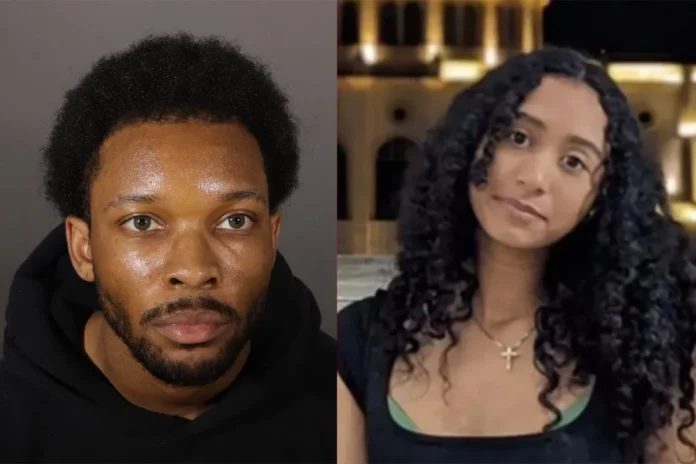
A Los Angeles judge ruled Monday that singer D4vd will stand trial for the murder, sexual abuse, and dismemberment of 14-year-old Celeste Rivas Hernandez, finding that prosecutors presented sufficient evidence during a five-day preliminary hearing to establish probable cause on all charges.
The ruling means the 21-year-old artist, whose legal name is David Anthony Burke, could face the death penalty or life in prison without the possibility of parole. Prosecutors have not yet decided whether they will seek capital punishment.
What We Know So Far
Los Angeles County Superior Court Judge Charlaine Olmedo ruled that the case could proceed on three charges: murder, continuous sexual abuse of a child under 14, and unlawful mutilation of human remains. Burke has pleaded not guilty to all charges and remained in custody without bail.
Olmedo also upheld three special circumstances alleged by prosecutors: that Burke ambushed the victim, killed her to cover up a crime, and killed her for financial gain. The upholding of those circumstances is what places the death penalty on the table.
“The people have met their burden on all counts,” Olmedo said in court.
Deputy District Attorney Beth Silverman told the judge that “based on the mountains of evidence presented, all of the allegations have been proved way beyond the standard required.”
Prosecutors wrapped up their case Monday by presenting a moment-by-moment account of Rivas Hernandez’s final night. She was picked up from her Lake Elsinore home by an Uber that Burke had ordered. As she approached his Hollywood residence shortly after 10 p.m. on April 23, 2025, she sent her final text message: “girly pop i’m almost there open ur door if ur home.”
Her phone went permanently silent after that.
The night before, the pair had argued via text about Burke’s relationship with a woman. Rivas Hernandez sent him an angry message threatening to expose their relationship and damage his career.
“I will tell my dad so many lies about you. I will end ur career and ur life. I will damage anything,” she wrote, the Los Angeles Times confirmed.
Her dismembered body was found months later inside a Tesla registered to Burke. Prosecutors allege he stabbed her to death when she arrived at his home, dismembered her body in his garage, and drove to Santa Barbara County to dispose of evidence. DNA samples from apparent blood stains in the garage matched Rivas Hernandez, a police analyst testified earlier in the hearing.
Autopsy records showed she died from stab wounds to her chest and abdomen.
In earlier testimony, LAPD Detective Corey Farrell described dozens of sexually explicit photographs of Burke and Rivas Hernandez found on his phone, along with text messages indicating she became pregnant at 13 and had an abortion in 2024. The material was so graphic it caused her mother to leave the courtroom in tears.
Prosecutors said Burke had known Rivas Hernandez’s actual age. Sheriff’s deputies investigating a separate missing persons report in 2024 notified him that she was underage, Deputy District Attorney Silverman said. Under California law, lack of knowledge of a victim’s age is not a defense to child sexual abuse charges.
What The Defense Is Saying
Defense attorney Marilyn Bednarski argued that the evidence was insufficient to support a murder charge and asked the judge to dismiss it.
“There’s no evidence that Mr. Burke harbored a deliberate intent to kill Miss Hernandez,” Bednarski said. “He had the opposite of homicidal malice toward her.”
The defense argued that the medical examiner’s finding of two puncture wounds was too vague and inconclusive to constitute murder evidence. Defense attorney Blair Berk also established that Rivas Hernandez had asked seven times in the days before her death to come see Burke, and that he had only reluctantly agreed after she insisted.
The defense showed additional texts in which Rivas Hernandez threatened to mutilate Burke and kill him.
“All of the malice had come from her,” the defense argued.
Berk asked the detective whether any witness had actually seen what happened between 10:10 p.m. and 10:31 p.m. on April 23, the window prosecutors believe the killing occurred.
“You have not identified a single witness who saw David Burke during those 21 minutes?” Berk asked. The detective confirmed that was correct.
Berk and Bednarski declined to comment after the ruling.
The family’s attorney, Patrick Steinfeld, criticized the defense’s approach.
“They made allegations that didn’t have any evidentiary basis, including the assertion that Celeste may have committed suicide or that Celeste was violent, and I personally found that very disturbing,” Steinfeld said. “It seems the defense attorneys are stopping at nothing in their attempts to discredit the prosecution’s evidence and the family was horrified.”
Why This Matters
D4vd became an online musical phenomenon as a teenager with a blend of indie rock, R&B, and lo-fi pop. His 2022 breakthrough song “Romantic Homicide” has more than a billion streams on Spotify. He performed at Coachella in 2024 and released his debut album “Withered” two days after authorities say Rivas Hernandez was killed.
His career was at its highest point when the allegations emerged, making the case one of the most prominent criminal proceedings involving a young musical artist in recent years.
The case centers on a relationship that prosecutors described as years-long grooming of a child. Silverman told the judge that Burke had groomed Rivas Hernandez over many months, repeatedly telling her that the sexual activity was something she had asked for.
“We have a minor who was not only under the eyes of the law at least sexually abused for many, many months, she was groomed, she was being gaslit,” Silverman said.
The evidence presented at the preliminary hearing included more than 1,200 text messages exchanged between the two in the 24 hours before her death, travel records, DNA analysis, phone location data, and photographs from Burke’s seized iPhone and iCloud accounts.
Los Angeles District Attorney Nathan Hochman issued a statement after the ruling.
“Burke is guilty beyond a reasonable doubt of the brutal murder of Celeste Rivas Hernandez,” Hochman said. “This has been a parent’s worst nightmare, hearing the ghoulish details of how their child was killed, dismembered and left as trash.”
What Happens Next
Burke will remain in custody without bail pending trial. A trial date has not yet been set.
Prosecutors must still decide whether to seek the death penalty or life in prison without the possibility of parole. The upholding of all three special circumstances by Judge Olmedo preserves both options.
The defense is expected to argue at trial that there was no premeditation, potentially raising claims about Rivas Hernandez’s own conduct toward Burke in the days before her death. Berk’s questioning during the preliminary hearing suggested the defense may also attempt to raise issues of domestic violence and mental health, though Judge Olmedo blocked some of those lines of questioning as irrelevant to the probable cause standard.
At least 50 people have died and about 700,000 others have been affected after relentless monsoon rains triggered severe flooding across India’s northeastern state of Assam, forcing hundreds of thousands from their homes as rescue and relief operations continue.
The overflowing Brahmaputra River inundated nearly 900 villages, washed away homes and submerged roads, prompting authorities to establish government relief camps for almost 300,000 displaced residents, state officials said Friday.
The disaster has also produced one of the flood’s most heartbreaking stories after a 13 year old boy drowned while rescuing his pet puppy from fast moving floodwaters.
What we know so far
Authorities said the Brahmaputra River, which rises in China’s Tibet region before flowing roughly 900 kilometers through Assam, burst its banks after days of intense monsoon rainfall.
Floodwaters have damaged homes, submerged farmland and disrupted electricity supplies to more than 7,000 households across the state.
Police, disaster response teams and local volunteers continued evacuating stranded residents while helicopters delivered food and emergency supplies to isolated communities.
Assam Chief Minister Himanta Biswa Sarma said relief efforts remain focused on reaching villages cut off by floodwaters.
In Guwahati, Assam’s largest city with about two million residents, major roads were submerged Thursday evening, leaving commuters stranded for hours.
“I had to stay overnight at my office. The roads were filled with water, some waist deep,” journalist Sudip Mazumdar said.
Jatin Gogoi, a farmer from Nazira, said floodwaters destroyed his bamboo home and swept away his livestock.
“I lost all my cattle. My five member family and I have nowhere to go, so we are taking shelter in a relative’s home,” he said.
Boy dies after rescuing puppy from floodwaters
Among the victims was Hridip Panika, a 13 year old seventh grade student from Bamun Pukhuri village in Assam’s Nazira area.
Family members said Hridip saw his three month old puppy, Borun, being swept away by powerful floodwaters as the waters surged through the village.
The teenager jumped into the flood to save the animal and successfully reached the puppy. Moments later, however, the current swept him away before rescuers could reach him.
Search teams later recovered his body.
Hridip was the only child of Deepak and Parbati Panika, whose home and belongings had already been destroyed by the flooding.
Videos shared widely on social media showed the grieving parents mourning beside their son’s body while the rescued puppy remained quietly nearby, prompting an outpouring of sympathy from across India.
Content creator Homoy Gogoi later visited the family and presented them with immediate financial assistance of 50,000 rupees from a community relief fund totaling 100,000 rupees.
What authorities are saying
State officials said emergency workers remain focused on rescue operations, restoring basic services and delivering food, drinking water and medical supplies to affected communities.
Relief agencies continue working to reach thousands of residents who remain isolated as floodwaters cover roads and bridges across several districts.
Authorities warned that additional rainfall could worsen flooding in parts of Upper Assam where rivers remain above danger levels.
Why this matters
Seasonal monsoon flooding is common across northeastern India, but climate scientists say rising global temperatures are making rainfall increasingly unpredictable and more intense.
South Asia’s traditional monsoon seasons, which typically run from June through September and again later in the year, are producing shorter periods of exceptionally heavy rainfall separated by prolonged dry spells. Those changing weather patterns have increased the frequency and severity of flash floods across the region.
Assam is particularly vulnerable because of the Brahmaputra River system, which regularly overflows during periods of heavy rainfall and affects millions of people living along its floodplains.
Beyond the growing death toll, the floods have devastated agriculture, damaged infrastructure and displaced hundreds of thousands of families, creating long term humanitarian and economic challenges.
The death of Hridip Panika has also drawn national attention to the human cost of natural disasters, illustrating how tragedies often extend beyond official casualty figures to deeply affect families and communities.
What happens next
Weather forecasters continue monitoring rainfall across northeastern India as emergency agencies expand relief operations in the hardest hit districts.
Authorities are expected to maintain evacuation efforts, restore damaged infrastructure and provide assistance to displaced families while assessing losses to homes, agriculture and public services.
Recovery is likely to take months in many flood affected communities as residents begin rebuilding homes and livelihoods once floodwaters recede.