Chuck Norris, the martial arts champion turned Hollywood action star who became a defining figure of 1980s cinema and later a television mainstay in Walker, Texas Ranger, has died at the age of 86, his family confirmed Friday.
A statement shared on the actor’s Instagram account said Norris died Thursday surrounded by loved ones. The family did not disclose the cause of death, noting only that he was at peace in his final moments.
The announcement followed accounts from Variety that Norris had been hospitalized in Hawaii earlier in the week.
Norris rose to prominence as a martial artist before transitioning into film, where his stoic presence and physical prowess made him a staple of action cinema. A six-time undefeated World Professional Middleweight Karate Champion, he brought authenticity and discipline to roles that often cast him as a lone enforcer of justice.
His film credits include Code of Silence, Missing in Action, and The Delta Force, productions that helped cement his reputation as a symbol of American strength during the Cold War era. On television, he became widely recognized for portraying Cordell Walker, a principled Texas Ranger, in Walker, Texas Ranger, which aired from 1993 to 2001 and reached audiences worldwide.
Norris made his film debut opposite Bruce Lee in the 1973 martial arts classic The Way of the Dragon, featuring a now-iconic fight sequence set in Rome’s Colosseum. Decades later, he appeared alongside fellow action stars Sylvester Stallone, Arnold Schwarzenegger, and Bruce Willis in The Expendables 2, reinforcing his status as a genre legend.
At the height of his career, Time characterized Norris as the “ultimate tough guy,” reflecting his dominance in the action film category during the 1980s. His roles often featured him overcoming overwhelming odds, dispatching multiple adversaries with martial arts precision and unwavering resolve.
Beyond his on-screen persona, Norris became an unexpected cultural phenomenon in the early days of social media. Beginning in 2005, a wave of viral humor known as “Chuck Norris Facts” exaggerated his toughness into mythic proportions, transforming him into an enduring internet icon. The jokes, widely shared online and later compiled into books, introduced him to a new generation far removed from his cinematic peak.
Born Carlos Ray Norris on March 10, 1940, in Ryan, Oklahoma, he was the eldest of three brothers. His early life was marked by hardship, including financial instability and his father’s struggles with alcoholism. Norris later wrote in his memoir, Against All Odds: My Story, that he was shy and withdrawn as a child, often avoiding speaking in class.
After graduating from high school, he enlisted in the U.S. Air Force in 1958 and was stationed in South Korea, where he began training in martial arts, including Tang Soo Do. That experience laid the foundation for his later success as both a competitor and instructor.
Following his military service, Norris opened martial arts schools in California and quickly gained recognition in competitive circuits. Among his students was Steve McQueen, who encouraged him to pursue acting. Norris later credited McQueen with advising him to rely on visual storytelling rather than dialogue, guidance that shaped his screen presence.
Norris went on to star in more than two dozen films, many of which performed strongly at the box office and resonated with military audiences. He maintained close ties to U.S. service members, including visits to troops in Iraq in 2006 and 2007.
In 1990, he founded Chun Kuk Do, his own martial arts system, and established the nonprofit Kickstart Kids, which focuses on teaching martial arts and character development to young people.
Outside entertainment, Norris was active in conservative political circles and collaborated with organizations such as the National Rifle Association. He also contributed commentary to WorldNetDaily, a right-leaning media platform.
An author as well as an actor, Norris published several books, including his memoir and the self-help title The Secret of Inner Strength, along with works on fitness, martial arts, and fiction.
He is survived by his family, including five children.
Throughout his career, Norris defended the action genre against criticism that it glorified violence. In a 1994 interview with the Los Angeles Times, he emphasized that storytelling—not aggression—was at the heart of his work, arguing that audiences ultimately connect with narratives in which justice prevails.
Norris’ death marks the passing of a distinctive era in Hollywood, when action stars were defined less by special effects and more by physical credibility and screen presence. Unlike many contemporaries, Norris entered film with a proven martial arts pedigree, lending authenticity to roles that might otherwise have seemed exaggerated. This authenticity helped differentiate him in a crowded field that included larger-than-life figures like Stallone and Schwarzenegger.
His career also reflects a broader evolution in American pop culture. During the Cold War, his films often portrayed clear moral binaries, with Norris embodying the archetypal American hero confronting external threats. These narratives resonated strongly with audiences seeking reassurance during a period of geopolitical tension.
Yet his later transformation into an internet phenomenon reveals an unusual second act. The “Chuck Norris Facts” phenomenon turned his serious, stoic image into a form of affectionate satire, extending his cultural relevance well into the digital age. Few actors have managed such a transition from traditional stardom to meme-driven legacy without diminishing their original body of work.
Norris’ influence also extends into martial arts education and youth development through Kickstart Kids, which continues to operate in schools. This aspect of his legacy underscores a commitment to discipline and personal growth that paralleled his on-screen values.
In assessing his impact, Norris occupies a unique space at the intersection of martial arts, film, television, and internet culture. His career illustrates how a figure rooted in physical performance and traditional media can adapt—intentionally or not—to new forms of cultural expression, ensuring enduring recognition across generations.
President Donald Trump indicated Friday that the United States could begin scaling back its military operations in the Middle East, even as his administration accelerates troop deployments and seeks billions more in funding for the ongoing conflict with Iran.
The remarks, delivered through a post on the social media platform Truth Social and later reinforced in comments to reporters, came after a surge in oil prices triggered a sharp downturn in U.S. stock markets, highlighting the growing economic consequences of the war.
Trump’s suggestion of a potential drawdown appeared to contrast with recent Pentagon actions, including the movement of additional warships and approximately 2,500 Marines to the region. Defense officials have also advanced a request for $200 billion in supplemental funding, which would require congressional approval as the national debt climbs to record levels.
In his online statement, Trump outlined several objectives guiding U.S. operations but offered limited clarity on how or when those goals might be achieved. The president’s messaging also left uncertainty surrounding Washington’s role in safeguarding the Strait of Hormuz, a strategic maritime corridor critical to global oil shipments.
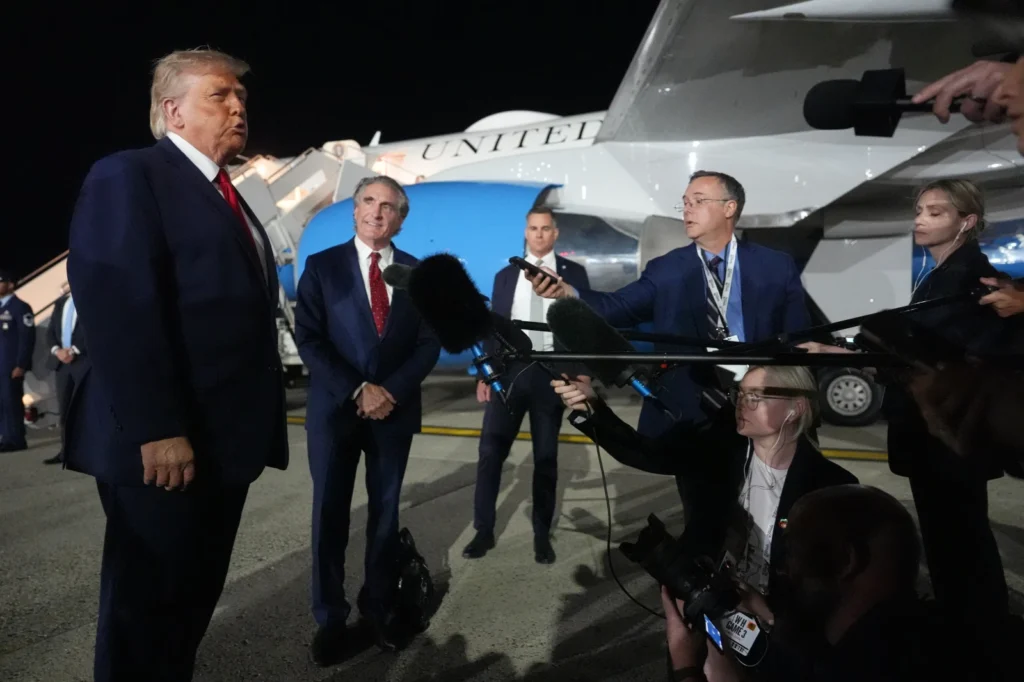
Speaking to reporters on the White House lawn before departing for Palm Beach, Florida, Trump expressed frustration with allied support, singling out the NATO alliance. He argued that member nations have not demonstrated sufficient resolve to assist in securing the waterway, despite its global importance.
“It’s a straightforward military maneuver,” Trump said, describing potential operations in the Strait. “It’s relatively safe, but it requires scale — ships, coordination, volume. NATO could contribute, but so far, they haven’t shown the willingness.”
The Strait of Hormuz remains one of the world’s most vital energy chokepoints, and recent disruptions linked to the conflict have sent shockwaves through global markets. A survey conducted by Reuters in partnership with Ipsos found that 55% of Americans say rising gas prices tied to the war have affected their personal finances, underscoring the domestic impact of the overseas conflict.
Despite hinting at a possible reduction in military engagement, Trump maintained a hardline stance on negotiations. When asked whether he would consider a ceasefire, the president dismissed the idea, signaling that U.S. operations would continue as long as military momentum remains favorable.
“You don’t pursue a ceasefire when you’re decisively overpowering the other side,” Trump said. “That’s not the position we’re in.”
The administration’s strategic ambiguity extended to questions about potential targets within Iran. When pressed on whether U.S. forces might escalate operations against Kharg Island — a key hub for Iran’s oil exports — Trump declined to provide specifics.
“I may have a plan, or I may not,” he said, adding that while the location has drawn attention in strategic discussions, he would not publicly outline any operational decisions.
According to Associated Press, internal deliberations within the administration have included scenarios involving heightened pressure on Iran’s infrastructure, though officials have emphasized that no final decisions have been announced.
The evolving U.S. posture reflects a broader tension between military escalation and political signaling. On one hand, the steady flow of additional troops and naval assets into the region suggests preparation for sustained or expanded operations. On the other, Trump’s public comments about “winding down” hint at an awareness of mounting economic and political costs at home.
Trump’s dual-track messaging reveals a complex strategic balancing act. By suggesting a potential drawdown while simultaneously reinforcing military capabilities, the administration appears to be preserving flexibility — both to escalate if necessary and to pivot toward de-escalation should conditions permit.
This approach may also serve a domestic political function. Rising fuel prices and market volatility are directly affecting American households, as reflected in polling data. By signaling a possible reduction in military engagement, Trump may be attempting to reassure voters concerned about the economic fallout, even as operational realities on the ground point in the opposite direction.
The criticism of NATO highlights another dimension of the conflict: the strain on transatlantic alliances. Trump’s remarks suggest frustration with what he perceives as unequal burden-sharing, a longstanding issue that has resurfaced in the context of securing global trade routes. However, such public criticism risks further complicating coordination at a time when multinational cooperation could prove critical.
The ambiguity surrounding the Strait of Hormuz is particularly consequential. Control of the passage is not only a military concern but a global economic imperative. Any sustained disruption could drive energy prices higher, intensify inflationary pressures, and potentially trigger broader economic instability. Trump’s mixed signals — at times asserting U.S. self-sufficiency, at others calling for allied support — reflect the difficulty of managing such a high-stakes environment.
Equally significant is the question of escalation targeting Iran’s oil infrastructure, including Kharg Island. Striking such assets could severely limit Iran’s revenue streams but also risks provoking a wider regional conflict, potentially drawing in additional actors and threatening global supply chains.
Ultimately, the contrast between rhetoric and action underscores the uncertainty surrounding U.S. strategy in the Middle East. While the administration leaves open the possibility of winding down operations, the continued influx of military resources suggests that Washington is preparing for a conflict that may persist — or even intensify — in the near term.
The United States military is deploying three additional warships carrying approximately 2,500 Marines to the Middle East, with another expeditionary unit of similar size already en route from the Pacific, as the Iran conflict enters its third week with no resolution in sight and the Pentagon requesting an additional $200 billion in congressional funding to sustain military operations.
The troop surge comes as Iran vowed Friday to deny its adversaries security despite nearly three weeks of devastating U.S.-Israeli strikes that have killed several of Tehran’s top leaders and severely damaged its weapons manufacturing facilities and energy infrastructure.
The escalating commitment of American military resources to the region signals that the conflict President Donald Trump once predicted would end swiftly shows no signs of concluding despite administration claims of overwhelming success.
One U.S. official confirmed to the Associated Press that the USS Boxer and two other amphibious assault vessels, along with roughly 2,500 Marines of the 11th Marine Expeditionary Unit, are bound for the Middle East from their home port of San Diego. Two additional U.S. officials verified that the ships were deploying without specifying their destination, speaking on condition of anonymity to discuss sensitive military operations not yet publicly announced.
The deployment follows just days after the U.S. military redirected another Marine expeditionary group aboard amphibious assault ships from the Pacific to the Middle East. Last week, Pentagon officials confirmed that the Japan-based USS Tripoli and the 31st Marine Expeditionary Unit received orders to deploy to the Middle East—shifting them from exercises in the vicinity of Taiwan where they had been signaling American commitment to defending the democratic island against potential Chinese aggression.
Earlier this week, the USS Tripoli and another amphibious assault ship, the USS New Orleans, were identified sailing west of Malaysia on publicly available satellite imagery, confirming their westward transit toward the Persian Gulf region. The pair of Marine Expeditionary Units will add approximately 5,000 Marines and thousands of sailors to a theater where the U.S. military acknowledges maintaining roughly 50,000 troops—a figure that continues climbing as the conflict intensifies rather than resolves.
The Pentagon’s request for another $200 billion to fund continuing war operations would require congressional approval at a moment when the U.S. national debt has reached a record $39 trillion.
The massive supplemental funding request—coming atop already substantial defense appropriations—raises questions about fiscal sustainability and whether the conflict will produce the protracted financial drain that Trump repeatedly warned against during his campaigns criticizing previous Middle Eastern wars.
A spokesperson for Iran’s paramilitary Revolutionary Guard told the Associated Press Friday that Tehran continues building missiles despite weeks of bombardment targeting production facilities. The spokesperson, identified as Naeini, insisted the Iran war would persist, though Iranian state television subsequently confirmed that Naeini was killed in an airstrike shortly after making those defiant comments—illustrating both Iran’s determination to resist and the lethality of ongoing strikes against its leadership.
Israel struck the Iranian capital Tehran with airstrikes Friday, with the attack occurring as Iranians marked Nowruz—the Persian New Year celebrated across Iran and Central Asia as the most important annual holiday.
The timing of strikes during major cultural celebrations has generated international criticism about proportionality and respect for civilian populations attempting to observe traditional festivities amid warfare.
U.S. and Israeli leaders have maintained that weeks of strikes have decimated Iran’s military capabilities. Airstrikes have eliminated the supreme leader, the secretary of Iran’s Supreme National Security Council, and numerous top-ranking military and political leaders in what represents an unprecedented decapitation of an adversary nation’s entire command structure.
Israeli Prime Minister Benjamin Netanyahu declared Thursday that Iran no longer possesses the ability to enrich uranium or manufacture ballistic missiles—claims that, if accurate, would represent catastrophic strategic losses for Tehran.
Netanyahu added that Israel would refrain from additional attacks on Iranian gas fields at Trump’s request, suggesting the American president is attempting to moderate Israeli operations to prevent further disruption to global energy markets.
The price of Brent crude oil—the international benchmark—has soared since Israel and the United States initiated hostilities with Iran. The petroleum price increases reflect market anxieties about supply disruptions from the Persian Gulf region that produces approximately one-third of global oil supplies and contains the Strait of Hormuz chokepoint through which roughly one-fifth of international petroleum shipments transit.
When questioned about Trump’s plans for the additional troops and media speculation that the administration is considering occupying or blockading Kharg Island—Iran’s primary oil export terminal—a White House official emphasized that Trump has said he has “no plans” to send ground troops into Iran while retaining all military options and refusing to broadcast strategy publicly.
The official, speaking on condition of anonymity because they lacked authorization for media engagement, asserted the U.S. military could “take out Kharg Island at any time.”
The comment reflects confidence about American military capabilities while leaving ambiguous whether such operations might eventually occur despite current denials about ground force deployments.
Trump referenced the war Friday while presenting the Commander in Chief trophy to the Navy football team for defeating Army during their 2025 game. Without providing operational details, he proclaimed “We’re doing extremely well,” maintaining the optimistic characterization he has consistently employed when discussing the conflict publicly.
Trump explained that Defense Secretary Pete Hegseth and Gen. Dan Caine, chairman of the Joint Chiefs of Staff, were absent from the ceremony because they were conducting operations from the White House Situation Room—suggesting active military planning was occurring simultaneously with the public event. As the trophy presentation unfolded, an official informed the Associated Press that the U.S. was deploying three additional warships with roughly 2,500 more Marines to the Middle East as the Iran war continues.
Satellite imagery is beginning to provide visual documentation of the war’s destructive toll, with photographs showing ships ablaze in Iranian ports and destroyed buildings at American bases throughout the region.
Information has remained scarce about damage across the Middle East—particularly within closed military facilities—since hostilities commenced February 28, though commercial satellite companies are gradually releasing images that offer independent verification of combat effects.
The images originate from Planet Labs PBC, a San Francisco-based firm whose satellite imagery is utilized by media outlets including the Associated Press. Planet Labs has imposed a two-week delay on its imagery becoming publicly available, citing concerns that real-time satellite intelligence could be exploited by “adversarial actors” for targeting or operational planning purposes.
High-resolution images have also been published by competing commercial satellite firms, while other providers including the U.S. Geological Survey have been releasing lower-resolution imagery that, despite reduced detail, has proven useful for documenting major fires, explosions, and infrastructure damage across the conflict zone.
The United States and Israel have been striking diverse targets including leadership figures in Iran, military installations, missile and air defense sites, and positions of the paramilitary Revolutionary Guard and its volunteer force, the Basij. Iran has responded with drone and missile attacks targeting Israel and nearby Gulf Arab nations, creating a regional conflict that has drawn multiple countries into direct combat.
Some of the most dramatic satellite imagery from Planet Labs documents scenes in Bandar Abbas—home to a major Iranian military port adjacent to the crucial Strait of Hormuz connecting the Persian Gulf to the Gulf of Oman and the Arabian Sea.
Images captured on March 2 show multiple vessels ablaze at the port following American strikes. U.S. Central Command has been systematically targeting Iran’s naval assets and claims to have sunk or damaged more than 100 Iranian vessels since the war commenced.
Planet Labs imagery from March 6 reveals extensive damage to several buildings at the Parchin military base outside Tehran. The International Atomic Energy Agency has long suspected Iran conducted tests of high explosives that could trigger nuclear weapons at Parchin, though Iran has consistently insisted its nuclear program serves exclusively peaceful purposes. The IAEA, Western intelligence agencies, and independent analysts have concluded Tehran operated an active weapons program until at least 2003.
Israel’s military confirmed its Parchin strikes targeted “infrastructure used for the production of essential components for the development of various weapons.” The facility has been linked to Iran’s ballistic missile program, making it a priority target for operations aimed at eliminating Tehran’s ability to threaten regional targets with conventional weapons.
The island kingdom of Bahrain—home to the U.S. Navy’s Fifth Fleet headquarters—has experienced heavy Iranian fire targeting both military bases and oil installations. A March 1 Planet Labs image shows a major building at the base destroyed along with two radomes—geodesic domes covering radar antennas—likely by Iranian missile and drone strikes. Subsequent March 6 imagery revealed additional building damage, confirming that Iran has successfully struck one of America’s most important regional military facilities.
The Navy has not provided comprehensive damage assessments from the Bahrain base, though Iran has repeatedly claimed successful attacks against it. Online videos have documented incoming fire targeting the facility.
During the 12-day war last June, Iran attacked and destroyed a similar radome at Al Udeid Air Base in Qatar used for secure communications, demonstrating capabilities to damage sophisticated American military infrastructure.
Satellite images captured March 15 by an Airbus Defense and Space Pléiades Neo satellite and analyzed by the Associated Press show damage at Abu Dhabi’s Al Dhafra Air Base in the United Arab Emirates. Damage is visible at one set of hangars to the facility’s northwest.
Another hangar to the southeast appears shredded by fire with an adjacent hangar sustaining roof damage, though the contents of the damaged hangars remain unclear.
Al Dhafra typically hosts approximately 2,000 American troops and has functioned as a major operational base for everything from armed drones to F-35 stealth fighters in recent years.
The U.S. military for years only vaguely referenced Al Dhafra as a base in “southwest Asia” before the UAE became more willing to acknowledge the American military presence there.
In Abu Dhabi, damage is visible at France’s Camp de la Paix naval base. Satellite images from March 3 show destruction to two large hangar-like structures at the facility located near Zayed Port and close to Abu Dhabi’s Cultural District that includes the Louvre Abu Dhabi and other major museums. The successful strikes on French military facilities demonstrate that Iran is willing to attack European forces alongside American targets, potentially drawing NATO allies into broader conflict.
The U.S. Geological Survey’s Landsat satellites have proven particularly effective in identifying major fires across the region. Imagery captured Monday showed a fire at Dubai International Airport after an Iranian drone strike ignited a fuel tanker at the world’s busiest airport for international travel, producing a noxious black smoke plume that disrupted operations at a critical global aviation hub.
Another fire was documented Monday at Oman’s southern port in Salalah, which came under attack from suspected Iranian drones on March 11. Tehran has denied launching those strikes in its campaign targeting Gulf Arab states, though the fire has apparently burned continuously since the initial attack—suggesting substantial fuel or chemical storage was ignited.
As the conflict approaches its fourth week with 5,000 additional Marines deploying to a region already hosting 50,000 American troops, the fundamental questions about the war’s objectives, duration, and costs remain unanswered despite administration assurances of imminent victory.
The mounting troop commitments, massive funding requests, soaring oil prices, and expanding geographic scope of combat operations suggest the conflict is following trajectories of previous Middle Eastern wars that consumed far more American blood and treasure than initial optimistic projections anticipated.
(Reuters/DW) — At least 17 bodies have been recovered from a migrant vessel discovered off the coast of Comoros, authorities confirmed Thursday, in a tragedy that underscores the growing dangers of irregular migration routes across the Indian Ocean.
Officials indicated the boat was carrying African migrants attempting to reach Mayotte, a French-administered island long viewed as a gateway to Europe due to its access to social services and infrastructure.
The vessel was located late Wednesday near the coastal town of Mitsamiouli after residents reported hearing cries for help from the water, prompting an emergency response.
Interior Minister Mohamed Ahamada said nine bodies were retrieved Thursday morning, adding to eight recovered overnight. Approximately 30 individuals survived the ordeal, he told reporters during a briefing.
Local medical officials, however, cited a slightly higher toll of 18 fatalities, noting that survivors reported originating primarily from the Democratic Republic of the Congo.
Authorities believe around 50 people were aboard the vessel, though the exact number remains uncertain as search operations continue. The Comorian coast guard is still attempting to locate several individuals believed missing.
Accounts from survivors and rescuers suggest that many victims were left struggling in open water after smugglers forced them off the boat before reaching shore.
Testimonies gathered by international media outlets paint a grim picture of the migrants’ journey.
One survivor, speaking to Agence France-Presse, described traveling for days through forests and across multiple countries before boarding the vessel. He said the trip lasted about a week and was plagued by uncertainty.
“Very quickly, we could tell the captain was lost,” he said. “At one point, we had no bread or water.”
Other survivors said they believed they had reached Mayotte when they were abandoned at sea, only to discover they were still nearly 200 kilometers away.
Residents in Mitsamiouli described hearing desperate screams while watching a football match, prompting them to rush to the shoreline, where they encountered men, women and children struggling in the water.
The route from the Comoros to Mayotte is among the most hazardous migration corridors in Africa. Migrants frequently rely on smugglers who use overcrowded and poorly equipped boats to attempt the crossing.
Despite being France’s poorest overseas department, Mayotte continues to attract migrants due to its perceived economic opportunities and access to public services.
Data from the International Organization for Migration indicates that thousands have died along this route over the years. In 2024 alone, at least 25 people perished near Mayotte when a smuggling vessel capsized.
Authorities in Comoros have mobilized emergency responders, including local residents and fishermen, to assist in recovery efforts.
Interior Minister Ahamada said teams are continuing to comb the waters for additional victims, with at least four people still unaccounted for.
The incident has renewed calls for stronger regional cooperation to combat human trafficking networks operating across East Africa and the Indian Ocean.
The latest tragedy highlights the persistent and complex forces driving migration toward Mayotte and similar destinations.
Economic instability, conflict and limited opportunities in parts of Central and East Africa continue to push individuals toward dangerous journeys in search of better living conditions. For many, Mayotte represents not just a destination, but a perceived entry point into the broader European system.
However, the reliance on smuggling networks exposes migrants to extreme risks. Boats are often overloaded, navigational expertise is limited, and smugglers frequently abandon passengers to avoid detection, as appears to have occurred in this case.
The incident also underscores the limitations of enforcement-only approaches to migration. While increased patrols and border controls may deter some crossings, they can also push migrants toward more dangerous routes, increasing the likelihood of fatalities.
From a policy perspective, addressing the root causes of migration — including poverty, political instability and lack of economic opportunity — remains critical. At the same time, improved search-and-rescue capabilities and legal migration pathways could help reduce reliance on traffickers.
The tragedy near Comoros is not an isolated event but part of a broader pattern seen across global migration routes, from the Mediterranean to the Atlantic and the Indian Ocean. Each incident adds to a growing humanitarian toll that continues to challenge governments and international organizations alike.
As recovery efforts continue off the coast of Mitsamiouli, the loss of life serves as a stark reminder of the human cost behind migration statistics — and the urgent need for coordinated solutions to prevent further tragedies.
(AP) — The United States’ national debt climbed past $39 trillion on Wednesday, setting a new record as the government faces mounting financial pressures just weeks into its military conflict with Iran.
The milestone underscores the competing fiscal demands confronting policymakers, including expanded defense spending tied to the war, efforts to advance sweeping tax legislation, and increased funding for immigration enforcement — all while pledging to curb long-term borrowing.
The surge comes during the administration of Donald Trump, who has repeatedly vowed to reduce the federal debt both on the campaign trail and while in office.
The pace of borrowing has intensified sharply in recent months. Federal debt crossed $38 trillion roughly five months ago and surpassed $37 trillion just two months prior to that, highlighting a rapid upward trajectory.
Budget analysts warn that continued borrowing at the current rate could push total debt beyond $40 trillion before the next national elections, raising concerns about long-term fiscal sustainability.
Michael Peterson, chief executive of the Peter G. Peterson Foundation, said the acceleration presents a growing burden for future generations.
“We must recognize this alarming rate of growth and the significant financial burden we are putting on the next generation,” Peterson said in a statement.
The rising debt carries tangible consequences for Americans, as outlined by the Government Accountability Office.
Higher federal borrowing can drive up interest rates, increasing costs for mortgages, auto loans and other forms of credit. It may also limit business investment, potentially leading to slower wage growth and higher prices for goods and services.
Fiscal policy experts caution that as interest payments consume a larger share of the federal budget, lawmakers may face difficult decisions on spending cuts, tax increases or both.
The escalation of military operations in Iran has added a significant new strain on federal finances. White House economic adviser Kevin Hassett indicated that the conflict has already cost the United States more than $12 billion, though the final price tag remains uncertain.
The war’s duration and scope will likely play a major role in shaping future debt levels, particularly if operations expand or persist over an extended period.
Historically, major conflicts have contributed to spikes in U.S. borrowing, a pattern seen alongside other drivers such as pandemic-related spending and tax policy changes.
Despite the rising debt, administration officials emphasize progress in narrowing the annual deficit.
Kush Desai, a White House spokesperson, pointed to federal data showing total government spending at $7.01 trillion in fiscal year 2025, compared with $5.23 trillion in revenue — resulting in a deficit of $1.78 trillion. That figure represents a $41 billion decline from the previous year.
Desai attributed the improvement to increased tax revenues, reductions in federal employment levels and efforts to combat fraud in government programs.
He added that ongoing policy measures are expected to further improve deficit levels and the nation’s debt-to-GDP ratio over time.
The crossing of the $39 trillion threshold reflects more than short-term fiscal pressures — it highlights a structural challenge facing the U.S. economy.
While war spending has accelerated borrowing in the near term, the underlying drivers of debt growth span multiple administrations and include tax cuts, entitlement obligations and emergency spending during crises such as the COVID-19 pandemic.
The current conflict with Iran introduces a layer of uncertainty that complicates fiscal planning. Military engagements tend to involve unpredictable costs, and their economic impact can extend beyond direct expenditures to include energy market disruptions and global financial instability.
At the same time, rising interest rates amplify the burden of existing debt. As borrowing costs increase, the government must allocate more funds simply to service its obligations, leaving fewer resources for other priorities.
This dynamic creates a feedback loop: higher debt leads to higher interest costs, which in turn contribute to further borrowing.
The political dimension also remains significant. While both major parties have contributed to rising debt levels over time, consensus on how to address the issue has proven elusive. Efforts to balance budgets often run into competing priorities, including defense, social programs and tax policy.
Looking ahead, the trajectory of U.S. debt will likely depend on a combination of factors: the duration of the Iran conflict, the direction of economic growth, interest rate trends and the willingness of policymakers to enact potentially unpopular fiscal reforms.
For now, surpassing $39 trillion serves as a stark indicator of the scale of the challenge — and a signal that the debate over America’s fiscal future is far from settled.
Lionel Messi added another landmark achievement to his storied career Wednesday night, scoring his 900th career goal during Inter Miami CF’s CONCACAF Champions Cup Round of 16 match against Nashville SC.
The milestone came early, as the Argentine star found the net in the seventh minute. Positioned inside the penalty area, Messi controlled a pass, turned past defenders and delivered a low left-footed strike into the far corner — a finish emblematic of the technique that has defined his career.
The goal places Messi in rare company alongside Cristiano Ronaldo as the only men’s players to surpass 900 career goals based on official tallies.
A milestone reached with efficiency
Messi reached the 900-goal mark in fewer appearances than Ronaldo, underscoring the Argentine’s efficiency in front of goal. Ronaldo, who achieved the same milestone in September 2024 at age 39, required roughly 100 additional matches to get there.
Messi, an eight-time Ballon d’Or winner and reigning World Cup champion, is set to turn 39 in June, further highlighting the pace at which he has accumulated goals throughout his career.
Debate over historical goal totals remains a part of football’s legacy discussions. Brazilian icon Pelé is often cited as having scored more than 1,000 goals, though official records typically place his total closer to 800, depending on which matches are included.
Dominance across clubs and country
More than half of Messi’s goals were scored during his long tenure with FC Barcelona, where he spent nearly two decades establishing himself as one of the sport’s greatest players.
Since joining Inter Miami in 2023, Messi has continued to deliver at the highest level, quickly becoming the centerpiece of the club and a defining figure in Major League Soccer. His No. 10 jersey has remained the league’s top seller, reflecting his global appeal.
His career achievements extend far beyond goal-scoring milestones. Messi has claimed eight Pichichi trophies as La Liga’s top scorer, multiple FIFA and UEFA player of the year honors, and two Golden Ball awards at the FIFA World Cup.
He has also been part of 47 trophy-winning campaigns for club and country, including Argentina’s triumph at the 2022 World Cup and Inter Miami’s MLS title last season, making him the most decorated player in men’s football history.
Messi’s impact remains central to both club and international football. He is expected to feature again for Argentina national team in the upcoming World Cup set to be hosted across the United States, Canada and Mexico.
Inter Miami coach Javier Mascherano previously underscored Messi’s enduring influence.
“The reality is that Leo clears all doubts,” Mascherano said, reflecting the confidence Messi continues to inspire within his teams.
Messi recently extended his contract with Inter Miami through 2028, signaling his intention to remain a central figure in the sport even as he approaches the later stages of his career.
Legacy strengthened as Messi redefines longevity
Messi’s 900th goal is more than a numerical milestone — it reinforces a legacy built on sustained excellence, adaptability and consistency across different leagues, teams and competitive contexts.
Unlike many goal scorers who rely heavily on physical dominance, Messi’s game has evolved with age. His vision, positioning and technical precision have allowed him to maintain elite productivity well into his late 30s. The goal against Nashville — controlled, composed and clinical — exemplifies that evolution.
The comparison with Ronaldo continues to define modern football discourse. While both players have reached unprecedented scoring heights, their paths differ significantly. Messi’s efficiency and playmaking contributions contrast with Ronaldo’s longevity and physical prowess, offering two distinct models of greatness.
At the same time, Messi’s move to MLS has expanded the league’s global visibility, demonstrating how a single player can transform the commercial and competitive landscape of a sport in a specific region. His presence has elevated attendance, viewership and international attention on American soccer.
Looking ahead, the question is no longer whether Messi will reach additional milestones, but how far he can extend the boundaries of what is considered possible in professional football.
With the 2026 World Cup on the horizon and his club future secured, Messi’s latest achievement suggests that even after 900 goals, his influence on the game remains far from complete.
(AP/NBC) — Israel’s killing of Iran’s intelligence minister has marked a significant escalation in its campaign against Tehran’s leadership, even as analysts warn that such strikes are unlikely to alter the broader course of a war now reverberating across global energy markets and regional security.
Iranian officials confirmed that Esmail Khatib was killed in an overnight Israeli strike, making him one of the highest-ranking figures targeted since the conflict began. The killing follows closely behind Israel’s assassination of senior political leader Ali Larijani and paramilitary commander Gholam Reza Soleimani, underscoring a sustained effort to dismantle Iran’s leadership structure.
Israeli Defense Minister Israel Katz signaled that further operations are imminent, promising “significant surprises” as Israel intensifies its offensive against the Islamic Republic.
Israel’s ability to target senior Iranian officials has drawn attention from defense analysts, who describe the operations as tactically effective but strategically uncertain.
Experts told NBC News that the removal of figures like Khatib and Larijani may disrupt Iran’s internal coordination but is unlikely to decisively shift the trajectory of the war.
Michael Stephens of the Royal United Services Institute described the killings as notable achievements but questioned their broader significance.
“It’s impressive what Israel is able to do,” Stephens said, while adding that the global implications of the conflict remain largely unchanged.
Khatib, as intelligence minister, played a central role in Iran’s internal security apparatus, making his death both symbolically and operationally significant. His removal follows earlier losses, including Supreme Leader Ali Khamenei, whose death early in the war sent shockwaves through the Iranian system.
Despite the immediate disruption caused by these killings, analysts caution that the long-term effects may favor more hard-line elements within Iran.
Rouzbeh Parsi of Lund University indicated that such actions are unlikely to influence battlefield dynamics in a decisive way.
“They will most likely not affect the operational side of the war,” he said.
Ellie Geranmayeh of the European Council on Foreign Relations warned that removing influential figures could accelerate the consolidation of power within the Islamic Revolutionary Guard Corps.
“If you look at how the assassination of Ali Khamenei empowered the most hard-line and security elements within the Islamic Republic of Iran, then further killings could accelerate that trajectory,” she said.
Khatib’s role in overseeing intelligence and internal security operations makes his death particularly sensitive, potentially creating short-term disarray while reinforcing the authority of more militarized factions over time.
The war has expanded beyond leadership targets to include critical energy assets, heightening concerns about global economic stability.
Israeli forces reportedly struck parts of Iran’s South Pars natural gas field, one of the largest in the world, while Iran responded with attacks on energy facilities across the Persian Gulf region.
Iran has also intensified efforts to restrict maritime traffic through the Strait of Hormuz, a crucial passage for global oil supplies.
According to The Associated Press, oil prices surged more than 5% to exceed $108 per barrel, reflecting growing fears of prolonged supply disruptions.
Energy infrastructure in Qatar, Saudi Arabia, United Arab Emirates, and Kuwait has been targeted, with Iran signaling its intent to sustain pressure on regional economies.
“Iran has successfully moved this conflict onto the global level,” Stephens said, noting that economic disruption has become a central component of Tehran’s strategy.
Iran has responded to Israel’s actions with a series of missile and drone attacks, including strikes near Tel Aviv that left casualties and attacks on Gulf states’ energy facilities.
The paramilitary Islamic Revolutionary Guard Corps said it deployed advanced missiles capable of evading air defenses, signaling an escalation in both capability and intent.
In Lebanon, Israel has intensified strikes against Hezbollah, hitting targets in Beirut and other areas. Lebanese authorities say the conflict has displaced more than 1 million people and caused hundreds of deaths.
Inside Iran, the Iranian Red Crescent has reported more than 1,300 fatalities since the conflict began, with additional casualties expected as fighting continues.
The United States has maintained a supporting role in the conflict. A person familiar with the matter said Washington was informed of Israeli plans to strike Iran’s gas infrastructure but did not participate directly.
President Donald Trump has expressed frustration over the lack of international support for efforts to secure shipping lanes in the Strait of Hormuz, highlighting tensions among Western allies.
Regional governments have voiced concern over the expanding scope of the conflict. Iranian President Masoud Pezeshkian warned that attacks on energy infrastructure could trigger “uncontrollable consequences,” while Gulf states described the situation as a dangerous escalation.
The killing of Iran’s intelligence minister represents one of the most consequential targeted strikes of the war, striking at the heart of Tehran’s security apparatus.
From a tactical standpoint, the operation highlights Israel’s intelligence capabilities and its ability to penetrate deeply into Iranian networks. Removing a figure like Khatib can disrupt surveillance systems, internal coordination and counterintelligence efforts in the short term.
However, the broader strategic picture remains unchanged.
Analysts emphasize that leadership decapitation alone is unlikely to achieve Israel’s stated goal of weakening or toppling Iran’s ruling system. Instead, the pattern seen thus far suggests a cycle in which high-profile assassinations are followed by intensified retaliation and further regional escalation.
At the same time, Iran’s focus on energy infrastructure and maritime chokepoints has effectively transformed the conflict into a global economic crisis. The disruption of oil and gas flows has immediate consequences for markets, inflation and geopolitical stability far beyond the Middle East.
There is also a growing concern that eliminating figures like Khatib and Larijani may narrow the space for diplomacy. As more pragmatic or politically connected leaders are removed, power may consolidate within military and ideological factions less inclined toward negotiation.
In that context, Israel’s latest strike, while dramatic, underscores a central tension in the conflict: tactical victories on the battlefield are accumulating, but a clear path to strategic resolution remains elusive.
As the war continues, the killing of Iran’s intelligence minister may be remembered less as a turning point and more as another step in a conflict that is expanding in scope, cost and global consequence.
A shooting at a Veterans Affairs outpatient clinic in Jasper, Georgia on Tuesday left one person hospitalized and the suspected gunman wounded after a confrontation with police, authorities said.
Officers were dispatched to the clinic shortly after 1:30 p.m. following reports of gunfire at the facility, which serves military veterans in the region. According to a statement issued by city officials, responding officers encountered the suspected shooter at the scene and engaged the individual. During that encounter, police shot the suspect.
Emergency responders located at least one victim at the clinic, who was later transported by air to a hospital for treatment. Officials have not released details about the victim’s condition, and authorities have not publicly identified either the injured individual or the suspect.
The facility, part of the U.S. Department of Veterans Affairs, offers a range of medical services, including primary care, mental health support, laboratory testing and telehealth programs. Calls to the clinic Tuesday afternoon were not answered, with phone lines routing to automated recordings.
Law enforcement officials did not immediately disclose what led to the shooting or whether the suspect had any connection to the clinic. The investigation remains ongoing, with multiple agencies involved in securing the area and gathering evidence.
Police response and scene details
Authorities indicated that officers arrived within minutes of receiving the emergency call and quickly located the suspected gunman. The situation escalated when officers confronted the individual, resulting in the suspect being shot. No officers were reported injured during the incident.
Images published by the Pickens County Progress showed a significant law enforcement presence near the clinic, including officers in tactical gear positioned around a strip mall where the facility is located. The response underscored the seriousness of the situation in the small mountain community.
The Jasper Police Department has not released additional details about the sequence of events leading up to the shooting, and officials have not said whether any weapons were recovered at the scene.
Community and facility background
The outpatient clinic in Jasper opened in 2020 as part of an effort by the Department of Veterans Affairs to expand healthcare access for veterans living in more rural areas of northern Georgia.
At the time of its opening, federal officials said the clinic would provide closer, more convenient care for veterans who might otherwise need to travel long distances for treatment.
Jasper, a community of roughly 4,600 residents, sits about 60 miles north of Atlanta, Georgia along the edge of the Appalachian Mountains. Often referred to as Georgia’s “First Mountain Town,” the area is known for its quiet setting, making violent incidents relatively rare.
Limited information as investigation continues
Authorities have released few specifics about the individuals involved, and it remains unclear whether the victim and the suspect knew each other or whether the shooting was targeted.
The The Associated Press reported that at least one person had been airlifted from the scene, consistent with initial accounts from local officials. NewsChannel9 also cited investigators confirming that the injured individual was transported by helicopter to receive emergency care.
Officials have not indicated whether additional victims may be identified as the investigation progresses.
Security concerns at healthcare facilities
The shooting highlights ongoing concerns about safety at healthcare facilities, particularly those serving vulnerable populations such as military veterans. VA clinics often provide mental health services alongside primary care, placing them at the intersection of public health and security challenges.
Incidents involving violence at medical centers, while relatively uncommon, can have far-reaching impacts on both patients and staff. In smaller communities like Jasper, such events can strain local emergency resources and raise questions about preparedness and response coordination.
The fact that the suspect was confronted and shot by responding officers suggests a rapid law enforcement response that may have prevented further harm. However, the lack of clarity about the motive or circumstances underscores the challenges investigators face in piecing together events in the immediate aftermath of such incidents.
As authorities continue to examine evidence and interview witnesses, additional details are expected to clarify what led to the shooting and whether any broader security measures may be considered for similar facilities in the future.
For now, officials have urged patience as the investigation unfolds, with the condition of the injured victim and the suspect remaining unknown.
Joe Kent, who directed the National Counterterrorism Center and served as a top aide to Director of National Intelligence Tulsi Gabbard, became the first senior Trump administration official to resign over the Iran war Tuesday, delivering a scathing rebuke accusing President Donald Trump of launching military operations under Israeli pressure despite Iran posing “no imminent threat” to the United States.
Kent’s stinging public resignation letter underscores profound discomfort many within the “America First” movement feel about the expanding Middle Eastern conflict that appears to contradict Trump’s longstanding promises to avoid entangling foreign wars that drain American resources and lives. The resignation creates the administration’s first high-profile defection over foreign policy and exposes internal divisions regarding how Israeli influence shapes U.S. military decision-making.
“I cannot in good conscience support the ongoing war in Iran. Iran posed no imminent threat to our nation, and it is clear that we started this war due to pressure from Israel and its powerful American lobby,” Kent wrote in his resignation letter posted to social media platform X, employing unusually blunt language for a departing intelligence official.
The reference to “imminent threat” carries significant legal weight. Legal experts have maintained that an imminent threat would be required for the United States to lawfully launch preemptive war under current domestic and international law absent congressional authorization. Kent’s assertion that no such threat existed suggests he believes the military campaign lacks proper legal foundation.
Kent continued his critique by invoking Trump’s original campaign promises and first-term foreign policy approach. “I support the values and the foreign policies that you campaigned on in 2016, 2020, 2024, which you enacted in your first term. Until June of 2025, you understood that the wars in the Middle East were a trap that robbed America of the precious lives of our patriots and depleted the wealth and prosperity of our nation.”
The June 2025 reference suggests Kent identified a specific turning point when Trump’s Middle East policy shifted from restraint toward confrontation—potentially tied to Israeli military operations against Iran or intensive lobbying by pro-Israel advocates within the administration and Congress.
Kent accused high-ranking Israeli officials and influential American media figures of deploying a “misinformation campaign that wholly undermined your America First platform and sowed pro-war sentiments to encourage a war with Iran.” The allegation that Israeli operatives deliberately manipulated information flows to influence American foreign policy represents an extraordinary claim from someone holding one of the U.S. intelligence community’s most sensitive positions.
“This echo chamber was used to deceive you into believing that Iran posed an imminent threat to the United States, and that should you strike now, there was a clear path to a swift victory,” Kent continued. “This was a lie and is the same tactic the Israelis used to draw us into the disastrous Iraq war that cost our nation the lives of thousands of our best men and women. We cannot make this mistake again.”
The comparison to Iraq War intelligence failures—when claims about weapons of mass destruction proved false and the promised swift victory devolved into years of costly occupation—represents one of the most damning indictments Kent could invoke. The parallel suggests he believes history is repeating itself with similar deceptions producing another catastrophic Middle Eastern quagmire.
Kent served in Army Special Forces and as a CIA paramilitary officer before twice running unsuccessfully for Congress in Washington state as a Trump-aligned Republican. His military and intelligence credentials lend credibility to his claims about threat assessments and the validity of justifications for military action, making his resignation more damaging than if it came from a political appointee lacking operational experience.
Democrats had opposed his appointment to lead the National Counterterrorism Center, citing his ties to far-right figures, his embrace of conspiracy theories about January 6, and an alleged attempt to influence a Venezuela intelligence report. Kent was confirmed last July on a 52-44 vote despite Democratic objections about his qualifications and ideological associations.
Like Gabbard—whom he worked closely with as one of her senior aides—Kent entered the administration with strong anti-interventionist credentials and commitments to restraining American military involvement overseas. His resignation suggests that those principles ultimately proved incompatible with supporting the Iran war whose strategic rationale and legal foundations he fundamentally rejects.
The White House and the Office of the Director of National Intelligence did not immediately respond to requests for comment regarding Kent’s resignation, though Trumpworld pushback against the departing official is likely to prove fierce given the explosive nature of his accusations and the political damage they could inflict on the administration’s Iran policy justifications.
Taylor Budowich, a Trump adviser and former deputy White House chief of staff, characterized Kent as a “crazed egomaniac” who “just wanted to make a splash before getting canned,” suggesting the administration will attempt portraying the resignation as an attention-seeking gesture from a troubled official rather than a principled stand based on legitimate policy disagreements.
The Associated Press confirmed that Kent said he “cannot in good conscience” support Trump’s Iran war, reiterating that Iran “posed no imminent threat to our nation, and it is clear that we started this war due to pressure from Israel and its powerful American lobby.” The repetition of this core accusation across multiple platforms ensured maximum visibility for Kent’s central claim about Israeli influence determining American military decisions.
Before entering Trump’s administration, Kent conducted two unsuccessful congressional campaigns in Washington state while also serving in the military, completing 11 deployments as a Green Beret before transitioning to CIA work. His extensive operational experience in counterterrorism and special operations provided firsthand knowledge of threat assessment processes and military planning that informed his conclusions about the Iran war’s justifications.
Democrats strongly opposed Kent’s confirmation by pointing to his promotion of conspiracy theories and connections to far-right figures including Graham Jorgensen—a member of the Proud Boys far-right military organization—and Joey Gibson, founder of the Christian nationalist group Patriot Prayer. Democrats also questioned Kent regarding his participation in a Signal group chat used by Trump’s national security team to discuss sensitive military plans, raising concerns about information security and appropriate use of encrypted communications for classified discussions.
According to Reuters, Kent’s resignation made him the first and most senior Trump administration member to quit over the Iran war, establishing a precedent that could encourage additional departures if other officials share his concerns about the conflict’s legal foundations and strategic wisdom. Intelligence officials were caught off guard by the news, suggesting Kent kept his resignation plans confidential even from colleagues who might have anticipated his growing discomfort with Iran policy.
Kent maintains close ties with Gabbard, who has maintained a conspicuously low profile since the Iran war commenced. Gabbard has not issued public statements regarding the conflict and has appeared publicly only during dignified transfer ceremonies for American soldiers killed during combat operations—a silence that some observers interpret as reflecting her own ambivalence about military actions that contradict her longstanding anti-interventionist positions.
The AP noted that Gabbard’s spokesperson also did not immediately respond to questions about Kent’s resignation, raising speculation about whether Gabbard shares Kent’s concerns but cannot publicly express them while serving in the administration. Her previous advocacy against regime change wars and criticism of interventionist foreign policy made her an unlikely champion for aggressive military action against Iran, creating apparent contradictions between her stated principles and the policies she now oversees.
Some experts have emphasized that an imminent threat would be required for the United States to launch war under current legal frameworks absent congressional authorization. The 2001 Authorization for Use of Military Force—which has been stretched to justify numerous military actions over two decades—does not clearly apply to Iran, while the Constitution grants Congress exclusive authority to declare war except when presidents must respond to imminent threats requiring immediate defensive action.
Kent’s assertion that Iran posed no imminent threat therefore suggests the military campaign lacks proper legal authorization—a claim with potentially significant constitutional implications if pursued by congressional critics or legal scholars challenging the war’s legitimacy. Whether courts would accept jurisdiction over such challenges or whether Congress would assert its war powers authority remains uncertain given historical reluctance to constrain presidential military actions once initiated.
The resignation also highlights tensions within the Trump coalition between nationalist-populist elements who oppose foreign military entanglements and neoconservative-aligned figures who support aggressive action against Iran regardless of America First principles. Kent’s departure suggests these factions cannot be reconciled when policy decisions require choosing between contradictory commitments.
For Trump, Kent’s resignation creates political vulnerabilities on multiple fronts. The accusation that Israeli pressure rather than American national security interests drove the decision to launch war could alienate both anti-interventionist supporters who backed Trump specifically to avoid such conflicts and critics who have long warned about foreign governments exercising disproportionate influence over U.S. foreign policy.
The comparison to Iraq War deceptions proves particularly damaging given that Trump himself repeatedly criticized that conflict during his campaigns, portraying it as a catastrophic mistake driven by false intelligence and special interests rather than genuine security concerns. If Kent’s characterization gains traction, it could undermine public support for the Iran war by suggesting Trump has repeated the exact mistakes he previously condemned.
As the war continues with mounting American casualties, economic disruption from oil supply interruptions, and no clear endpoint despite administration promises of swift victory, Kent’s resignation may prove prophetic if the conflict devolves into the protracted quagmire he warned against. Whether additional officials follow his example by resigning in protest or whether he remains an isolated dissenter will signal how deeply opposition to the war extends within the administration’s national security apparatus.
For now, Kent’s departure stands as the most dramatic illustration yet that the Iran war has fractured the Trump coalition and raised fundamental questions about whether the president betrayed his core supporters’ expectations by launching exactly the type of Middle Eastern military adventure he spent years promising to avoid.
(AP) — Israel said Tuesday it killed two senior Iranian security figures in overnight airstrikes, a move Israeli officials described as a significant blow to Iran’s leadership as the conflict between the longtime adversaries intensified across the Middle East.
Iran did not immediately acknowledge the deaths, but responded with fresh waves of missile and drone attacks targeting Israel and several Gulf Arab nations, underscoring a rapidly widening war with no immediate path to de-escalation.
Israeli Defense Minister Israel Katz said the strikes killed Ali Larijani, secretary of Iran’s Supreme National Security Council, and Gholam Reza Soleimani, the head of the paramilitary Basij force under the Islamic Revolutionary Guard Corps.
“They were eliminated last night,” Katz said, describing the operation as part of Israel’s broader effort to weaken Iran’s command structure during wartime.
Larijani had been one of Iran’s most influential political figures, particularly after the death of Supreme Leader Ali Khamenei, who was killed in an airstrike during the opening phase of the war. Larijani previously served as parliament speaker and was closely involved in strategic decision-making, including nuclear negotiations with the administration of President Donald Trump.
Soleimani, meanwhile, commanded the Basij, a volunteer force that has played a central role in enforcing domestic security and suppressing dissent across Iran.
Both figures had been sanctioned by Western governments over their involvement in Iran’s crackdown on protests earlier this year.
Israeli Prime Minister Benjamin Netanyahu said the killings were intended to erode Iran’s governing system.
“We are undermining this regime to give the Iranian people the opportunity to remove it,” Netanyahu said, signaling Israel’s broader strategic objective.
The deaths of Larijani and Soleimani, if confirmed, would represent one of the most significant losses for Iran’s leadership structure since the conflict began, stripping the government of key figures involved in both security operations and political coordination.
Iran’s current Supreme Leader, Mojtaba Khamenei, has not appeared publicly in recent days. Israeli officials have suggested he may have been wounded, though no independent confirmation has emerged.
In response, Iran fired additional missiles and drones toward Israeli territory and Gulf nations, expanding the geographic scope of the conflict.
Air defenses were activated across multiple countries as projectiles targeted energy infrastructure and urban centers.
In the United Arab Emirates, authorities temporarily closed airspace over Dubai as the military intercepted incoming threats. The shutdown marked the second such disruption in as many days.
Explosions were also reported over Abu Dhabi, where officials said a man was killed by debris from an intercepted missile, bringing the death toll in the country to eight since the war began.
In the emirate of Fujairah, an oil facility was struck in a drone attack, though authorities said no injuries were reported. A tanker anchored nearby sustained minor damage after being hit by debris, according to the United Kingdom Maritime Trade Operations.
Elsewhere in the region, Saudi Arabia said it intercepted drones, while air defense systems were heard engaging targets over Doha.
In Iraq, the U.S. Embassy in Baghdad was struck by shrapnel from intercepted drones, highlighting the risk to American personnel in the region.
The escalating attacks have intensified fears of a global energy crisis, particularly as Iran signaled it would maintain tight control over the Strait of Hormuz, through which roughly one-fifth of the world’s oil supply passes.
Iranian officials indicated that while the waterway technically remains open, access could be restricted for the United States and its allies.
Shipping traffic has already been disrupted, with about 20 vessels reportedly struck since the conflict began.
Rising oil prices and concerns over supply disruptions have begun to ripple through global markets.
President Donald Trump said he had urged several countries to deploy naval forces to safeguard shipping routes, though no immediate commitments were announced.
The Israeli military said it had launched a “wide-scale wave of strikes” targeting Tehran, focusing on command centers, missile launch sites and air defense systems.
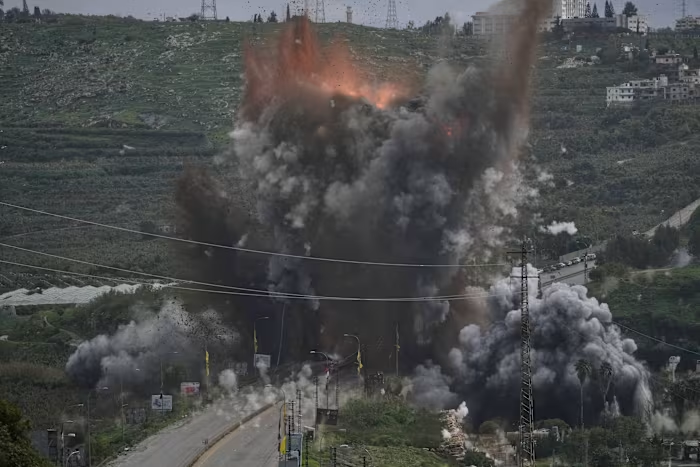
Israel also intensified operations against Hezbollah positions in Lebanon, where the group has been firing rockets into northern Israel since the conflict escalated.
The Lebanese Armed Forces said one soldier was killed and four others wounded in an Israeli strike on the village of Kfar Sir.
Lebanese authorities say more than 1 million people have been displaced by the fighting, with hundreds killed since hostilities intensified.
According to the Iranian Red Crescent, more than 1,300 people have been killed in Iran since the conflict began.
In Israel, officials say at least 12 people have died from Iranian missile strikes, while the United States has reported 13 military personnel killed in the broader conflict.
The reported killing of two high-ranking Iranian officials marks a critical escalation point in the war, suggesting Israel is now targeting not only military infrastructure but also the leadership core of the Iranian state.
Such strikes carry both tactical and symbolic weight. Removing figures like Larijani and Soleimani could disrupt coordination within Iran’s security apparatus, but it also risks provoking a more aggressive response from Tehran.
Iran’s decision to expand attacks beyond Israel to include Gulf states signals a shift toward a regionalized conflict, drawing in countries that had previously tried to remain on the sidelines.
The involvement of strategic النفط infrastructure and the Strait of Hormuz raises the stakes far beyond the Middle East. Even limited disruptions in this corridor can have immediate global consequences, driving up energy prices and increasing economic uncertainty worldwide.
At the same time, the reluctance of other nations to commit military support despite U.S. appeals reflects broader concerns about being pulled into a prolonged and unpredictable war.
With both Israel and Iran showing little willingness to back down, analysts warn the conflict may enter a more dangerous phase marked by sustained regional attacks, economic disruption and the potential for wider international involvement.
As the situation continues to evolve, the coming days may prove pivotal in determining whether the conflict remains contained or spirals into a broader regional war with global repercussions.